India Salary Hike 2026: Increment and Attrition Data by Industry
By ClauseAudit Research · 10 sources ·
What is the average salary hike in India for 2026?
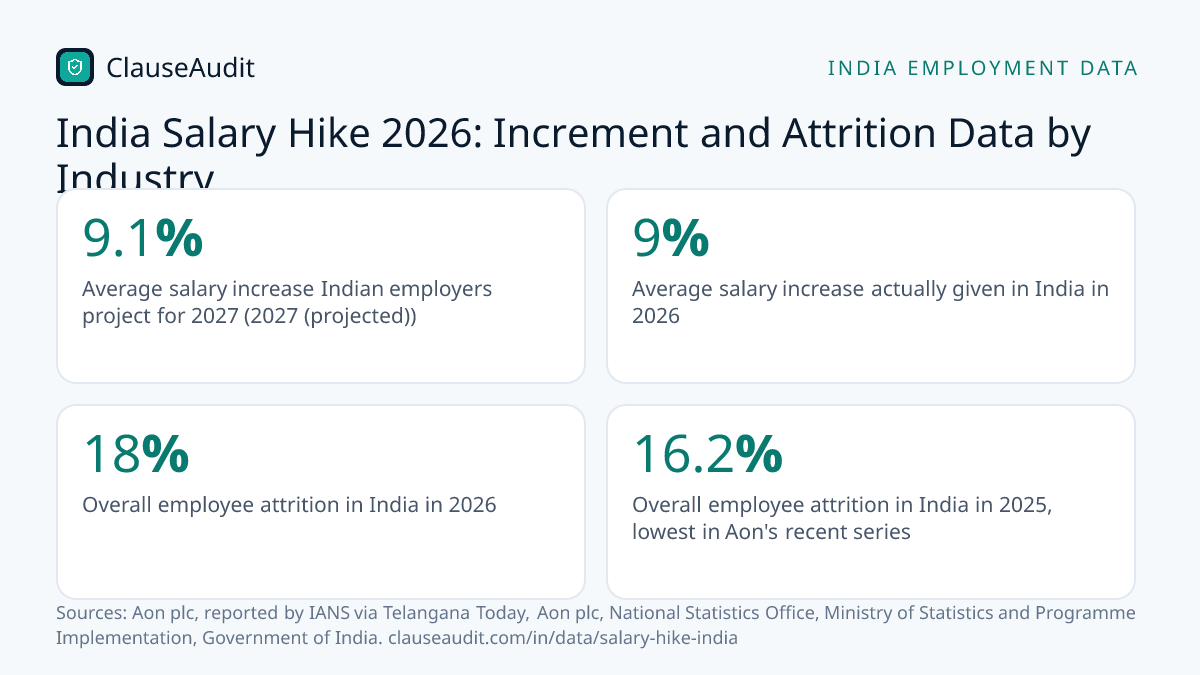
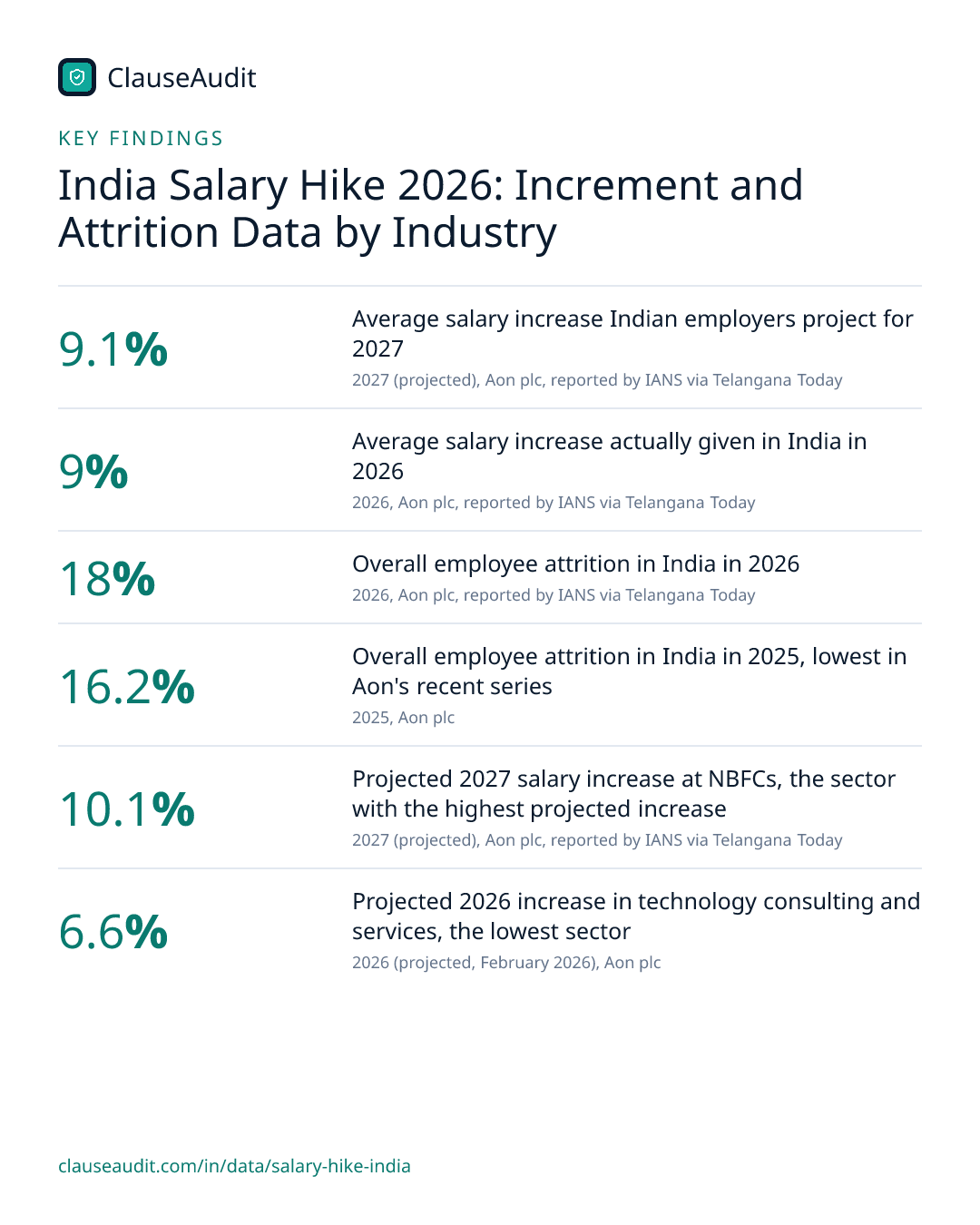
Indian employers gave an average salary increase of 9% in 2026, according to Aon's survey of 1,200+ organisations, just under the 9.1% Aon had projected in February. Real estate and NBFCs led the 2026 forecasts, technology consulting and services trailed at 6.6%, and attrition rose to 18%.

- Average salary increase Indian employers project for 2027 (2027 (projected), Aon plc, reported by IANS via Telangana Today)
- 9.1%
- Average salary increase actually given in India in 2026 (2026, Aon plc, reported by IANS via Telangana Today)
- 9%
- Overall employee attrition in India in 2026 (2026, Aon plc, reported by IANS via Telangana Today)
- 18%
- Overall employee attrition in India in 2025, lowest in Aon's recent series (2025, Aon plc)
- 16.2%
- Projected 2027 salary increase at NBFCs, the sector with the highest projected increase (2027 (projected), Aon plc, reported by IANS via Telangana Today)
- 10.1%
- Projected 2026 increase in technology consulting and services, the lowest sector (2026 (projected, February 2026), Aon plc)
- 6.6%
- India retail (CPI) inflation, September 2026 over September 2025 (September 2026 (provisional), National Statistics Office, Ministry of Statistics and Programme Implementation, Government of India)
- 5.54%
- Average monthly earnings of male regular wage/salaried workers in 2025 (January to December 2025, National Statistics Office, Ministry of Statistics and Programme Implementation, Government of India)
- ₹24,217
The average Indian salary hike in 2026 came in at 9%. That is close to what Aon, Deloitte and Mercer forecast, and close to the year before. Employers are holding a steady line, and the projection for 2027 is 9.1%.
The average hides a wide spread. Where you work matters more than the headline. A software services engineer and an NBFC credit manager can sit in the same appraisal cycle and walk away with very different letters. This page explains what the numbers mean for your next appraisal, job switch or rate revision, and which contract terms decide how much of a hike you actually keep.
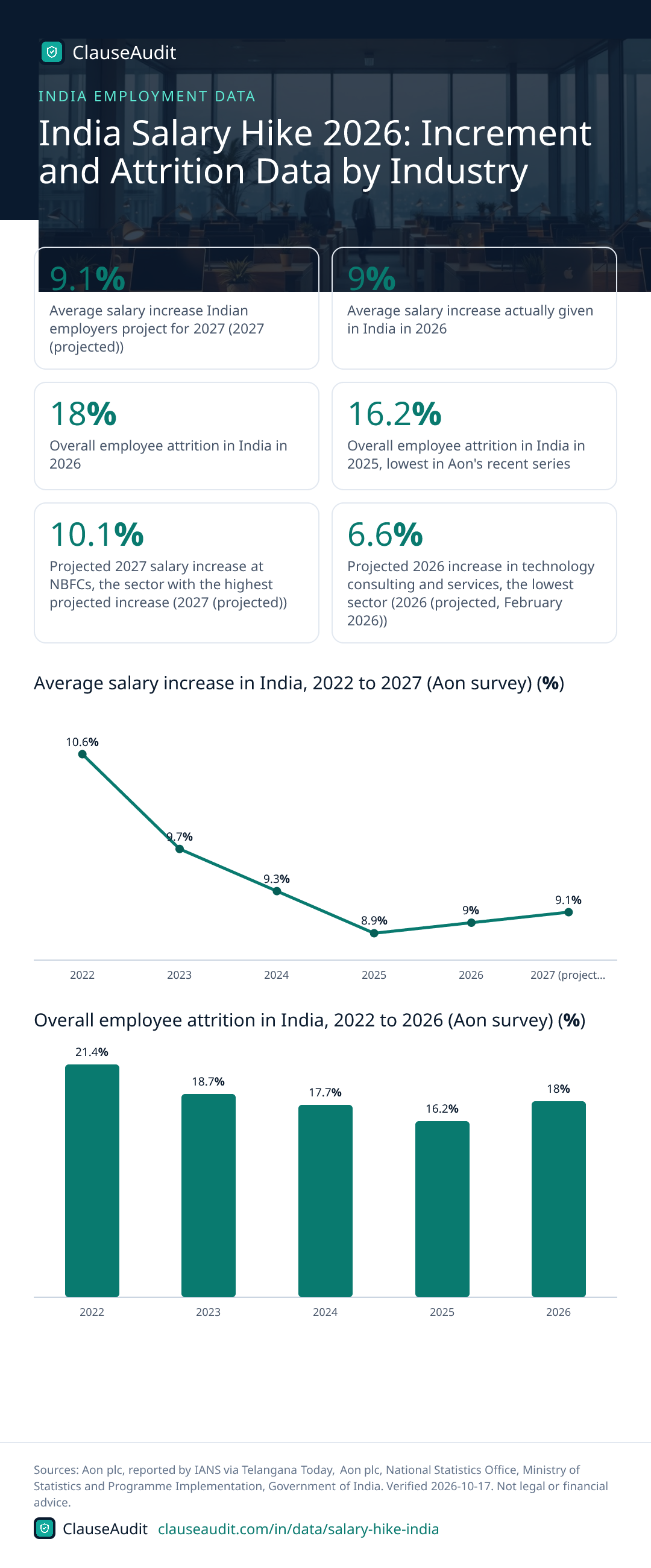
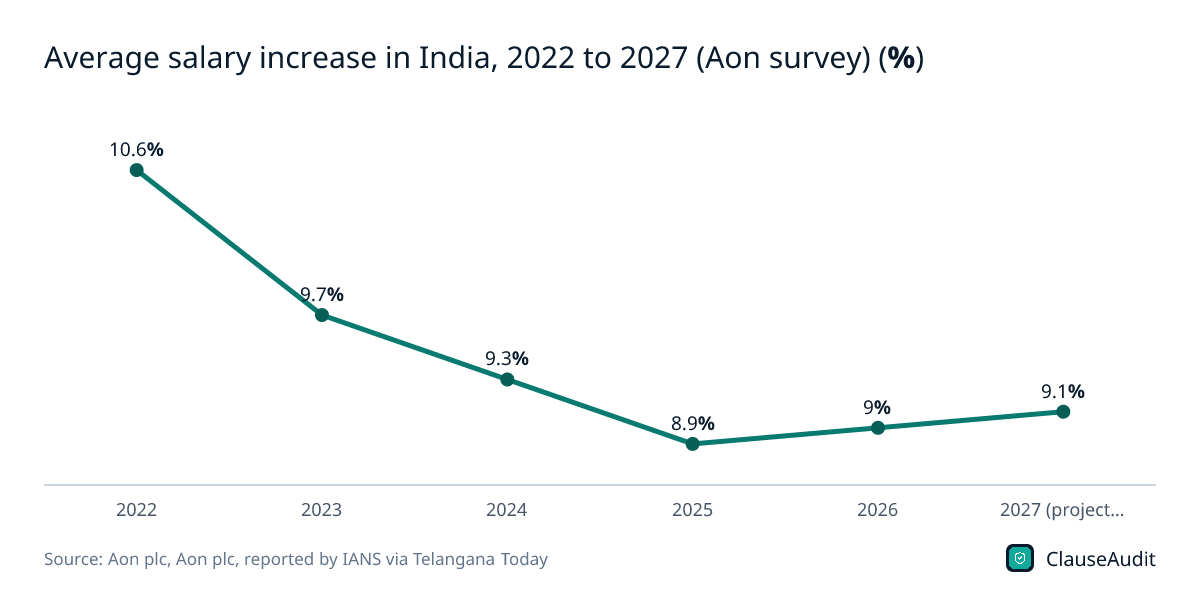
Average salary increase in India, 2022 to 2027 (Aon survey) (%)
Chart data
| Label | Value (%) |
|---|---|
| 2022 | 10.6% |
| 2023 | 9.7% |
| 2024 | 9.3% |
| 2025 | 8.9% |
| 2026 | 9% |
| 2027 (projected) | 9.1% |
Increments fell from 10.6% in 2022 to 8.9% in 2025, then flattened. The 2026 actual and 2027 projection suggest employers have settled at roughly this level rather than cutting further.
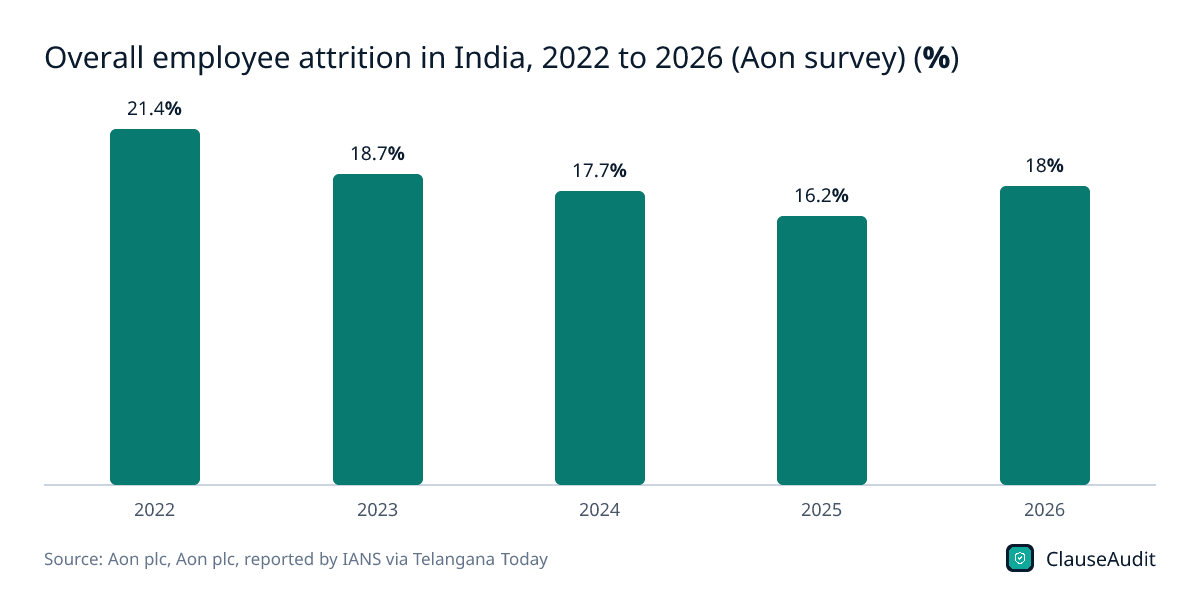
Download this chart (PNG)Overall employee attrition in India, 2022 to 2026 (Aon survey) (%)
Chart data
| Label | Value (%) |
|---|---|
| 2022 | 21.4% |
| 2023 | 18.7% |
| 2024 | 17.7% |
| 2025 | 16.2% |
| 2026 | 18% |
Attrition dropped every year to 16.2% in 2025, then turned up to 18% in 2026. More people are moving again, though not at the 2022 pace of 21.4%.
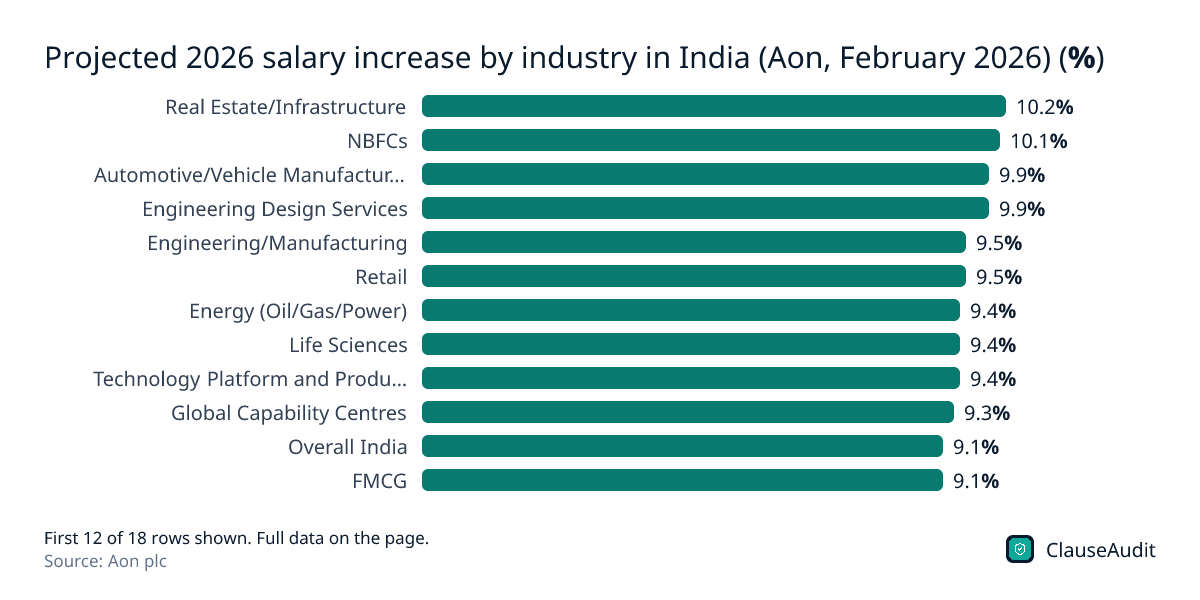
Download this chart (PNG)Projected 2026 salary increase by industry in India (Aon, February 2026) (%)
Chart data
| Label | Value |
|---|---|
| Real Estate/Infrastructure | 10.2% |
| NBFCs | 10.1% |
| Automotive/Vehicle Manufacturing | 9.9% |
| Engineering Design Services | 9.9% |
| Engineering/Manufacturing | 9.5% |
| Retail | 9.5% |
| Energy (Oil/Gas/Power) | 9.4% |
| Life Sciences | 9.4% |
| Technology Platform and Products | 9.4% |
| Global Capability Centres | 9.3% |
| Overall India | 9.1% |
| FMCG | 9.1% |
| Banking | 8.8% |
| E-commerce | 8.8% |
| Funds and Asset Management | 8.5% |
| Chemicals | 8.3% |
| Life Insurance | 8.2% |
| Technology Consulting and Services | 6.6% |
Technology consulting and services sits well below every other sector at 6.6%. Every other industry landed between 8.2% and 10.2%, so the sector you work in can shift your hike by more than three percentage points.
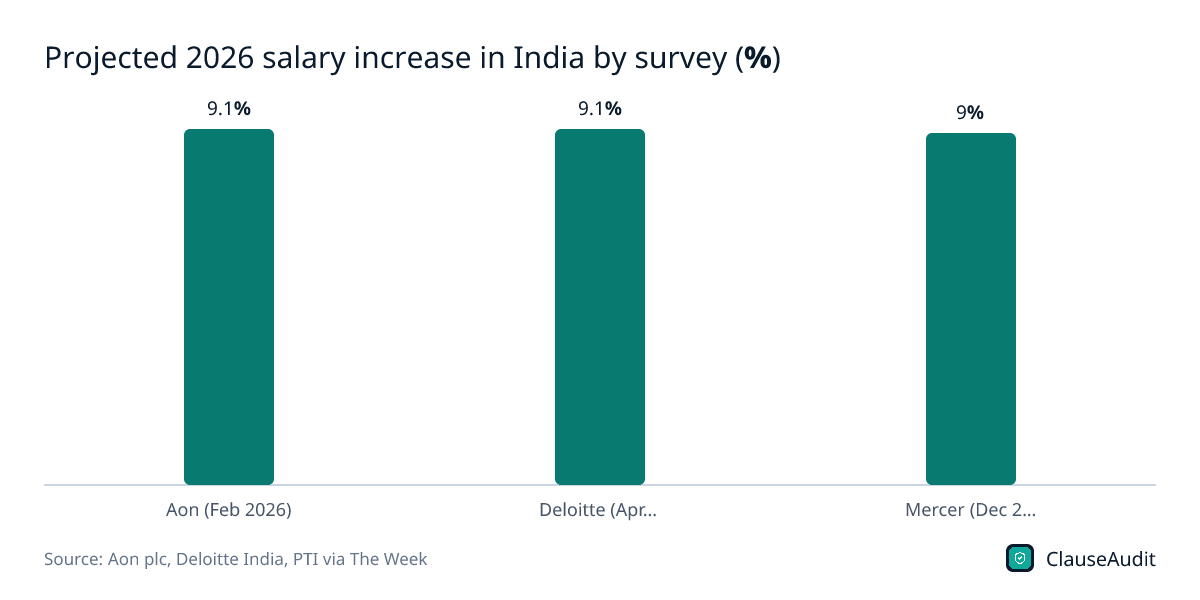
Download this chart (PNG)Projected 2026 salary increase in India by survey (%)
Chart data
| Label | Value (%) |
|---|---|
| Aon (Feb 2026) | 9.1% |
| Deloitte (Apr 2026) | 9.1% |
| Mercer (Dec 2025) | 9% |
Three surveys with different samples landed between 9% and 9.1% for 2026. When independent forecasts agree this closely, you can treat the number as a fair market benchmark.
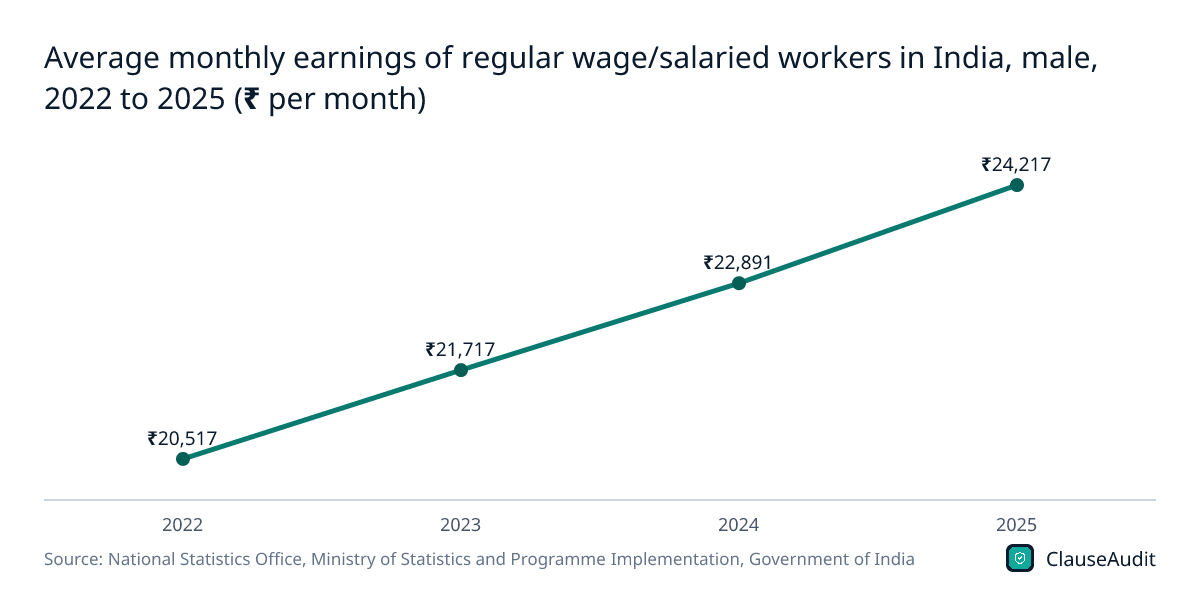
Download this chart (PNG)Average monthly earnings of regular wage/salaried workers in India, male, 2022 to 2025 (₹ per month)
Chart data
| Label | Value (₹ per month) |
|---|---|
| 2022 | ₹20,517 |
| 2023 | ₹21,717 |
| 2024 | ₹22,891 |
| 2025 | ₹24,217 |
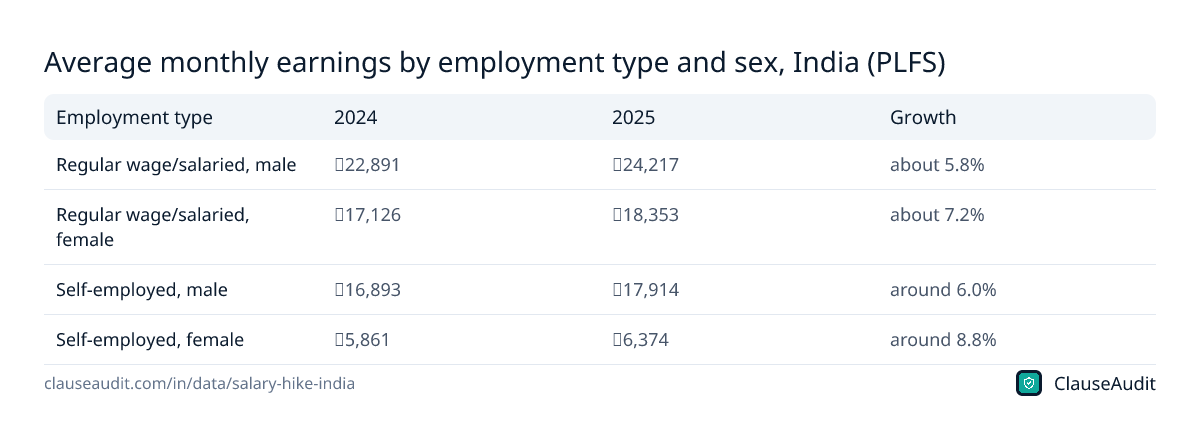
Government survey data covers far more workers than corporate pay surveys. Male salaried earnings rose from ₹22,891 in 2024 to ₹24,217 in 2025, about 5.8%, which is slower than the corporate increment averages.
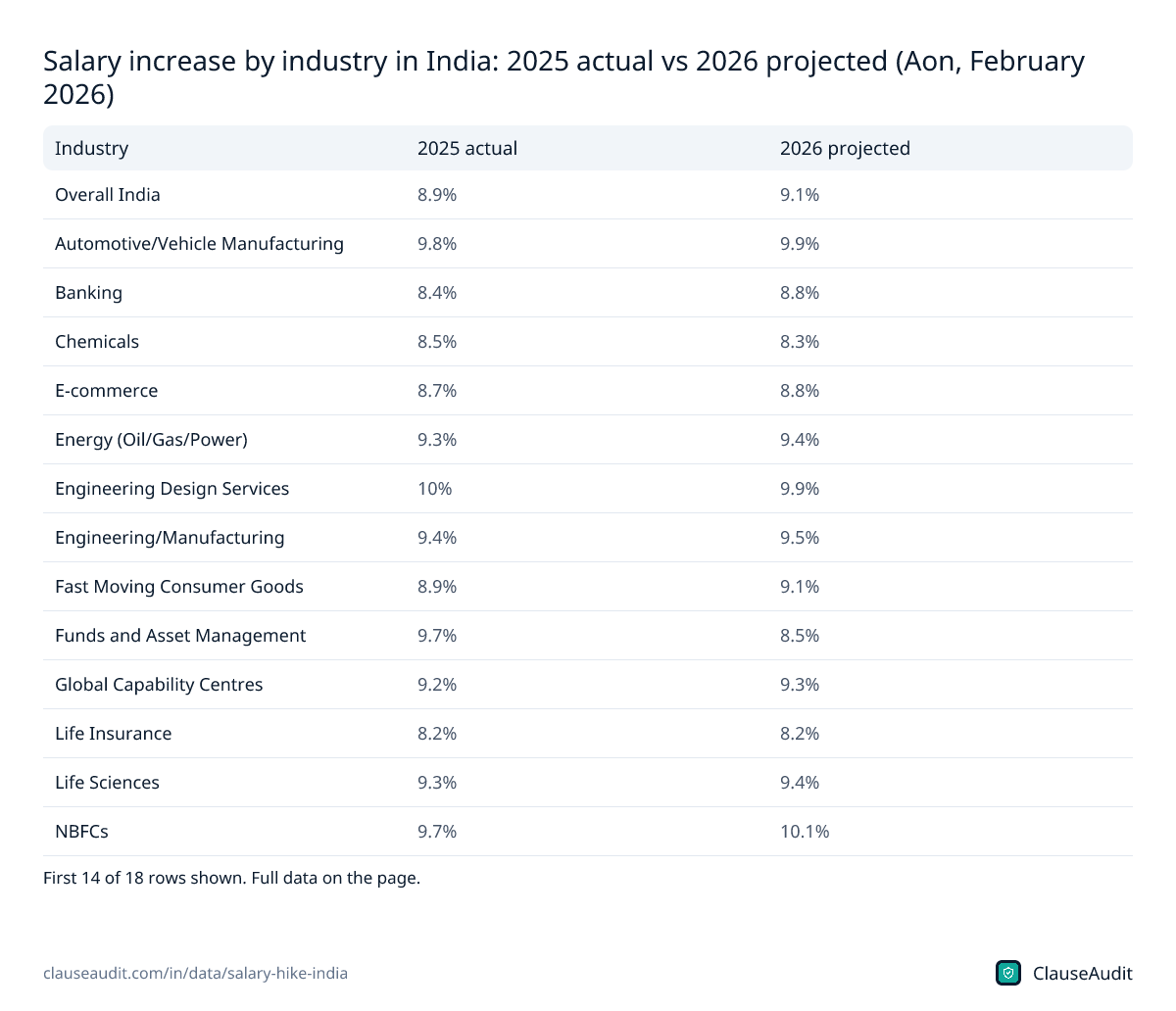
Download this chart (PNG)Salary increase by industry in India: 2025 actual vs 2026 projected (Aon, February 2026)
| Industry | 2025 actual | 2026 projected |
|---|---|---|
| Overall India | 8.9% | 9.1% |
| Automotive/Vehicle Manufacturing | 9.8% | 9.9% |
| Banking | 8.4% | 8.8% |
| Chemicals | 8.5% | 8.3% |
| E-commerce | 8.7% | 8.8% |
| Energy (Oil/Gas/Power) | 9.3% | 9.4% |
| Engineering Design Services | 10% | 9.9% |
| Engineering/Manufacturing | 9.4% | 9.5% |
| Fast Moving Consumer Goods | 8.9% | 9.1% |
| Funds and Asset Management | 9.7% | 8.5% |
| Global Capability Centres | 9.2% | 9.3% |
| Life Insurance | 8.2% | 8.2% |
| Life Sciences | 9.3% | 9.4% |
| NBFCs | 9.7% | 10.1% |
| Real Estate/Infrastructure | 10.5% | 10.2% |
| Retail | 9% | 9.5% |
| Technology Consulting and Services | 7% | 6.6% |
| Technology Platform and Products | 9.2% | 9.4% |
Source: Aon plc, Aon Survey Projects Slight Uptick in Salaries in India From 8.9 Percent in 2025 to 9.1 Percent in 2026 (Annual Salary Increase and Turnover Survey 2025-26 India). Download as image
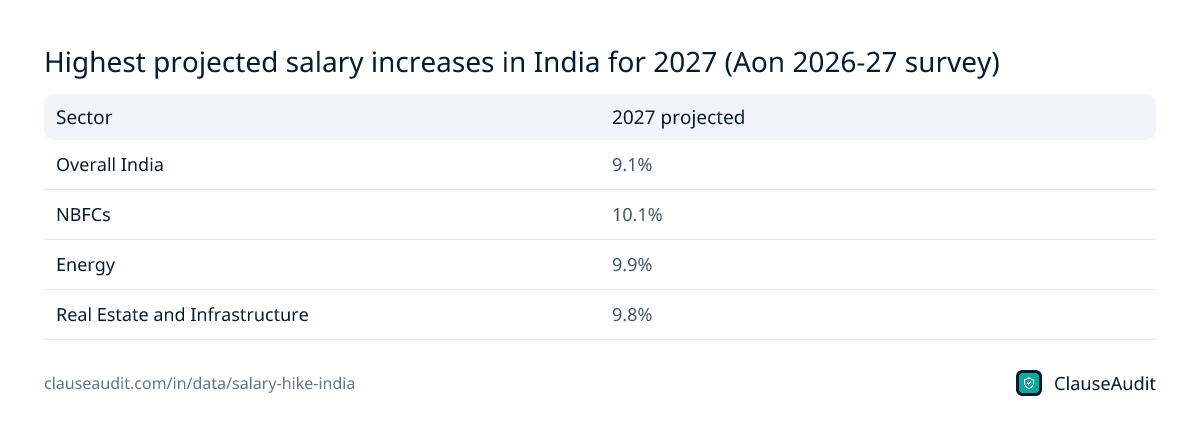
Highest projected salary increases in India for 2027 (Aon 2026-27 survey)
| Sector | 2027 projected |
|---|---|
| Overall India | 9.1% |
| NBFCs | 10.1% |
| Energy | 9.9% |
| Real Estate and Infrastructure | 9.8% |
Source: Aon plc, reported by IANS via Telangana Today, Annual Salary Increase and Turnover Survey for India 2026-27 (IANS report: Salaries in India likely to rise 9.1pc in 2027, Aon survey finds); Free Press Journal (reporting Aon plc survey), India's Salary Growth Likely To Hold At 9.1 Per Cent In 2026-27 Despite Global Uncertainty: Aon Survey. Download as image
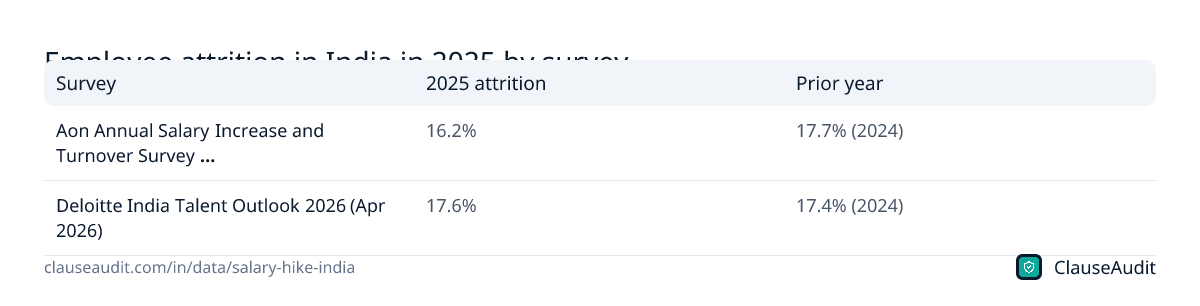
Employee attrition in India in 2025 by survey
| Survey | 2025 attrition | Prior year |
|---|---|---|
| Aon Annual Salary Increase and Turnover Survey 2025-26 (Feb 2026) | 16.2% | 17.7% (2024) |
| Deloitte India Talent Outlook 2026 (Apr 2026) | 17.6% | 17.4% (2024) |
Source: Aon plc, Aon Survey Projects Slight Uptick in Salaries in India From 8.9 Percent in 2025 to 9.1 Percent in 2026 (Annual Salary Increase and Turnover Survey 2025-26 India); Deloitte India, Average increment in India is expected to be 9.1 percent in 2026 (Deloitte India Talent Outlook 2026). Download as image
Average monthly earnings by employment type and sex, India (PLFS)
| Employment type | 2024 | 2025 | Growth |
|---|---|---|---|
| Regular wage/salaried, male | ₹22,891 | ₹24,217 | about 5.8% |
| Regular wage/salaried, female | ₹17,126 | ₹18,353 | about 7.2% |
| Self-employed, male | ₹16,893 | ₹17,914 | around 6.0% |
| Self-employed, female | ₹5,861 | ₹6,374 | around 8.8% |
Source: National Statistics Office, Ministry of Statistics and Programme Implementation, Government of India, Press Note on Periodic Labour Force Survey (PLFS) Annual Report, 2025 [January 2025 to December 2025]. Download as image
Is a 9% salary hike good in 2026?
It is average, and average is the right word to use with care. Survey figures blend top performers, who often get well above the mean, with people who got little or nothing. If your appraisal letter says 9%, you received roughly what the market paid. If it says less and your rating was good, you have a reason to ask questions.
Inflation is the other test. Retail inflation was 5.54% in September 2026, up from 4.83% in August. A hike in the market range still beats prices, but the cushion is thinner than it looks on paper. Your own costs, such as rent and school fees, can rise faster than the national index.
Timing matters too. Most companies announce hikes once a year, and the letter often arrives after the new financial year has started. If your increment is backdated, confirm the arrears will be paid and in which month. If it is not, a late cycle quietly shrinks the raise.
Check what the percentage applies to. Many hikes are stated on total CTC, which can include variable pay, employer PF and benefits you never see in your bank account. A raise on fixed pay is worth more than the same raise on a CTC padded with a bonus that depends on company results.
How low are IT salary hikes in 2026?
Technology consulting and services had the lowest projected increase of any sector at 6.6% for 2026, down from 7% actual in 2025. It was also the lowest sector in 2025, so this is not a one-year dip. The sector has trailed the overall figure by about two percentage points or more in both years.
Tech is not one market, though. Technology platform and products companies were projected at 9.4%, and global capability centres at 9.3%. An engineer who moves from a services firm to a product company or a GCC is moving into a different pay band, not just a different employer. That gap is one reason a switch can pay more than staying for the next appraisal.
Why did attrition rise to 18% in 2026?
Overall attrition climbed to 18% in 2026, up from 16.2% in 2025, which was the lowest in Aon's recent series. Deloitte's survey put 2025 attrition at 17.6%. After a few quiet years, more people are changing jobs again.
For workers, higher attrition usually means more bargaining room. Employers who are losing people tend to sweeten offers with joining bonuses, retention payments and faster promotions. Those sweeteners often come with strings: repayment if you leave within a set period, longer notice periods, or a training bond. Read those terms as carefully as the salary figure.
If you are being counter-offered, slow down. A counter-offer usually matches the outside number on paper, but check whether it comes as fixed pay or as a one-time retention bonus with a repayment clause. The first moves your base for every future hike. The second does not.
For employers, rising exits get expensive. Replacing someone often costs more than keeping them, so a slightly better increment for strong performers can be cheaper than another recruitment round.
Which industries pay the highest salary hikes in India?
For 2027, NBFCs lead the projections at 10.1%, followed by energy at 9.9% and real estate and infrastructure at 9.8%. In the 2026 forecasts, real estate and infrastructure topped the list at 10.2%, with NBFCs at 10.1% and automotive and engineering design services both at 9.9%.
The 2026 forecasts also showed some sectors slowing. Funds and asset management dropped from 9.7% actual in 2025 to 8.5% projected for 2026, and real estate eased from 10.5% to 10.2%. Retail moved the other way, from 9% to 9.5%.
The pattern is steady. NBFCs and real estate sit near the top in both years. Banking, life insurance and chemicals sat below the overall average in the 2026 forecasts. If you are early in your career and flexible about sector, this spread compounds. A small yearly gap turns into a large one over a career, and it is worth more than any single appraisal.
What the numbers mean for freelancers and businesses
Corporate surveys track payroll, but they still help if you work for yourself. Your clients' salary budgets are rising around 9%. If your day rate has stayed flat for a long stretch while their in-house costs went up, you have a reasonable case for a revision. Government data shows self-employed earnings growing too, though from a lower base than salaried pay.
Write the review into the contract. A retainer that says rates will be reviewed each year, with notice of any change, turns a nervous conversation into a routine one. Without that clause, many clients assume your rate is fixed until you leave.
For small businesses, the market rate tells you what it costs to keep people. Falling well below it in a year of rising attrition invites resignations. Budgeting near the average for most staff, and above it for the people you cannot afford to lose, is the usual approach.
How to use these numbers in your next appraisal or offer
- Compare your hike to your own sector's figure, not the national average. A 9% raise is strong in technology services and below par in an NBFC.
- Ask whether the percentage applies to fixed pay or to total CTC, and get the new fixed salary in writing.
- When you get an offer, check how much of the package is variable and what the payout depends on.
- Before you accept a joining or retention bonus, read the clawback period and how the repayment is calculated.
- If you freelance on a retainer, add a yearly rate review to the contract so a revision is expected rather than awkward.
- Keep the survey source handy. Naming a published benchmark makes the conversation about the market, not about you.
How ClauseAudit helps
Your hike is only as good as the terms around it. An automated review of your offer letter, appointment letter or revised employment agreement flags the clauses that decide what you actually take home and what it costs to leave, explained in plain English.
Upload the document and you'll see each risky clause, why it matters under Indian law, and what to ask for instead.
- How CTC is split between fixed pay, variable pay and benefits, and whether basic pay meets the wage definition under the new Labour Codes
- Clauses that make increments or bonuses fully discretionary, or let the employer revise pay without consent
- Clawback terms on joining bonuses, retention payments and relocation support
- Employment bonds or training repayment amounts that may be hard to enforce
- Notice periods that are longer for you than for the employer, and how buyout is handled
- ESOP vesting, cliffs and what happens to unvested options if you resign
Frequently asked questions
What is the average salary hike in India in 2026?
Aon's survey found an average actual increase of 9% in 2026 across 1,200+ organisations in 45 industries. That is slightly below the 9.1% employers projected in February 2026. Deloitte also projected 9.1% for 2026, and Mercer projected 9%, so the major surveys agree closely.
What salary hike is expected in India in 2027?
Employers project an average increase of 9.1% for 2027, according to Aon's 2026-27 survey released in October 2026. NBFCs lead at 10.1%, followed by energy at 9.9% and real estate and infrastructure at 9.8%. Projections often end up slightly different from what is actually paid, so treat them as a guide.
What is the IT salary hike in India for 2026?
It depends on the kind of tech company. Technology consulting and services had the lowest projection of any sector at 6.6% for 2026, down from 7% actual in 2025. Technology platform and products companies were projected at 9.4%, and global capability centres at 9.3%.
What is the attrition rate in India in 2026?
Overall attrition was 18% in 2026, according to Aon, up from 16.2% in 2025. The 2025 figure was the lowest in Aon's recent series, so 2026 marks a turn back toward more job switching. It remains below the 21.4% recorded in 2022.
Is a 9% hike above inflation?
Yes, at current rates. Retail inflation was 5.54% in September 2026 and 4.83% in August 2026. A raise around the market average still grows your real income, but by less than the headline suggests, and city costs such as rent can rise faster than the national index.
Is my hike calculated on CTC or on fixed salary?
Check your appraisal letter. Many companies state the increase on total CTC, which can include variable pay, employer PF and benefits. A percentage on fixed pay usually means more money in your account each month. Ask HR for the revised fixed salary and the revised variable component separately, in writing.
Can my employer refuse to give me a salary hike?
Usually, yes. Many Indian employment contracts make increments discretionary, so there is rarely a legal right to a raise. What your employer cannot do is cut agreed pay without your consent or pay below the applicable minimum wage. If your contract promises a review or a formula, you can hold them to it.
Should I switch jobs for a bigger hike?
A switch often brings a larger jump than an appraisal, especially if you move from technology services into products, GCCs or a high-paying sector like NBFCs. Before you resign, check your notice period, any bond or bonus clawback, and unvested ESOPs, since these can eat into the gain.
Use this data
Every chart and card below is free to reuse under CC BY 4.0. Download what you need and link back to this page.
 Stat cards
 Key findings card
 Infographic
 Average salary increase in India, 2022 to 2027 (Aon survey) (%)
 Overall employee attrition in India, 2022 to 2026 (Aon survey) (%)
 Projected 2026 salary increase by industry in India (Aon, February 2026) (%)
 Projected 2026 salary increase in India by survey (%)
 Average monthly earnings of regular wage/salaried workers in India, male, 2022 to 2025 (₹ per month)
 Salary increase by industry in India: 2025 actual vs 2026 projected (Aon, February 2026)
 Highest projected salary increases in India for 2027 (Aon 2026-27 survey)
 Employee attrition in India in 2025 by survey
 Average monthly earnings by employment type and sex, India (PLFS)
Embed the infographic
Free to share on your site, blog or slides under CC BY 4.0. Please keep the credit link.
Sources and method
Every number on this page comes from the sources below, each opened and read on or before October 17, 2026. A second, independent review checked every figure against its source and corrected anything that did not match. Figures that could not be confirmed were left out.
- Aon plc, reported by IANS via Telangana Today, Annual Salary Increase and Turnover Survey for India 2026-27 (IANS report: Salaries in India likely to rise 9.1pc in 2027, Aon survey finds) (14 October 2026)
- Free Press Journal (reporting Aon plc survey), India's Salary Growth Likely To Hold At 9.1 Per Cent In 2026-27 Despite Global Uncertainty: Aon Survey (14 October 2026)
- Aon plc, Aon Survey Projects Slight Uptick in Salaries in India From 8.9 Percent in 2025 to 9.1 Percent in 2026 (Annual Salary Increase and Turnover Survey 2025-26 India) (24 February 2026)
- Aon plc, Salaries in India to Increase by 9.2 Percent in 2025 Amidst Global Uncertainty and Softening Growth, Aon Study (19 February 2025)
- Aon plc, Aon Survey Projects Salaries in India to Increase by 9.5 Percent in 2024 (Annual Salary Increase and Turnover Survey 2023-24 India) (21 February 2024)
- Aon plc, Aon Survey Projects Double-Digit Salary Growth to Continue in India Despite Economic Volatility (23 February 2023)
- Deloitte India, Average increment in India is expected to be 9.1 percent in 2026 (Deloitte India Talent Outlook 2026) (6 April 2026)
- PTI via The Week, India Inc to see 9 pc salary growth in 2026 with focus on short-term incentives: Report (Mercer India Total Remuneration Survey 2026) (17 December 2025)
- National Statistics Office, Ministry of Statistics and Programme Implementation, Government of India, Press Note on Periodic Labour Force Survey (PLFS) Annual Report, 2025 [January 2025 to December 2025] (27 March 2026)
- National Statistics Office, Ministry of Statistics and Programme Implementation, Government of India, Press Release of Consumer Price Index on Base 2024=100 for September, 2026 (12 October 2026)
Cite this page
ClauseAudit, “India Salary Hike 2026: Increment and Attrition Data by Industry”, updated October 17, 2026, https://clauseaudit.com/in/data/salary-hike-india. Free to reuse with a link back (CC BY 4.0).
This page summarises published data and law as checked on October 17, 2026. Figures are updated as new editions are released, and your own situation may differ. It is general information, not legal, tax or financial advice.