Overtime and Working Hours Rules in India by State (Labour Codes and Shops & Establishments Acts)
By ClauseAudit Research · 22 sources ·
What are the overtime rules in India?
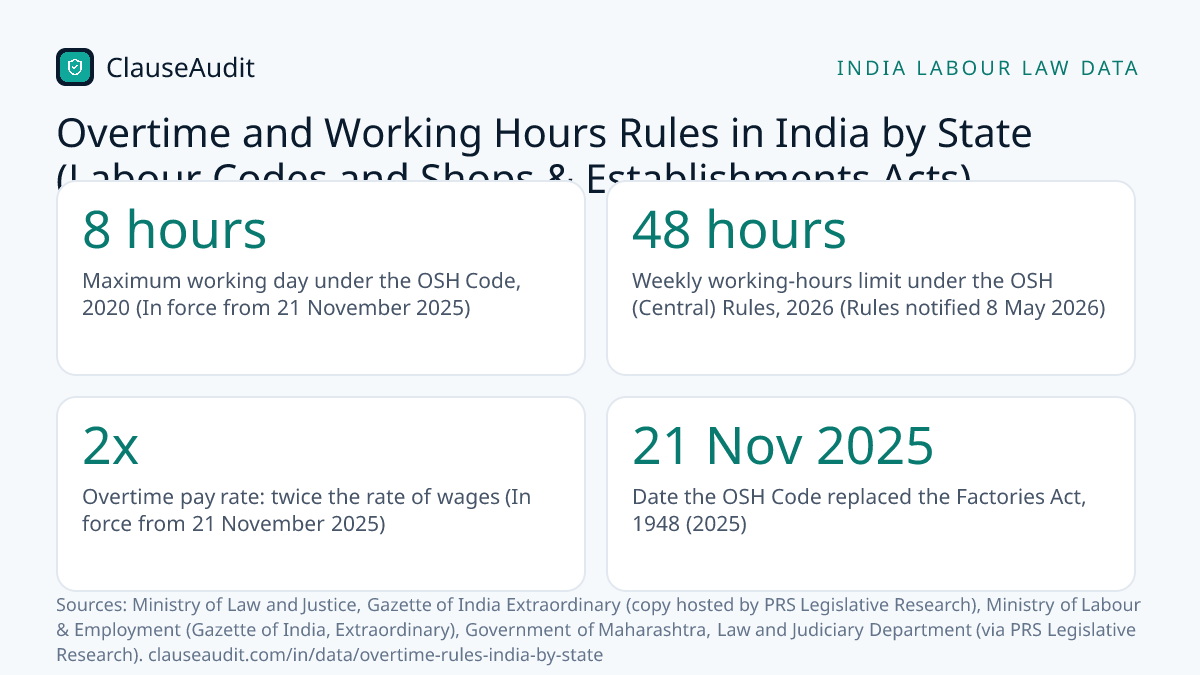
Overtime in India is paid at twice the rate of wages, and you can only be asked to work it with your consent. The OSH Code, in force from 21 Nov 2025, caps a normal day at 8 hours. Many states now let shops run 10-hour days with 144 overtime hours a quarter.

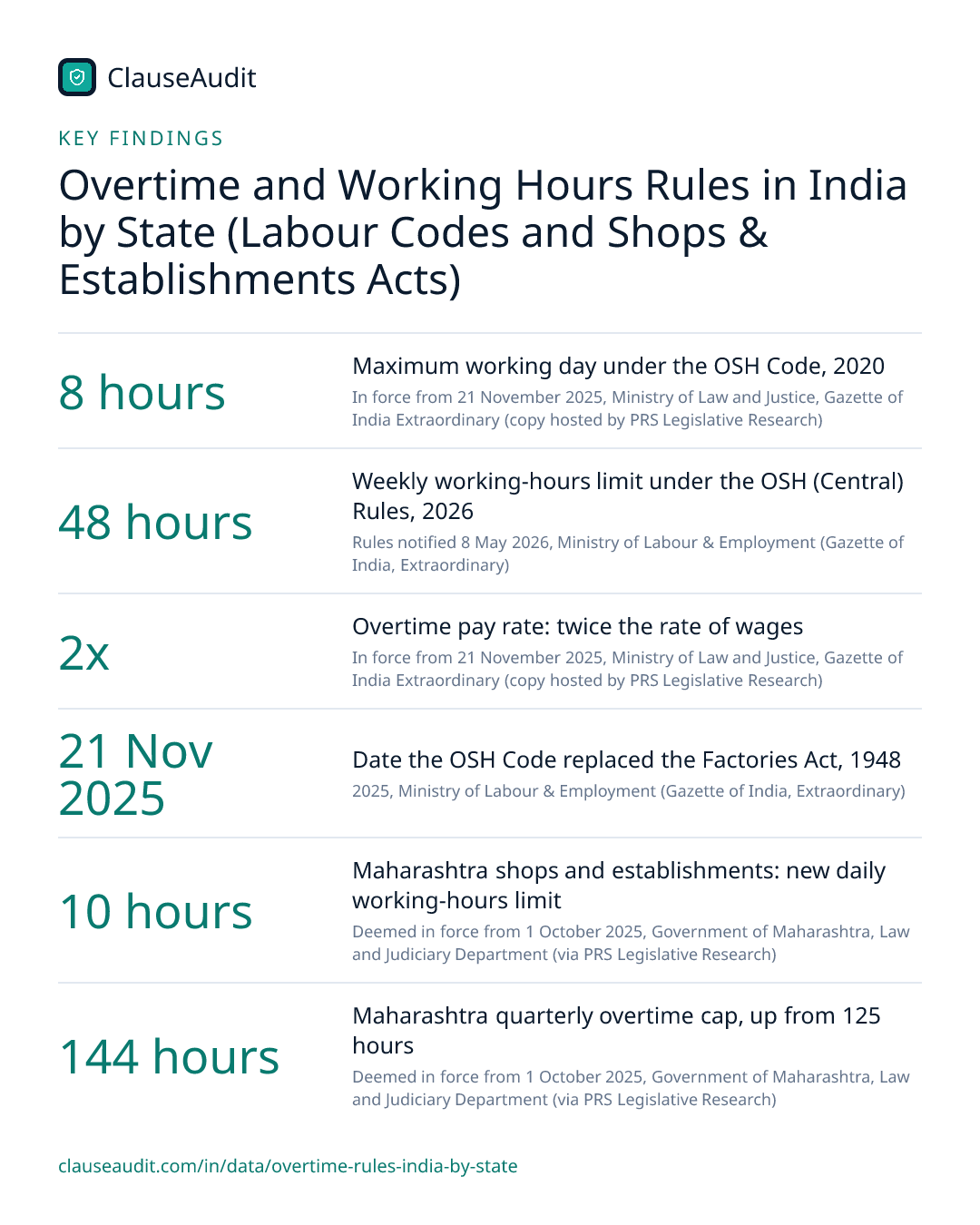
- Maximum working day under the OSH Code, 2020 (In force from 21 November 2025, Ministry of Law and Justice, Gazette of India Extraordinary (copy hosted by PRS Legislative Research))
- 8 hours
- Weekly working-hours limit under the OSH (Central) Rules, 2026 (Rules notified 8 May 2026, Ministry of Labour & Employment (Gazette of India, Extraordinary))
- 48 hours
- Overtime pay rate: twice the rate of wages (In force from 21 November 2025, Ministry of Law and Justice, Gazette of India Extraordinary (copy hosted by PRS Legislative Research))
- 2x
- Date the OSH Code replaced the Factories Act, 1948 (2025, Ministry of Labour & Employment (Gazette of India, Extraordinary))
- 21 Nov 2025
- Maharashtra shops and establishments: new daily working-hours limit (Deemed in force from 1 October 2025, Government of Maharashtra, Law and Judiciary Department (via PRS Legislative Research))
- 10 hours
- Maharashtra quarterly overtime cap, up from 125 hours (Deemed in force from 1 October 2025, Government of Maharashtra, Law and Judiciary Department (via PRS Legislative Research))
- 144 hours
- Haryana quarterly overtime cap for shops, up from 50 hours (Deemed in force from 12 November 2025, Haryana Government Gazette, Extraordinary (via PRS Legislative Research))
- 156 hours
- Delhi's current overtime ceiling under the Shops and Establishments Act, 1954 (Act text quoted in Bill introduced 9 January 2026, Legislative Assembly of the NCT of Delhi (via PRS Legislative Research))
- 150 hours a year
India now has two layers of hours law. The OSH Code sets the national floor for establishments with ten or more workers: 8 hours a day, 48 hours a week under the central rules, and overtime paid at double rate. Offices, shops, malls and IT firms also answer to their state's Shops and Establishments Act, and that is where most of the change happened in 2025 and 2026.
Since October 2025, several states have pushed the shop working day to 10 hours and raised the overtime cap to 144 hours a quarter, with Haryana going to 156. Many of these changes came by ordinance, so the status of each one matters. The map and table below show where each state stands and what we could and could not confirm.
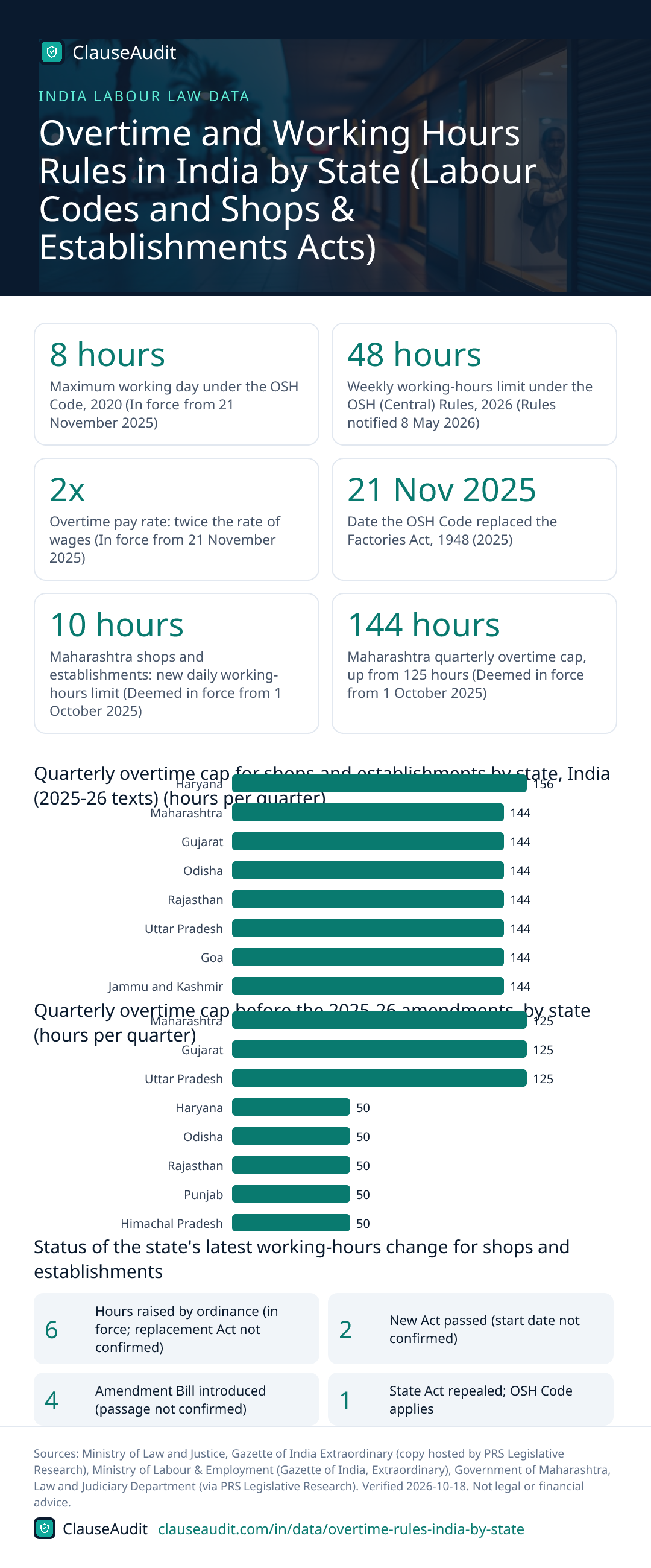
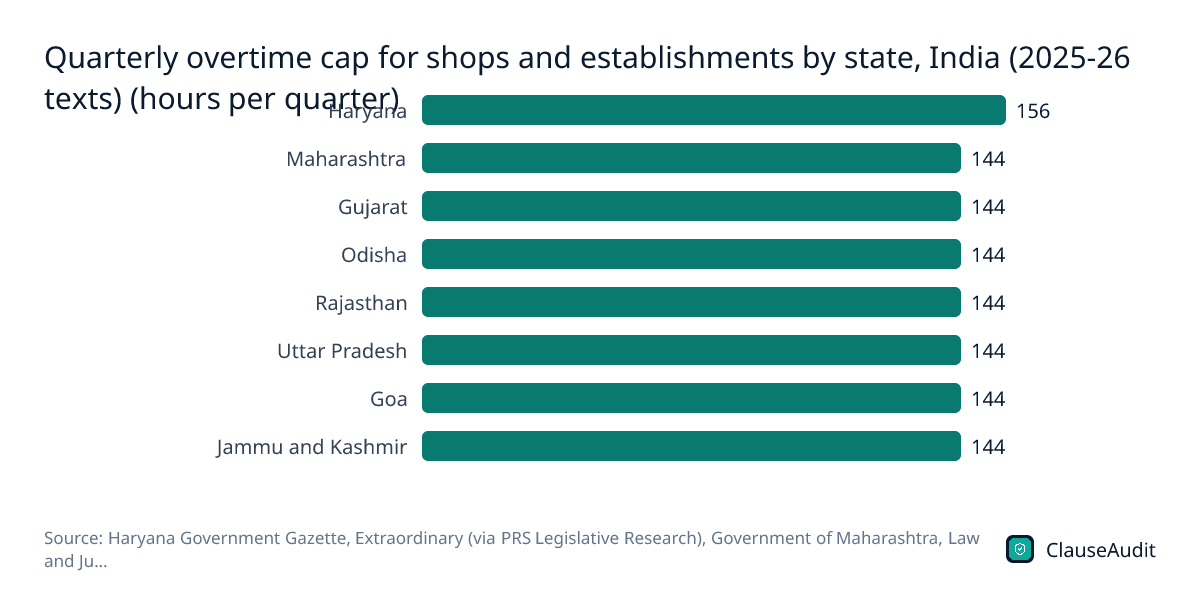
Quarterly overtime cap for shops and establishments by state, India (2025-26 texts) (hours per quarter)
Chart data
| Label | Value |
|---|---|
| Haryana | 156 |
| Maharashtra | 144 |
| Gujarat | 144 |
| Odisha | 144 |
| Rajasthan | 144 |
| Uttar Pradesh | 144 |
| Goa | 144 |
| Jammu and Kashmir | 144 |
Haryana sits alone at 156 hours a quarter. Every other state in this chart has settled on 144. All of these figures come from ordinances or Acts whose status we could not fully confirm.
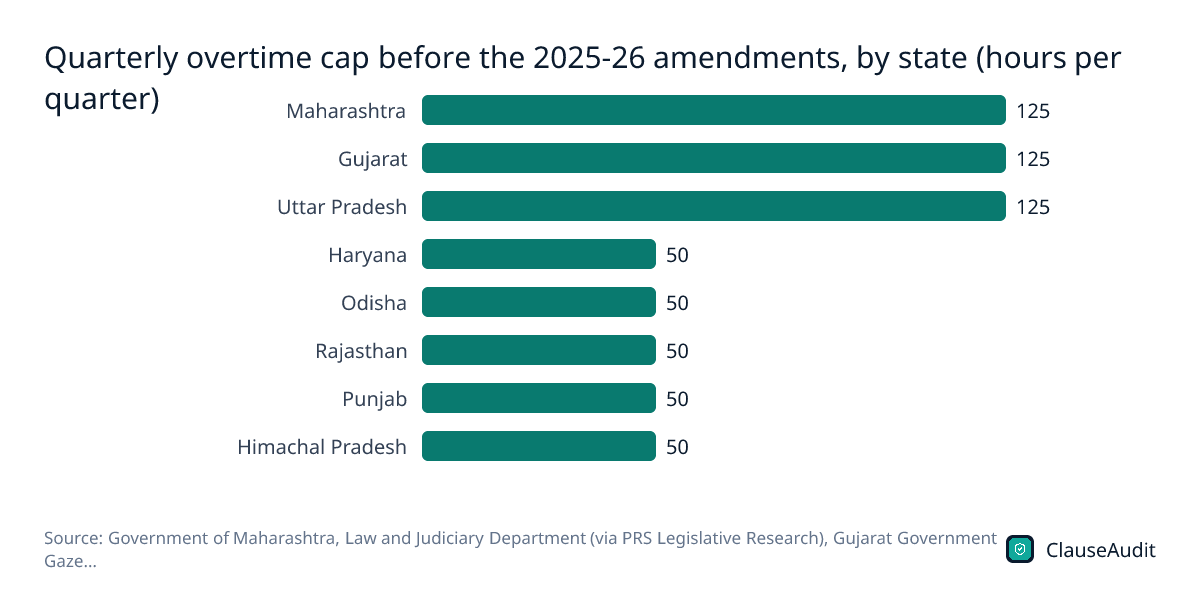
Download this chart (PNG)Quarterly overtime cap before the 2025-26 amendments, by state (hours per quarter)
Chart data
| Label | Value |
|---|---|
| Maharashtra | 125 |
| Gujarat | 125 |
| Uttar Pradesh | 125 |
| Haryana | 50 |
| Odisha | 50 |
| Rajasthan | 50 |
| Punjab | 50 |
| Himachal Pradesh | 50 |
The jump is biggest in the states that started at 50 hours a quarter. Haryana, Odisha and Rajasthan roughly tripled their caps in one move, while Maharashtra and Gujarat went from 125 to 144.
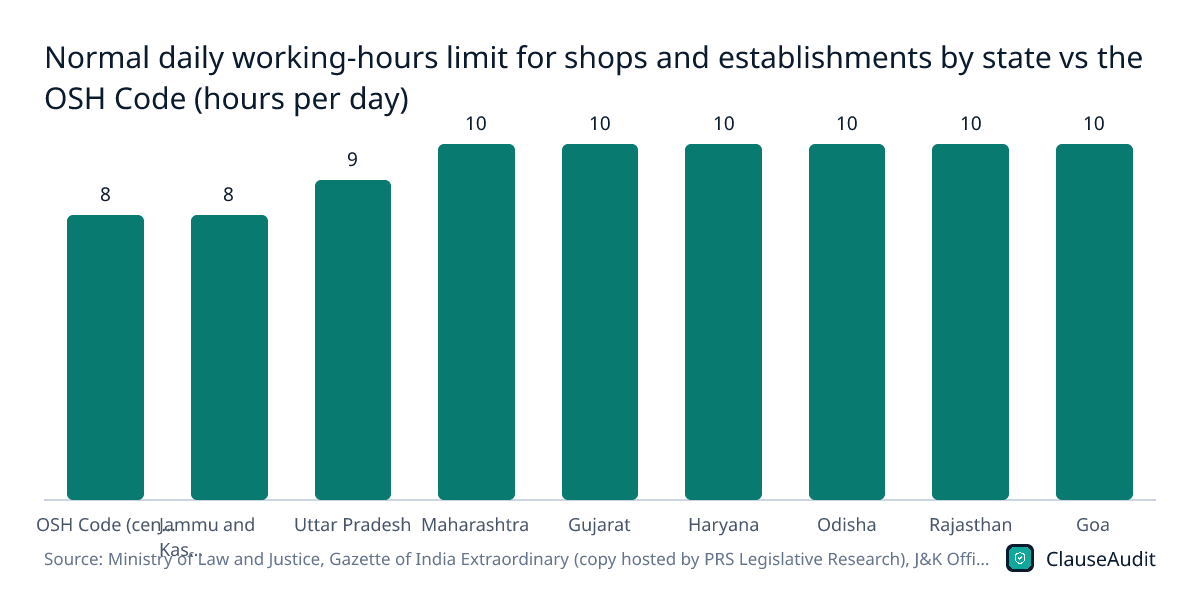
Download this chart (PNG)Normal daily working-hours limit for shops and establishments by state vs the OSH Code (hours per day)
Chart data
| Label | Value (hours per day) |
|---|---|
| OSH Code (central) | 8 |
| Jammu and Kashmir | 8 |
| Uttar Pradesh | 9 |
| Maharashtra | 10 |
| Gujarat | 10 |
| Haryana | 10 |
| Odisha | 10 |
| Rajasthan | 10 |
| Goa | 10 |
Six of the eight states charted now allow a 10-hour normal day for shops, against 8 hours in the OSH Code. A longer normal day can mean your ninth and tenth hours no longer count as overtime, as long as your week stays within 48 hours.
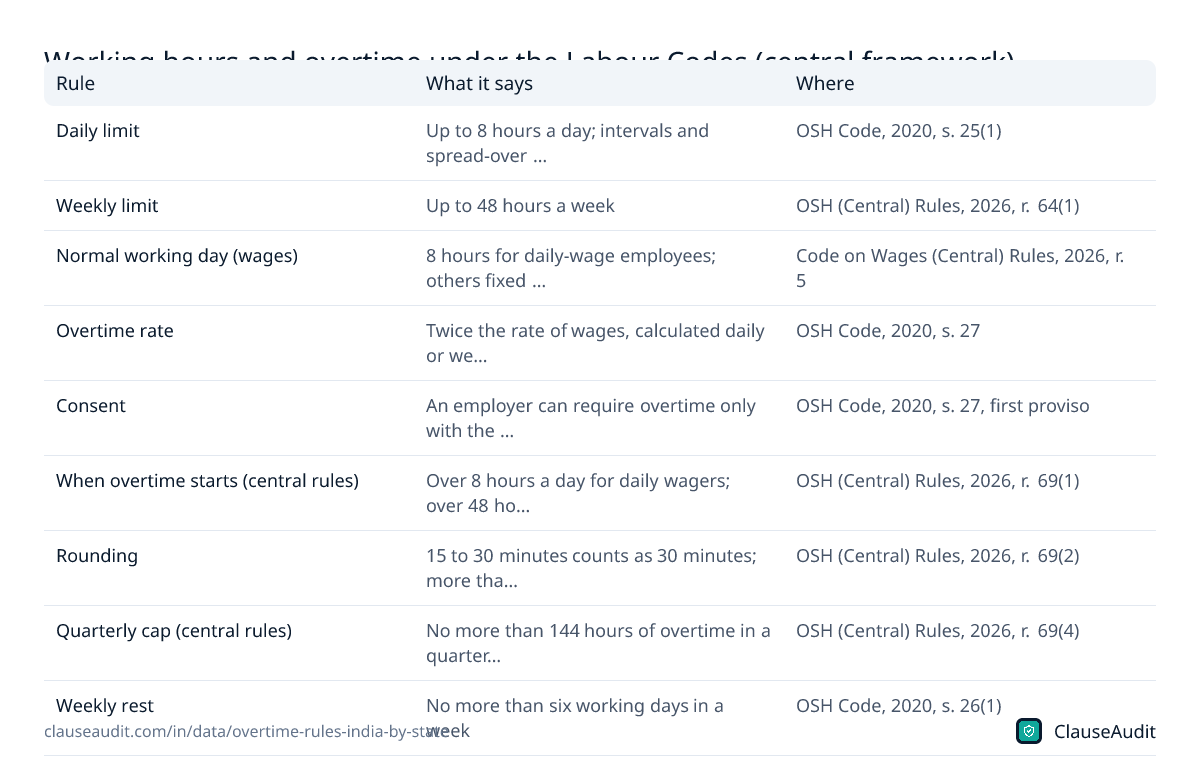
Download this chart (PNG)Working hours and overtime under the Labour Codes (central framework)
| Rule | What it says | Where |
|---|---|---|
| Daily limit | Up to 8 hours a day; intervals and spread-over set by the appropriate Government | OSH Code, 2020, s. 25(1) |
| Weekly limit | Up to 48 hours a week | OSH (Central) Rules, 2026, r. 64(1) |
| Normal working day (wages) | 8 hours for daily-wage employees; others fixed so weekly hours do not exceed 48 | Code on Wages (Central) Rules, 2026, r. 5 |
| Overtime rate | Twice the rate of wages, calculated daily or weekly, whichever is more favourable to the worker | OSH Code, 2020, s. 27 |
| Consent | An employer can require overtime only with the worker's consent | OSH Code, 2020, s. 27, first proviso |
| When overtime starts (central rules) | Over 8 hours a day for daily wagers; over 48 hours a week for other workers | OSH (Central) Rules, 2026, r. 69(1) |
| Rounding | 15 to 30 minutes counts as 30 minutes; more than 30 minutes counts as one hour | OSH (Central) Rules, 2026, r. 69(2) |
| Quarterly cap (central rules) | No more than 144 hours of overtime in a quarter, in the proviso for dock, mine and construction work | OSH (Central) Rules, 2026, r. 69(4) |
| Weekly rest | No more than six working days in a week | OSH Code, 2020, s. 26(1) |
| Who is covered | Establishments with ten or more workers | OSH Code, 2020, s. 2 |
Source: Ministry of Law and Justice, Gazette of India Extraordinary (copy hosted by PRS Legislative Research), The Occupational Safety, Health and Working Conditions Code, 2020 (No. 37 of 2020), ss. 2, 25, 26, 27, 143; Ministry of Labour & Employment (Gazette of India, Extraordinary), G.S.R. 345(E): Occupational Safety, Health and Working Conditions (Central) Rules, 2026, rules 64 and 69; Ministry of Labour & Employment (Gazette of India, Extraordinary), G.S.R. 343(E): Code on Wages (Central) Rules, 2026, rule 5. Download as image
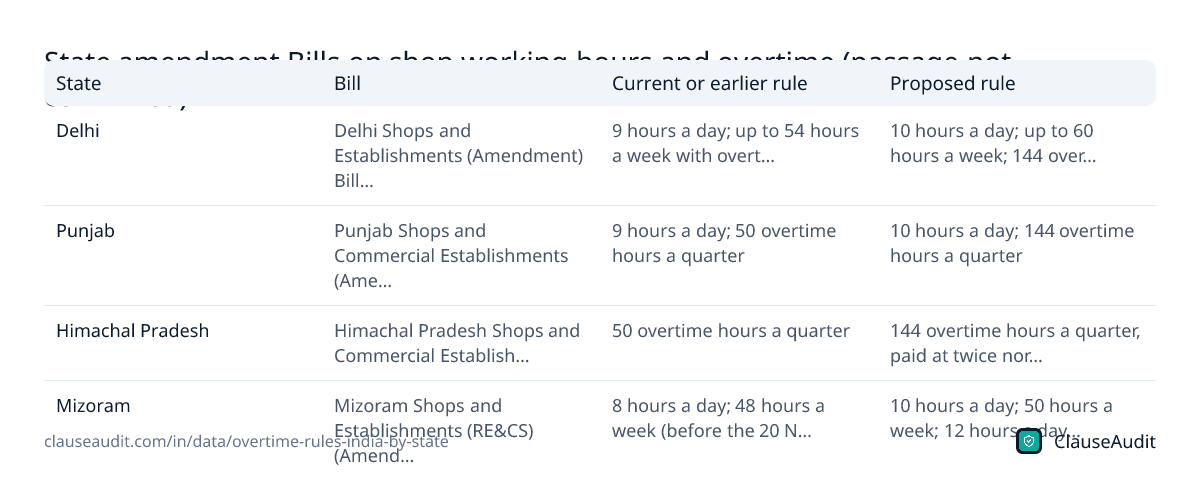
State amendment Bills on shop working hours and overtime (passage not confirmed)
| State | Bill | Current or earlier rule | Proposed rule |
|---|---|---|---|
| Delhi | Delhi Shops and Establishments (Amendment) Bill, 2026, introduced 9 January 2026 | 9 hours a day; up to 54 hours a week with overtime; 150 overtime hours a year | 10 hours a day; up to 60 hours a week; 144 overtime hours a quarter; 12-hour spread-over |
| Punjab | Punjab Shops and Commercial Establishments (Amendment) Bill, 2025, dated 10 July 2025 | 9 hours a day; 50 overtime hours a quarter | 10 hours a day; 144 overtime hours a quarter |
| Himachal Pradesh | Himachal Pradesh Shops and Commercial Establishments (Amendment) Bill, 2025 | 50 overtime hours a quarter | 144 overtime hours a quarter, paid at twice normal hourly wages |
| Mizoram | Mizoram Shops and Establishments (RE&CS) (Amendment) Bill, 2026, dated 6 February 2026, replacing the Amendment Ordinance, 2025 promulgated 20 November 2025 | 8 hours a day; 48 hours a week (before the 20 November 2025 Ordinance) | 10 hours a day; 50 hours a week; 12 hours a day including overtime; 125 overtime hours in 3 consecutive months (the Bill replaces an Ordinance of 20 November 2025; we did not open the Ordinance's text) |
| Meghalaya | Meghalaya Shops and Establishments (Amendment) Bill, 2025, introduced 10 September 2025 | Not stated in the Bill | 48 hours a week; spread-over of 9, 10 or 12 hours for a 6, 5 or 4-day week; 144 overtime hours a quarter at twice the ordinary rate |
Source: Legislative Assembly of the NCT of Delhi (via PRS Legislative Research), Delhi Shops and Establishments (Amendment) Bill, 2026 (Bill No. 03 of 2026); Punjab Vidhan Sabha (via PRS Legislative Research), Punjab Shops and Commercial Establishments (Amendment) Bill, 2025 (Bill No. 14-PLA-2025); Himachal Pradesh Legislative Assembly (via PRS Legislative Research), Himachal Pradesh Shops and Commercial Establishments (Amendment) Bill, 2025 (Bill No. 24 of 2025); Mizoram Legislative Assembly (via PRS Legislative Research), Mizoram Shops and Establishments (Regulation of Employment and Conditions of Service) (Amendment) Bill, 2026; Meghalaya Legislative Assembly (via PRS Legislative Research), Meghalaya Shops and Establishments (Amendment) Bill, 2025 (L.B. No. 84 of 2025). Download as image
Status of the state's latest working-hours change for shops and establishments by State
- 6Hours raised by ordinance (in force; replacement Act not confirmed)
- 2New Act passed (start date not confirmed)
- 4Amendment Bill introduced (passage not confirmed)
- 1State Act repealed; OSH Code applies
| State | Law | Daily hours | Weekly hours | Overtime cap | Overtime pay | Earlier rule | Source |
|---|---|---|---|---|---|---|---|
| Bihar | Act 9 of 2025 repealed by Act 15 of 2026 | See OSH Code | See OSH Code | See OSH Code | See OSH Code | Act 9 of 2025: 144 hours in 3 months; twice the rate | Bihar Shops and Establishments (Regulation of Employment and Conditions of Service) (Repeal) Act, 2026 (Act No. 15 of 2026) |
| Delhi | Delhi S&E Act, 1954 (2026 amendment Bill pending) | 9 hours (proposed 10) | Up to 54 with overtime (proposed 60) | 150 hours a year (proposed 144 a quarter) | Not stated in Bill | Current law | Delhi Shops and Establishments Act, 1954, ss. 8, 10, 11; Delhi Shops and Establishments (Amendment) Bill, 2026 |
| Goa | Goa Act 23 of 2025 | 10 hours (spread-over 12) | 48 hours | 144 hours in 3 months | Twice the ordinary rate | New Act | Goa Shops and Establishments (Regulation of Employment and Conditions of Service) Act, 2025, ss. 12-14 |
| Gujarat | S&E Act, 2019 as amended by Ord. No. 3 of 2025 | 10 hours | Not stated in amending text | 144 hours a quarter | Not stated in amending text | 9 hours a day; 125 hours OT | Gujarat Shops and Establishments (Regulation of Employment and Conditions of Service) Act, 2019, ss. 12, 15, as amended by Gujarat Ordinance No. 3 of 2025 |
| Haryana | S&CE Act, 1958 as amended by Ord. No. 4 of 2025 | 10 hours | 48 hours | 156 hours a quarter | Not stated in amending text | 9 hours a day; 50 hours OT | Haryana Shops and Commercial Establishments Act, 1958 (Punjab Act 15 of 1958), ss. 7, 8, as amended by Haryana Ordinance No. 4 of 2025 |
| Himachal Pradesh | HP S&CE Act, 1969 (2025 amendment Bill) | Not stated in amending text | Not stated in amending text | 50 hours a quarter (proposed 144) | Twice normal hourly wages (per Bill's objects) | Current law | Himachal Pradesh Shops and Commercial Establishments Act, 1969, s. 7; Bill No. 24 of 2025 |
| Jammu and Kashmir | J&K Act No. VI of 2025 | 8 hours (spread-over 10.5) | 48 hours | 144 hours in 3 months | Twice the ordinary rate | New Act | Jammu and Kashmir Shops and Establishments (Licensing, Regulation of Employment and Conditions of Service) Act, 2025, ss. 13-14 |
| Maharashtra | S&E Act, 2017 as amended by Ord. VIII of 2025 | 10 hours (spread-over 12) | 48 hours | 144 hours a quarter | Not stated in amending text | 9 hours a day; 125 hours OT | Maharashtra Shops and Establishments (Regulation of Employment and Conditions of Service) Act, 2017, ss. 12, 14, 15, as amended by Mah. Ord. VIII of 2025 |
| Meghalaya | Meghalaya S&E Act, 2003 (2025 amendment Bill) | Spread-over 9, 10 or 12 hours (6, 5 or 4-day week, proposed) | 48 hours (proposed) | Proposed 144 hours a quarter | Twice the ordinary rate (proposed) | Current law | Meghalaya Shops and Establishments Act, 2003, s. 5; Amendment Bill, 2025 (L.B. No. 84 of 2025) |
| Mizoram | Not yet confirmed: check the source | Mizoram Shops and Establishments (Regulation of Employment and Conditions of Service) Act, 2010 (Act No. 14 of 2010), ss. 8, 9, 11, as amended by the Mizoram Shops and Establishments (Regulation of Employment and Conditions of Service) (Amendment) Ordinance, 2025; Amendment Bill, 2026 (replaces the Ordinance) | |||||
| Odisha | S&CE Act as amended by Ord. 3 of 2025 | 10 hours (12 with overtime) | Not stated in amending text | 144 hours a quarter | Not stated in amending text | 9 hours a day; 50 hours OT | Odisha Shops and Commercial Establishments Act, ss. 7, 8, 9, as amended by Odisha Ordinance 3 of 2025 |
| Punjab | Punjab S&CE Act, 1958 (2025 amendment Bill) | 9 hours (proposed 10) | Not stated in amending text | 50 hours a quarter (proposed 144) | Not stated in amending text | Current law | Punjab Shops and Commercial Establishments Act, 1958, s. 7; Bill No. 14-PLA-2025 |
| Rajasthan | S&CE Act, 1958 as amended by Ord. No. 3 of 2025 | 10 hours | 48 hours | 144 hours a quarter | Not stated in amending text | 9 hours a day; 50 hours OT | Rajasthan Shops and Commercial Establishments Act, 1958 (Act No. 31 of 1958), ss. 7, 9, as amended by Rajasthan Ordinance No. 3 of 2025 |
| Uttar Pradesh | Dookan Aur Vanijya Adhishthan Adhiniyam as amended by Ord. No. 16 of 2025 | 9 hours (11 with overtime) | 48 hours | 144 hours a quarter | Twice the ordinary rate | 125 hours OT | Uttar Pradesh Dookan Aur Vanijya Adhishthan Adhiniyam, s. 6, as substituted by U.P. Ordinance No. 16 of 2025 |
How does overtime pay work under the new Labour Codes?
The Occupational Safety, Health and Working Conditions Code replaced the Factories Act, 1948 on 21 Nov 2025. Section 27 says overtime is paid at twice the rate of wages. The pay is worked out daily or weekly, whichever gives the worker more.
That last part is easy to miss. Say you work one long day and then a short week. A daily count might show overtime even though your weekly total stays under 48 hours. The Code says you get the better of the two.
The central rules notified on 8 May 2026 add the detail. For daily wagers, overtime starts after 8 hours in a day. For everyone else under those rules, it starts after 48 hours in a week. Small slices of time count too: 15 to 30 minutes is rounded to 30 minutes, and anything over 30 minutes counts as one hour.
Keep in mind that the central rules only apply where the Central Government is the appropriate Government. Your state notifies its own rules, so check the version that covers your workplace.
Which states allow a 10-hour working day?
Maharashtra, Gujarat, Haryana, Odisha and Rajasthan now set a 10-hour normal day for shops and establishments, and Goa's new Act does the same once it starts. Uttar Pradesh sets 9 hours, with up to 11 including overtime. Jammu and Kashmir's new Act sets 8.
A longer day does not mean a longer week. In the states charted above, wherever the text states a weekly limit, it is 48 hours. In practice that points to a shorter week with longer days, not more total hours, unless overtime is added on top.
Status matters here. Maharashtra's change has been deemed in force from 1 October 2025 and Haryana's from 12 November 2025, both by ordinance. An ordinance lapses if the legislature does not replace it, and we could not confirm that the replacement Bills passed. Goa and Jammu and Kashmir passed full Acts, but those start on a date the government notifies, and we could not confirm those dates.
Delhi, Punjab, Himachal Pradesh and Meghalaya have Bills on the table. Delhi's current law allows 9 hours a day and 150 overtime hours a year, and its Bill would move to 10 hours a day and 144 hours a quarter. Bihar went the other way and repealed its own new shops Act, leaving the OSH Code to cover the ground.
Is overtime compulsory in India?
No. The first proviso to Section 27 of the OSH Code says an employer can require overtime only with the worker's consent. Maharashtra's amending Bill also says overtime is not mandatory, and Meghalaya's proposal would make it optional for employees.
Consent is where contracts cause trouble. Many offer letters say you will work "such hours as the business requires" or that your salary "covers all hours worked". A clause like that is the employer's attempt to get blanket consent in advance. It may not hold up against a statute that requires your consent and pays twice the rate, but it shapes what your manager expects and what you feel able to refuse.
If your contract has wording like this, ask for it to name the normal hours, say that overtime is voluntary and confirm how it is paid.
What do these rules mean for workers, employers and freelancers?
For a salaried worker in a shop, office or mall, the higher caps cut both ways. Your employer can now ask for far more overtime in a quarter than before, but every one of those hours should come with consent and extra pay. If your state moved from 50 to 144 hours, the room for unpaid "stay back" culture just got larger, so keep your own record of hours.
For an employer, the risk is paperwork that still cites the Factories Act or an old state limit. If your policy says overtime is capped at 50 hours a quarter in a state that now allows 144, you are only limiting yourself. And if your state has not yet changed its law, a 10-hour roster could still breach a 9-hour daily limit. Check the status column on this page before you change shifts.
For a freelancer or consultant, these limits generally do not apply, because you are not an employee. That changes if the client controls your hours, your place of work and your tools like an employer would. A "consultant" contract with fixed office hours and no overtime pay is worth a second look, both for the worker and for the business that wrote it.
How to check your own hours and overtime terms
- Find out which law covers you. An establishment with ten or more workers falls under the OSH Code. A shop, office or commercial establishment also falls under its state Act.
- Look up your state in the table above, and note whether the change is an ordinance, a new Act waiting for a start date or only a Bill.
- Read your contract's hours clause. It should name the normal daily and weekly hours, not just say "as required".
- Check the overtime clause for the rate. Anything below twice the rate of wages is a red flag where the OSH Code applies, and several state Acts set the same rate.
- Look for words that treat your salary as covering all hours. Ask for them to be removed or limited.
- Keep a simple log of start times, finish times and breaks. Under the central rules, even 15 to 30 minutes of extra work can count.
How ClauseAudit helps
Hours and overtime rarely sit in one tidy clause. They hide in the salary section, the duties section and the code of conduct. An automated review of your offer letter or employment agreement pulls them together and flags terms that sit badly with the OSH Code or your state's shops law.
You get a plain-English report listing each risky clause, why it matters and what to ask for instead.
- Working hours: does the contract name your normal daily and weekly hours, or only say "as the business requires"?
- Overtime pay: is the rate stated, and is it at least twice the rate of wages?
- Consent: does any clause treat overtime as compulsory or as already agreed?
- All-inclusive salary: does the pay clause claim to cover every hour you work?
- Old law references: does the letter still cite the Factories Act or a superseded state limit?
- Worker status: if you are hired as a consultant, does the contract set fixed hours like an employment contract would?
Frequently asked questions
What is the overtime rate in India?
Under Section 27 of the OSH Code, overtime is paid at twice the rate of wages. The calculation is done daily or weekly, whichever is more favourable to the worker. Several state shops laws, including those in Uttar Pradesh, Goa and Jammu and Kashmir, also set twice the ordinary rate.
What are the maximum working hours per day in India?
The OSH Code sets a limit of 8 hours a day for establishments it covers. For shops and offices, state law often allows more. Maharashtra, Gujarat, Haryana, Odisha and Rajasthan set a 10-hour normal day, as will Goa once its new Act starts. Uttar Pradesh sets 9 hours, with up to 11 including overtime.
Is the 48 hours a week limit still in place?
Yes. The OSH (Central) Rules, 2026 say no worker shall work more than 48 hours in a week. In the eight states charted above, every text that states a weekly limit keeps it at 48 hours, even where the daily limit rose to 10. Delhi's pending Bill would allow up to 60 hours a week.
Can my employer force me to work overtime?
Not under the OSH Code. Its Section 27 lets an employer require overtime only with the worker's consent. Maharashtra's amending Bill also states that overtime is not mandatory. If your contract says otherwise, ask for the clause to be changed before you sign.
How many overtime hours are allowed in a quarter?
It depends on the state. Haryana allows 156 hours a quarter for shops, the highest in the texts reviewed. Maharashtra, Gujarat, Odisha, Rajasthan, Uttar Pradesh, Goa and Jammu and Kashmir use 144 hours. Punjab and Himachal Pradesh still show 50 hours, with Bills proposing 144.
Are the new state working-hours rules actually in force?
Some are, with a catch. Maharashtra, Gujarat, Haryana, Odisha, Rajasthan and Uttar Pradesh acted by ordinance, which applies at once but needs a replacement Act to last. We could not confirm those Acts passed. Goa and Jammu and Kashmir passed new Acts that start on a notified date we could not confirm.
Do overtime rules apply to freelancers in India?
Generally no, since they cover employees and workers, not independent contractors. But a label does not settle it. If a client fixes your hours, your workplace and your tools the way an employer would, you may be an employee in practice, and the hours and overtime rules could apply.
Does the OSH Code apply to small businesses?
The OSH Code applies to establishments with ten or more workers. Smaller shops and offices may still be covered by their state's Shops and Establishments Act, which sets its own daily hours and overtime limits. Check both before you plan rosters or sign an employment contract.
Use this data
Every chart and card below is free to reuse under CC BY 4.0. Download what you need and link back to this page.
 Stat cards
 Key findings card
 Infographic
 Quarterly overtime cap for shops and establishments by state, India (2025-26 texts) (hours per quarter)
 Quarterly overtime cap before the 2025-26 amendments, by state (hours per quarter)
 Normal daily working-hours limit for shops and establishments by state vs the OSH Code (hours per day)
 Working hours and overtime under the Labour Codes (central framework)
 State amendment Bills on shop working hours and overtime (passage not confirmed)
Embed the infographic
Free to share on your site, blog or slides under CC BY 4.0. Please keep the credit link.
Sources and method
Every number on this page comes from the sources below, each opened and read on or before October 18, 2026. A second, independent review checked every figure against its source and corrected anything that did not match. 13 of 14 State entries were confirmed; any that could not be are marked "Not yet confirmed" and left out of every count and chart.
- Ministry of Law and Justice, Gazette of India Extraordinary (copy hosted by PRS Legislative Research), The Occupational Safety, Health and Working Conditions Code, 2020 (No. 37 of 2020), ss. 2, 25, 26, 27, 143 (29 September 2020)
- Ministry of Labour & Employment (Gazette of India, Extraordinary), S.O. 5321(E): commencement of the Occupational Safety, Health and Working Conditions Code, 2020 (21 November 2025)
- Ministry of Labour & Employment (Gazette of India, Extraordinary), G.S.R. 345(E): Occupational Safety, Health and Working Conditions (Central) Rules, 2026, rules 64 and 69 (8 May 2026)
- Ministry of Labour & Employment (Gazette of India, Extraordinary), G.S.R. 343(E): Code on Wages (Central) Rules, 2026, rule 5 (8 May 2026)
- Government of Maharashtra, Law and Judiciary Department (via PRS Legislative Research), Maharashtra Shops and Establishments (Regulation of Employment and Conditions of Service) (Amendment) Bill, 2025 (L.A. Bill No. LXXXIX of 2025), replacing Mah. Ord. VIII of 2025 (Introduced 8 December 2025)
- Gujarat Government Gazette, Extraordinary (via PRS Legislative Research), Gujarat Ordinance No. 3 of 2025: Gujarat Shops and Establishments (Regulation of Employment and Conditions of Service) (Amendment) Ordinance, 2025 (16 December 2025)
- Gujarat Government Gazette, Extraordinary (via PRS Legislative Research), Gujarat Shops and Establishments (Regulation of Employment and Conditions of Service) (Amendment) Bill, 2026 (11 February 2026)
- Haryana Government Gazette, Extraordinary (via PRS Legislative Research), Haryana Shops and Commercial Establishment (Amendment) Bill, 2025, replacing Haryana Ordinance No. 4 of 2025 (18 December 2025)
- Odisha Gazette, Law Department (via PRS Legislative Research), Odisha Ordinance 3 of 2025: Odisha Shops and Commercial Establishments (Amendment) Ordinance, 2025 (Promulgated 5 November 2025; published 8 November 2025)
- Rajasthan Gazette, Extraordinary (via PRS Legislative Research), Rajasthan Ordinance No. 3 of 2025: Rajasthan Shops and Commercial Establishments (Amendment) Ordinance, 2025 (Promulgated 17 December 2025; published 18 December 2025)
- Rajasthan Legislative Assembly (via PRS Legislative Research), Rajasthan Shops and Commercial Establishments (Amendment) Bill, 2026 (with extract of section 7 of the 1958 Act) (2026)
- Uttar Pradesh Gazette, Extraordinary (via PRS Legislative Research), U.P. Ordinance No. 16 of 2025: Uttar Pradesh Dookan Aur Vanijya Adhishthan (Sanshodhan) Adhyadesh, 2025 (English translation) (19 November 2025)
- Uttar Pradesh Gazette, Extraordinary (via PRS Legislative Research), Uttar Pradesh Dookan Aur Vanijya Adhishthan (Sanshodhan) Vidheyak, 2025 (English translation and Hindi text) (Introduced 22 December 2025; published 30 December 2025)
- Official Gazette, Government of Goa (via PRS Legislative Research), Goa Shops and Establishments (Regulation of Employment and Conditions of Service) Act, 2025 (Goa Act 23 of 2025), ss. 12-14 (1 October 2025)
- J&K Official Gazette (via PRS Legislative Research), Jammu and Kashmir Shops and Establishments (Licensing, Regulation of Employment and Conditions of Service) Act, 2025 (Act No. VI of 2025), ss. 13-14 (1 November 2025)
- Bihar Gazette, Law Department (via PRS Legislative Research), Bihar Shops and Establishments (Regulation of Employment and Conditions of Service) Act, 2025 (Act No. 9 of 2025) (12 August 2025)
- Bihar Gazette, Law Department (via PRS Legislative Research), Bihar Shops and Establishments (Regulation of Employment and Conditions of Service) (Repeal) Act, 2026 (Act No. 15 of 2026) (3 August 2026)
- Legislative Assembly of the NCT of Delhi (via PRS Legislative Research), Delhi Shops and Establishments (Amendment) Bill, 2026 (Bill No. 03 of 2026) (Introduced 9 January 2026)
- Punjab Vidhan Sabha (via PRS Legislative Research), Punjab Shops and Commercial Establishments (Amendment) Bill, 2025 (Bill No. 14-PLA-2025) (10 July 2025)
- Himachal Pradesh Legislative Assembly (via PRS Legislative Research), Himachal Pradesh Shops and Commercial Establishments (Amendment) Bill, 2025 (Bill No. 24 of 2025) (2025 (as introduced))
- Mizoram Legislative Assembly (via PRS Legislative Research), Mizoram Shops and Establishments (Regulation of Employment and Conditions of Service) (Amendment) Bill, 2026 (2026)
- Meghalaya Legislative Assembly (via PRS Legislative Research), Meghalaya Shops and Establishments (Amendment) Bill, 2025 (L.B. No. 84 of 2025) (Introduced 10 September 2025)
Cite this page
ClauseAudit, “Overtime and Working Hours Rules in India by State (Labour Codes and Shops & Establishments Acts)”, updated October 18, 2026, https://clauseaudit.com/in/data/overtime-rules-india-by-state. Free to reuse with a link back (CC BY 4.0).
This page summarises published data and law as checked on October 18, 2026. Figures are updated as new editions are released, and your own situation may differ. It is general information, not legal, tax or financial advice.