Model Tenancy Act Adoption by State: Deposit Caps, Rent Authority and Eviction Rules Across India
By ClauseAudit Research · 15 sources ·
Which Indian states have adopted the Model Tenancy Act?
As of December 2025, 6 States and 4 UTs had passed rental laws on the lines of the Model Tenancy Act, and Chandigarh joined in May 2026. Most cap the security deposit at 2 months' rent for homes and 6 months' rent for commercial space. Tamil Nadu and Andhra Pradesh use an older 3x cap that the agreement can override.
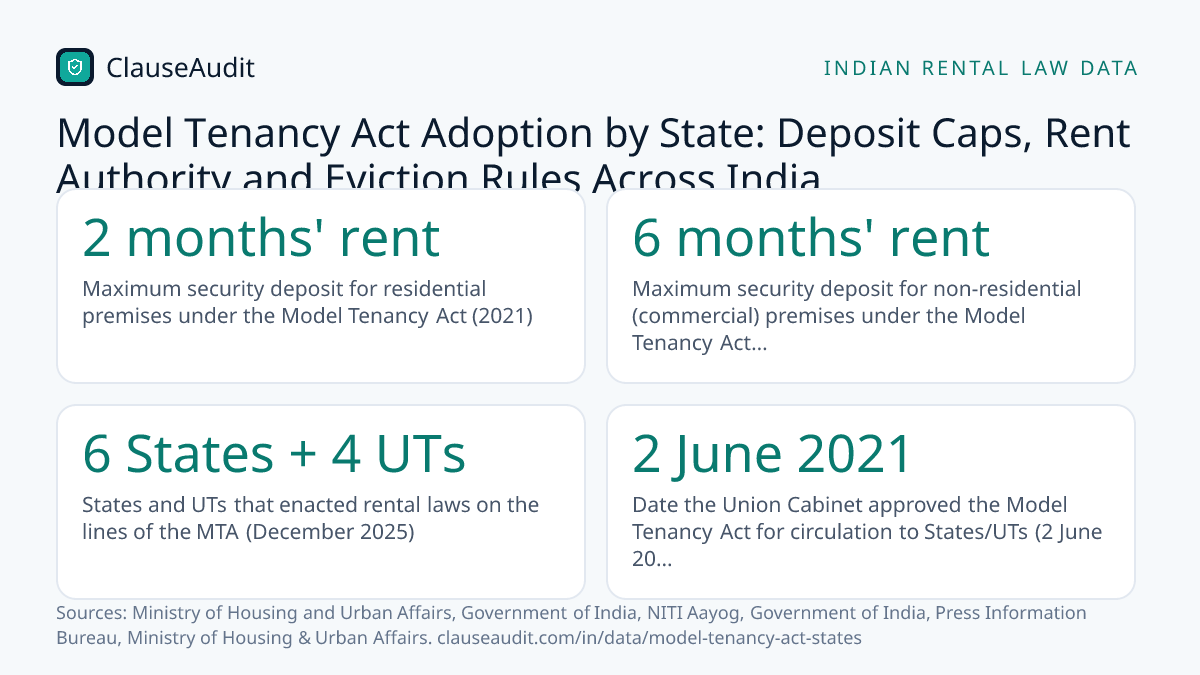
- Maximum security deposit for residential premises under the Model Tenancy Act (2021, Ministry of Housing and Urban Affairs, Government of India)
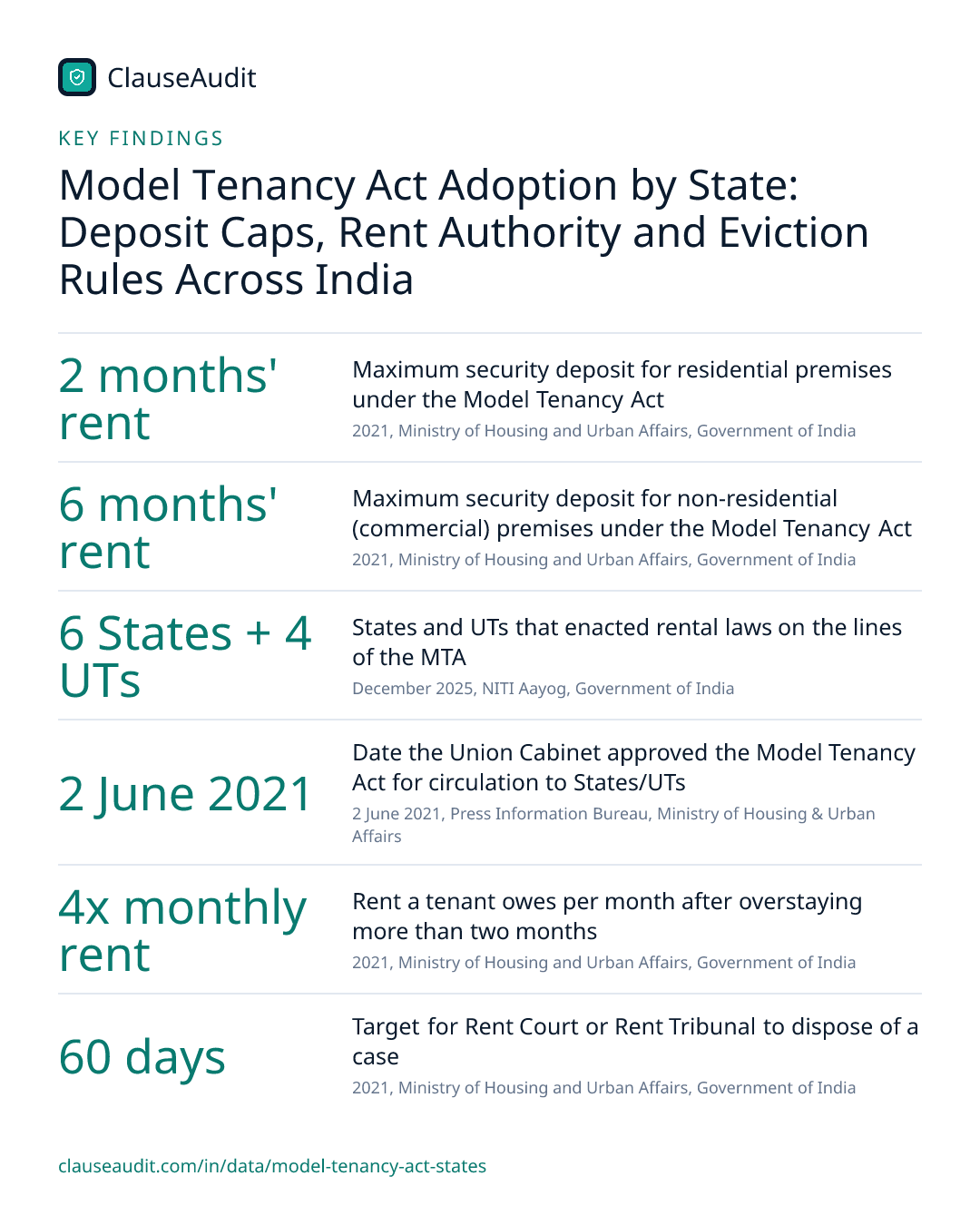
- 2 months' rent
- Maximum security deposit for non-residential (commercial) premises under the Model Tenancy Act (2021, Ministry of Housing and Urban Affairs, Government of India)
- 6 months' rent
- States and UTs that enacted rental laws on the lines of the MTA (December 2025, NITI Aayog, Government of India)
- 6 States + 4 UTs
- Date the Union Cabinet approved the Model Tenancy Act for circulation to States/UTs (2 June 2021, Press Information Bureau, Ministry of Housing & Urban Affairs)
- 2 June 2021
- Rent a tenant owes per month after overstaying more than two months (2021, Ministry of Housing and Urban Affairs, Government of India)
- 4x monthly rent
- Target for Rent Court or Rent Tribunal to dispose of a case (2021, Ministry of Housing and Urban Affairs, Government of India)
- 60 days
- Minimum written notice before a landlord may enter the rented premises (2021, Ministry of Housing and Urban Affairs, Government of India)
- 24 hours
- Deposit cap in Andhra Pradesh's and Tamil Nadu's pre-2021 tenancy laws (2017-2018, Government of Andhra Pradesh (text hosted by FAO FAOLEX))
- 3x monthly rent
The Model Tenancy Act is a template, not a law you can rely on everywhere. The Union Cabinet approved it on 2 June 2021 and sent it to the States, and each State or UT decides whether to pass its own version. If yours has not, the Act's deposit cap and Rent Court deadlines do not apply to your flat or shop.
NITI Aayog counted 6 States and 4 UTs with laws on these lines by December 2025. Most copy the 2021 model closely. Two southern States, Tamil Nadu and Andhra Pradesh, passed earlier versions in 2017 and 2018 with softer rules. This page shows what each law says and what it means for the agreement you are about to sign.
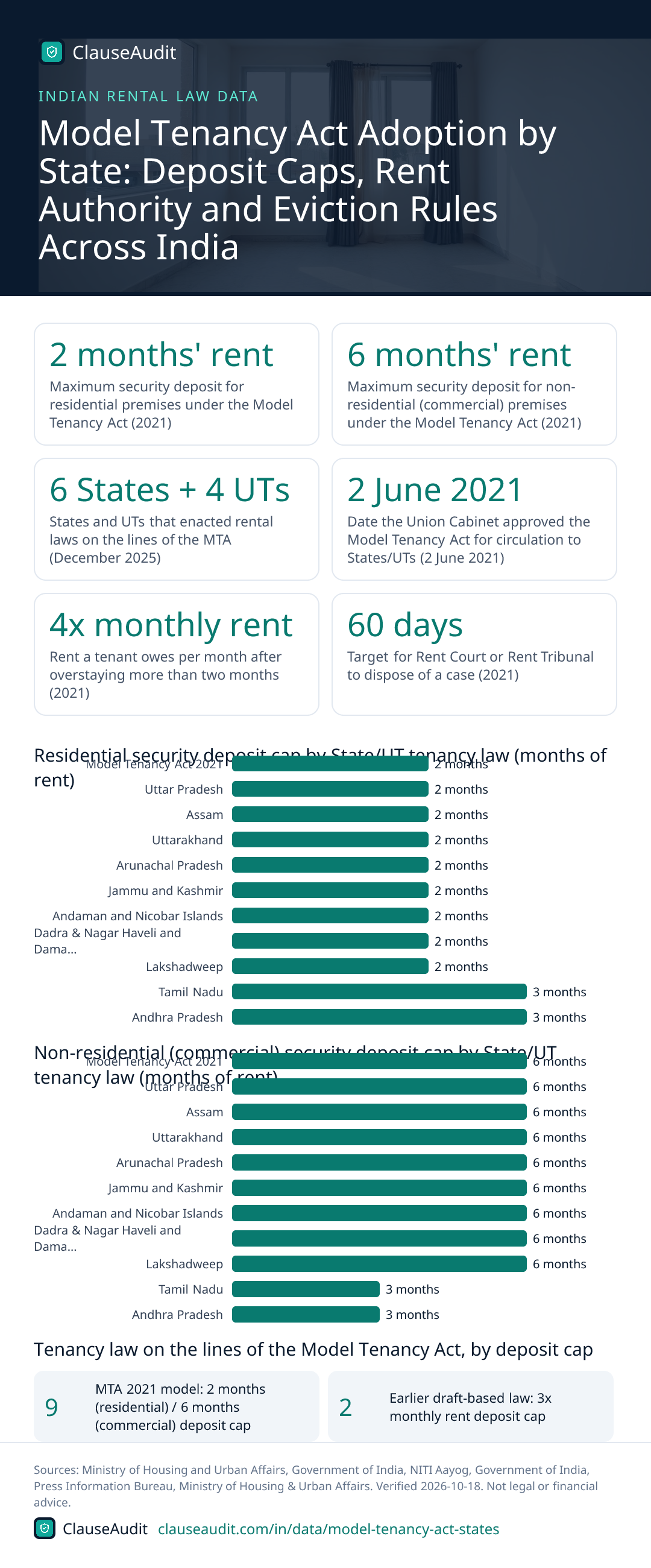
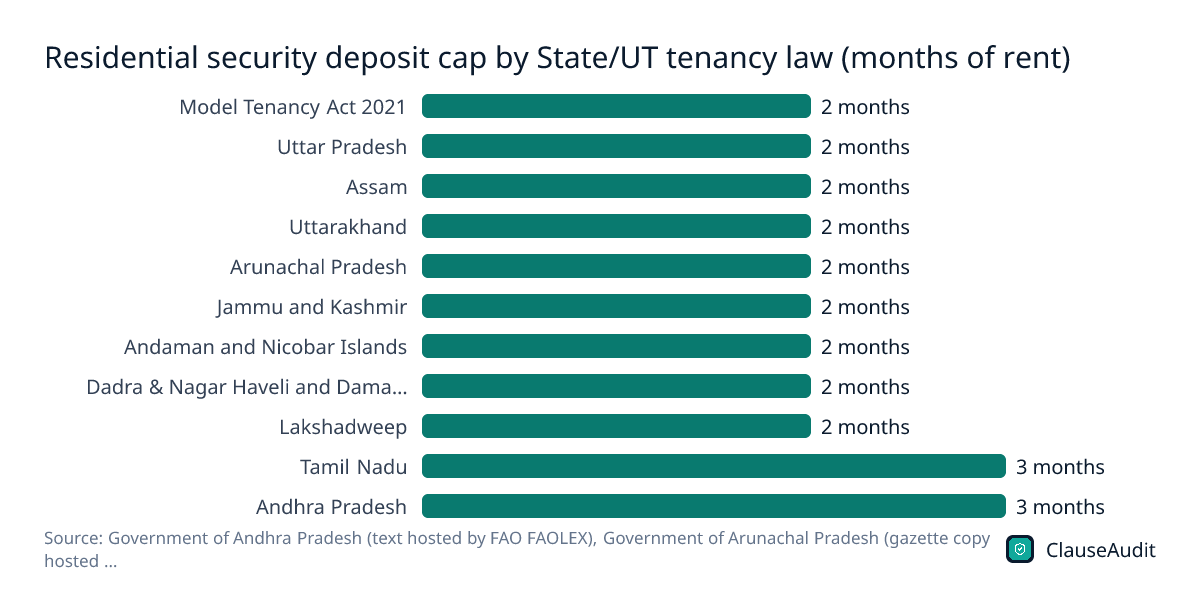
Residential security deposit cap by State/UT tenancy law (months of rent)
Chart data
| Label | Value |
|---|---|
| Model Tenancy Act 2021 | 2 months |
| Uttar Pradesh | 2 months |
| Assam | 2 months |
| Uttarakhand | 2 months |
| Arunachal Pradesh | 2 months |
| Jammu and Kashmir | 2 months |
| Andaman and Nicobar Islands | 2 months |
| Dadra & Nagar Haveli and Daman & Diu | 2 months |
| Lakshadweep | 2 months |
| Tamil Nadu | 3 months |
| Andhra Pradesh | 3 months |
Every law based on the 2021 model uses the same 2 months' rent cap for homes. The two older laws allow 3x monthly rent, and even that gives way if the agreement says otherwise.
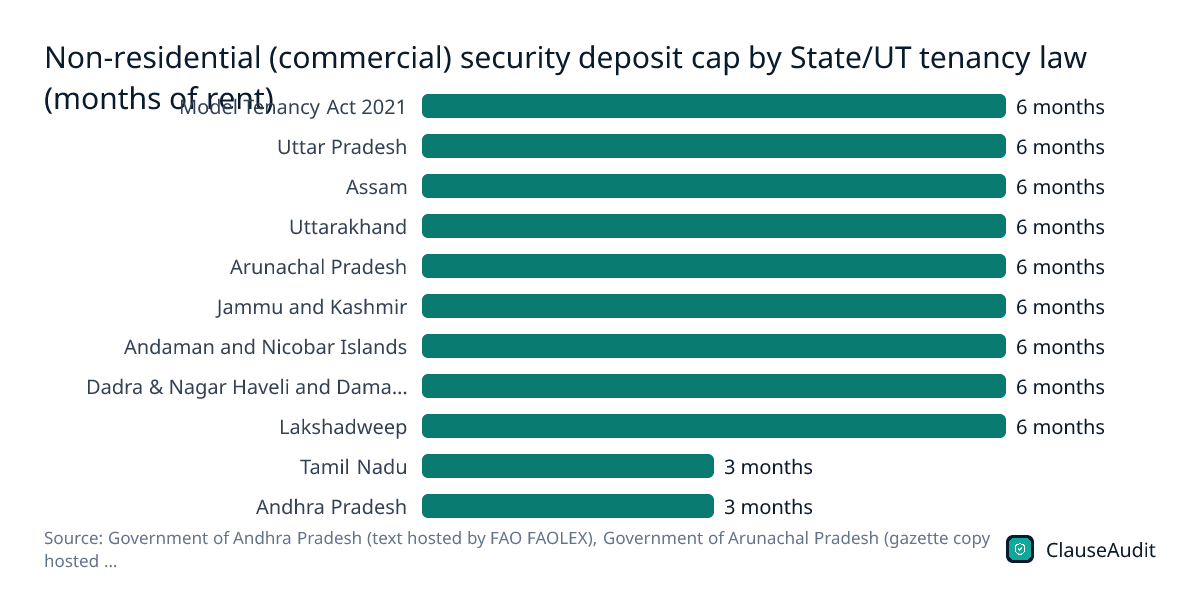
Download this chart (PNG)Non-residential (commercial) security deposit cap by State/UT tenancy law (months of rent)
Chart data
| Label | Value |
|---|---|
| Model Tenancy Act 2021 | 6 months |
| Uttar Pradesh | 6 months |
| Assam | 6 months |
| Uttarakhand | 6 months |
| Arunachal Pradesh | 6 months |
| Jammu and Kashmir | 6 months |
| Andaman and Nicobar Islands | 6 months |
| Dadra & Nagar Haveli and Daman & Diu | 6 months |
| Lakshadweep | 6 months |
| Tamil Nadu | 3 months |
| Andhra Pradesh | 3 months |
For shops and offices the newer laws allow up to 6 months' rent. Tamil Nadu and Andhra Pradesh have no separate commercial cap, so a business tenant there is held to the same 3x figure unless the agreement sets a different one.
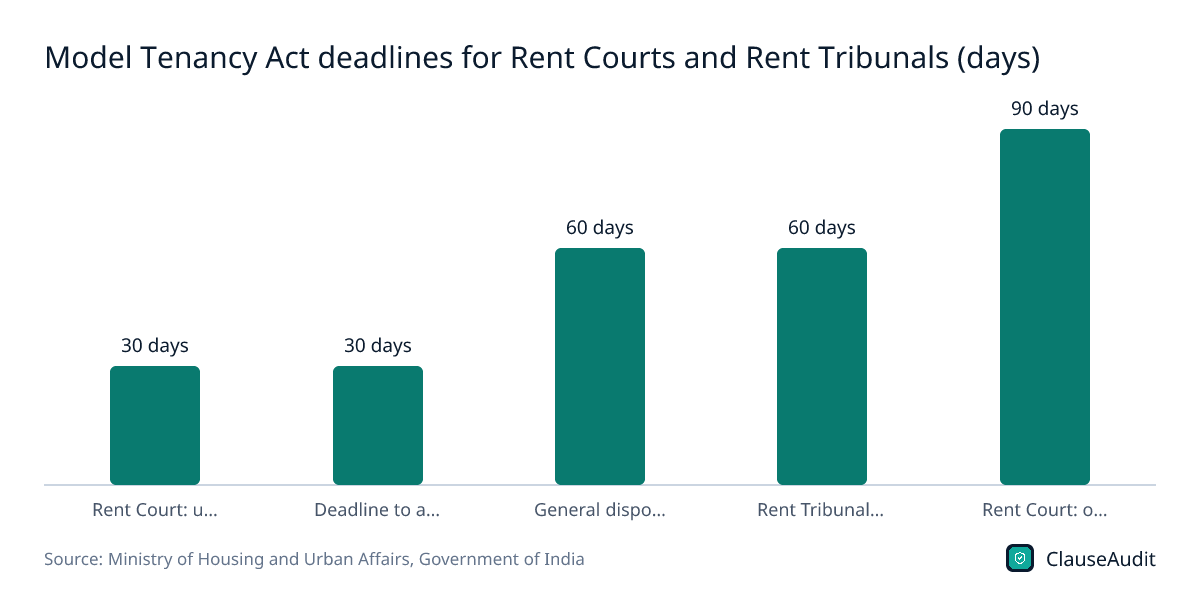
Download this chart (PNG)Model Tenancy Act deadlines for Rent Courts and Rent Tribunals (days)
Chart data
| Label | Value |
|---|---|
| Rent Court: unauthorised subletting or misuse cases [s.21(2)(c),(d)] | 30 days |
| Deadline to appeal a Rent Court order to the Rent Tribunal | 30 days |
| General disposal target, Rent Court or Tribunal | 60 days |
| Rent Tribunal: decide an appeal (from notice service) | 60 days |
| Rent Court: other eviction grounds and landlord-death cases | 90 days |
These are targets written into the model law, not promises. Subletting and misuse cases get the shortest clock at 30 days, while most eviction grounds, including unpaid rent, sit in the 90-day group.
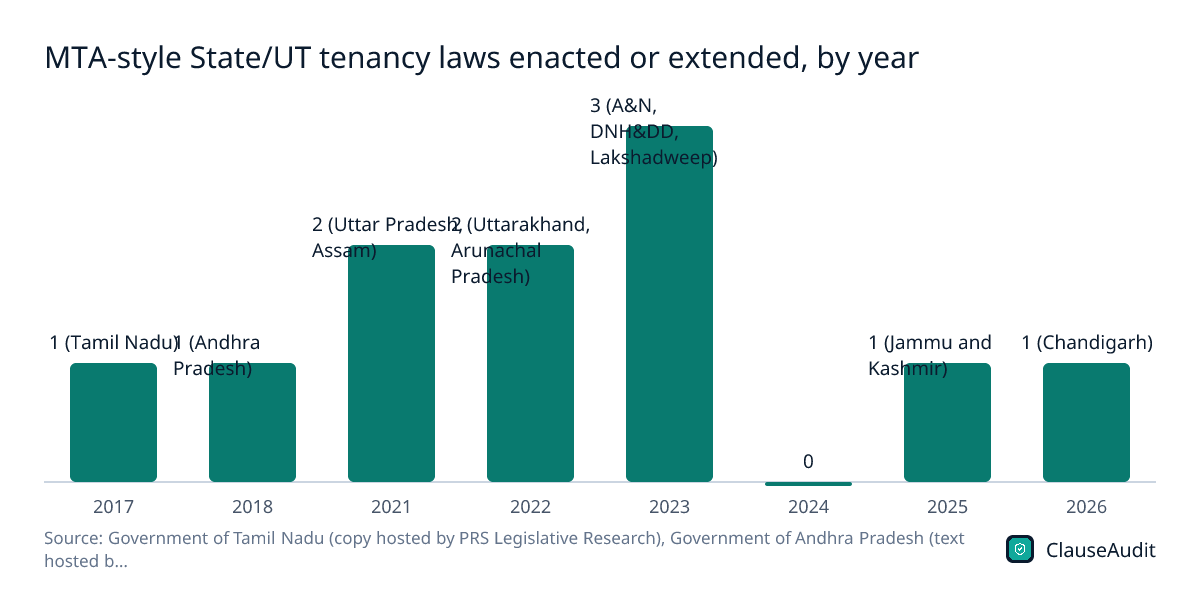
Download this chart (PNG)MTA-style State/UT tenancy laws enacted or extended, by year
Chart data
| Label | Value |
|---|---|
| 2017 | 1 (Tamil Nadu) |
| 2018 | 1 (Andhra Pradesh) |
| 2021 | 2 (Uttar Pradesh, Assam) |
| 2022 | 2 (Uttarakhand, Arunachal Pradesh) |
| 2023 | 3 (A&N, DNH&DD, Lakshadweep) |
| 2024 | 0 |
| 2025 | 1 (Jammu and Kashmir) |
| 2026 | 1 (Chandigarh) |
Adoption has been slow and uneven, with no new law in 2024. Passing a law is also not the same as switching it on: several of these start only on a date the government notifies.
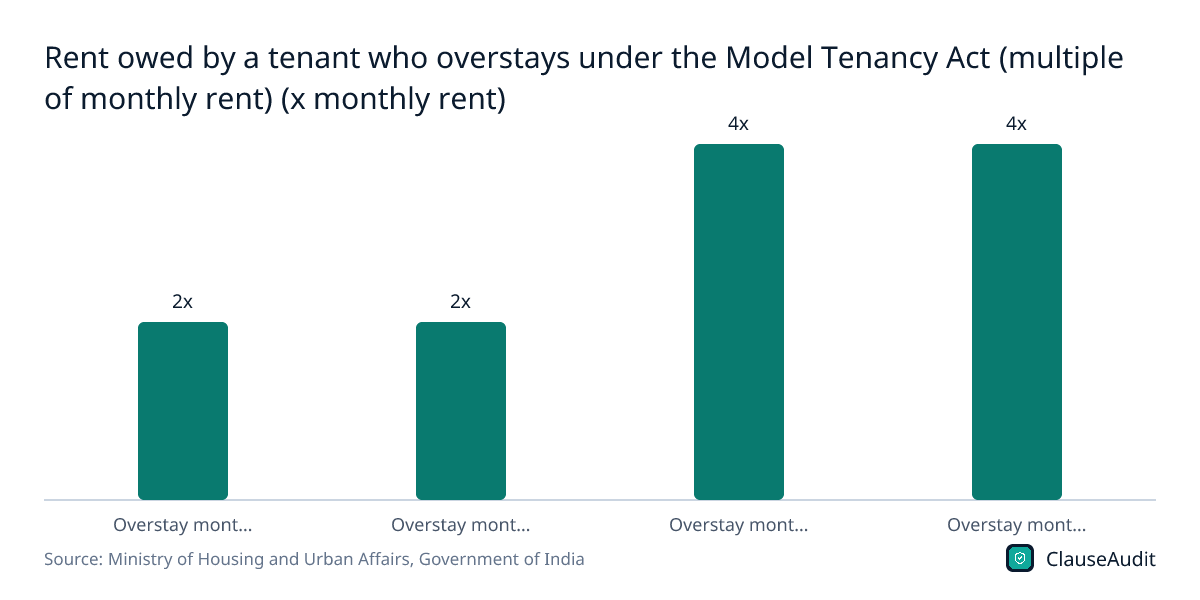
Download this chart (PNG)Rent owed by a tenant who overstays under the Model Tenancy Act (multiple of monthly rent) (x monthly rent)
Chart data
| Label | Value (x monthly rent) |
|---|---|
| Overstay month 1 | 2x |
| Overstay month 2 | 2x |
| Overstay month 3 | 4x |
| Overstay month 4 onward | 4x |
A tenant who stays past the end of the tenancy pays 2x the monthly rent for the first two months and 4x after that. This is the model's strongest push to get people to leave on time.
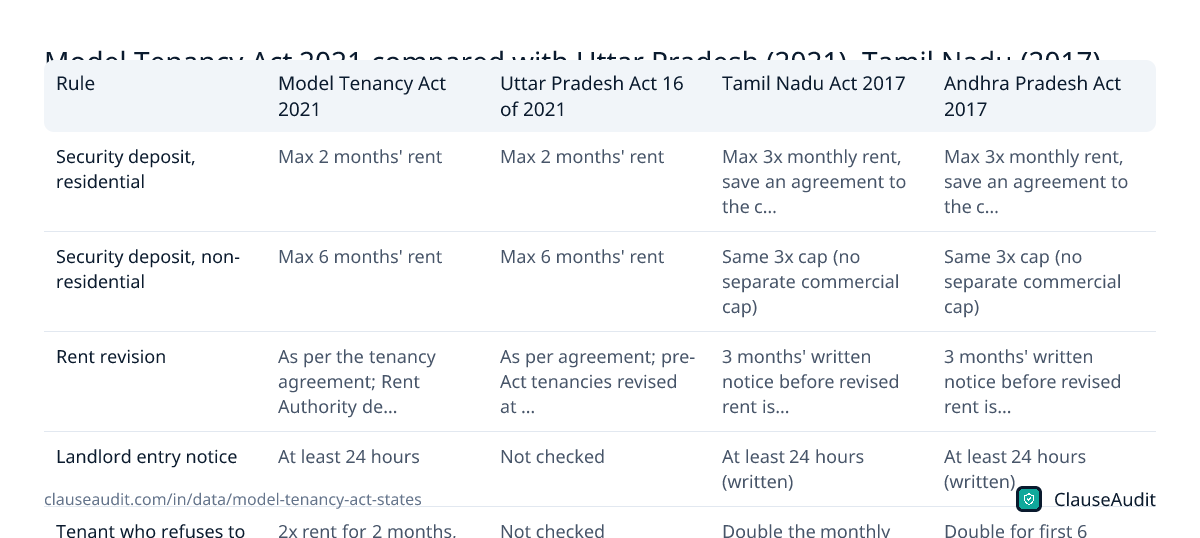
Download this chart (PNG)Model Tenancy Act 2021 compared with Uttar Pradesh (2021), Tamil Nadu (2017) and Andhra Pradesh (2017) tenancy laws
| Rule | Model Tenancy Act 2021 | Uttar Pradesh Act 16 of 2021 | Tamil Nadu Act 2017 | Andhra Pradesh Act 2017 |
|---|---|---|---|---|
| Security deposit, residential | Max 2 months' rent | Max 2 months' rent | Max 3x monthly rent, save an agreement to the contrary | Max 3x monthly rent, save an agreement to the contrary |
| Security deposit, non-residential | Max 6 months' rent | Max 6 months' rent | Same 3x cap (no separate commercial cap) | Same 3x cap (no separate commercial cap) |
| Rent revision | As per the tenancy agreement; Rent Authority decides disputes | As per agreement; pre-Act tenancies revised at 5% a year (residential) or 7% (non-residential), compounded | 3 months' written notice before revised rent is due, unless agreed otherwise | 3 months' written notice before revised rent is due, unless agreed otherwise |
| Landlord entry notice | At least 24 hours | Not checked | At least 24 hours (written) | At least 24 hours (written) |
| Tenant who refuses to vacate | 2x rent for 2 months, then 4x | Not checked | Double the monthly rent | Double for first 6 months, then 3x |
| Rent Court deadline, main eviction grounds | 90 days | Not checked | 90 days | 90 days |
Source: Ministry of Housing and Urban Affairs, Government of India, The Model Tenancy Act, 2021 (English text, as approved by the Union Cabinet); Government of Uttar Pradesh (gazette copy hosted by PRS Legislative Research), The Uttar Pradesh Regulation of Urban Premises Tenancy Act, 2021 (U.P. Act No. 16 of 2021), Uttar Pradesh Extraordinary Gazette; Government of Tamil Nadu (copy hosted by PRS Legislative Research), The Tamil Nadu Regulation of Rights and Responsibilities of Landlords and Tenants Act, 2017 (L.A. Bill No. 38 of 2017 as published in the Tamil Nadu Government Gazette Extraordinary); Government of Andhra Pradesh (text hosted by FAO FAOLEX), Andhra Pradesh Residential and Non-Residential Premises Tenancy Act, 2017 (Act No. 10 of 2018). Download as image
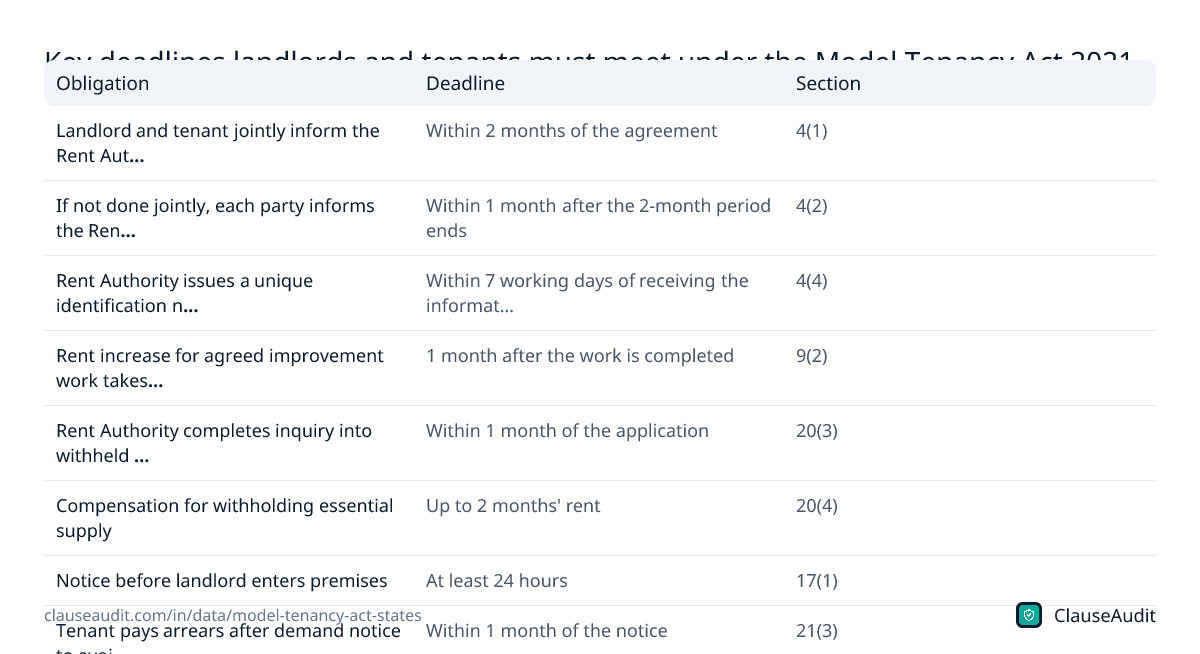
Key deadlines landlords and tenants must meet under the Model Tenancy Act 2021
| Obligation | Deadline | Section |
|---|---|---|
| Landlord and tenant jointly inform the Rent Authority of a written tenancy agreement | Within 2 months of the agreement | 4(1) |
| If not done jointly, each party informs the Rent Authority separately | Within 1 month after the 2-month period ends | 4(2) |
| Rent Authority issues a unique identification number and uploads agreement details | Within 7 working days of receiving the information | 4(4) |
| Rent increase for agreed improvement work takes effect | 1 month after the work is completed | 9(2) |
| Rent Authority completes inquiry into withheld essential supplies | Within 1 month of the application | 20(3) |
| Compensation for withholding essential supply | Up to 2 months' rent | 20(4) |
| Notice before landlord enters premises | At least 24 hours | 17(1) |
| Tenant pays arrears after demand notice to avoid eviction for non-payment | Within 1 month of the notice | 21(3) |
Source: Ministry of Housing and Urban Affairs, Government of India, The Model Tenancy Act, 2021 (English text, as approved by the Union Cabinet). Download as image
Tenancy law on the lines of the Model Tenancy Act, by deposit cap by State
- 9MTA 2021 model: 2 months (residential) / 6 months (commercial) deposit cap
- 2Earlier draft-based law: 3x monthly rent deposit cap
| State | Law | Residential deposit cap | Non-residential deposit cap | Enacted / promulgated | Source |
|---|---|---|---|---|---|
| Andaman and Nicobar Islands | Andaman and Nicobar Islands Tenancy Regulation, 2023 (No. 2 of 2023) | 2 months' rent | 6 months' rent | 24 Nov 2023 (President's Regulation, Art. 240) | Section 11(1), Andaman and Nicobar Islands Tenancy Regulation, 2023 |
| Andhra Pradesh | Andhra Pradesh Residential and Non-Residential Premises Tenancy Act, 2017 (Act No. 10 of 2018) | 3x monthly rent, save an agreement to the contrary | 3x monthly rent, save an agreement to the contrary | Act No. 10 of 2018 | Section 11(1), Andhra Pradesh Residential and Non-Residential Premises Tenancy Act, 2017 |
| Arunachal Pradesh | Arunachal Pradesh Tenancy Act, 2022 (Act No. 17 of 2022) | 2 months' rent | 6 months' rent | Assent 3 Nov 2022 | Section 11(1), Arunachal Pradesh Tenancy Act, 2022 |
| Assam | Assam Tenancy Act, 2021 (Assam Act No. XXXI of 2021) | 2 months' rent | 6 months' rent | Assent 23 Sep 2021 | Section 11(1), Assam Tenancy Act, 2021 |
| Chandigarh | Assam Tenancy Act, 2021 as extended to the UT of Chandigarh | 2 months' rent (Assam Act s.11) | 6 months' rent (Assam Act s.11) | Extended by the Centre on 6 May 2026; UT Tenancy Rules, 2026 notified Sep 2026 | Assam Tenancy Act, 2021 as extended under s.87, Punjab Reorganisation Act, 1966 |
| Dadra and Nagar Haveli and Daman and Diu | Dadra and Nagar Haveli and Daman and Diu Tenancy Regulation, 2023 (No. 3 of 2023) | 2 months' rent | 6 months' rent | 24 Nov 2023 (President's Regulation, Art. 240) | Section 11(1), Dadra and Nagar Haveli and Daman and Diu Tenancy Regulation, 2023 |
| Jammu and Kashmir | Jammu and Kashmir Tenancy Act, 2025 (Act No. IV of 2025) | 2 months' rent | 6 months' rent | Assent 1 Nov 2025 | Section 11(1), Jammu and Kashmir Tenancy Act, 2025 |
| Lakshadweep | Lakshadweep Tenancy Regulation, 2023 (No. 4 of 2023) | 2 months' rent | 6 months' rent | 24 Nov 2023 (President's Regulation, Art. 240) | Section 11(1), Lakshadweep Tenancy Regulation, 2023 |
| Tamil Nadu | Tamil Nadu Regulation of Rights and Responsibilities of Landlords and Tenants Act, 2017 (Act 42 of 2017) | 3x monthly rent, save an agreement to the contrary | 3x monthly rent, save an agreement to the contrary | 2017 (Act 42 of 2017) | Section 11(1), Tamil Nadu Regulation of Rights and Responsibilities of Landlords and Tenants Act, 2017 |
| Uttar Pradesh | Uttar Pradesh Regulation of Urban Premises Tenancy Act, 2021 (U.P. Act No. 16 of 2021) | 2 months' rent | 6 months' rent | Assent 24 Aug 2021; in force from 11 Jan 2021 | Section 11(1), Uttar Pradesh Regulation of Urban Premises Tenancy Act, 2021 |
| Uttarakhand | Uttarakhand Tenancy Act, 2021 (Act No. 02 of 2022) | 2 months' rent | 6 months' rent | Act No. 02 of 2022 | Section 11(1), Uttarakhand Tenancy Act, 2021 |
Which states have adopted the Model Tenancy Act?
The newer group follows the 2021 model closely: Uttar Pradesh, Assam, Uttarakhand and Arunachal Pradesh, plus the UTs of Jammu and Kashmir, Andaman and Nicobar Islands, Dadra and Nagar Haveli and Daman and Diu, and Lakshadweep. Chandigarh now applies the Assam Tenancy Act, which the Centre extended to it in May 2026.
Tamil Nadu and Andhra Pradesh sit in a separate group. NITI Aayog lists them alongside the others, but their laws came out of an earlier draft and were passed in 2017 and 2018, before the final model existed.
Two cautions. First, a law on paper is not always in force. The three UT regulations from 2023 and the Uttarakhand Act each start on a date the government notifies, so check that date before you quote the law to anyone. Second, large rental markets such as Maharashtra, Karnataka and Delhi are not on the list. If you rent there, your State's existing rent law and the words in your agreement still decide most disputes.
How much security deposit can a landlord take under the Model Tenancy Act?
For a home, the model caps the deposit at 2 months' rent. For non-residential premises such as a shop, clinic or office, the cap is 6 months' rent. Every State and UT law based on the 2021 model keeps both numbers unchanged.
This matters most in cities where landlords are used to asking for much more. If you live in a State that has adopted the model and the agreement asks for a larger deposit, you have a statutory cap to point to. Ask for the excess to be cut, and get that change in writing.
Tamil Nadu and Andhra Pradesh are different. Their cap is 3x the monthly rent for any premises, but it applies "save an agreement to the contrary". In plain terms, if you sign an agreement that sets a higher deposit, the cap does not save you. Read the deposit clause there before you pay, not after.
Business tenants should also look past the headline number. A 6-month cap still leaves a lot of cash sitting with the landlord, so the refund clause matters just as much: when the money comes back, what can be deducted, and who decides.
What does the Rent Authority do, and do you need to register your agreement?
The model sets up a three-tier system: a Rent Authority, a Rent Court and a Rent Tribunal. The Rent Authority is the front desk. Under section 4, landlord and tenant must jointly inform it of their written agreement within 2 months. If they do not, each side can inform it separately within 1 month after that.
The Authority then has 7 working days to issue a unique identification number and upload the agreement details. That number is useful. If a dispute starts later, a recorded agreement is far easier to enforce than an unsigned email thread or a verbal promise.
The practical point for you: do not leave this to the landlord. Agree in the contract who files, by when, and who keeps the receipt.
How fast are eviction and rent disputes decided?
The model asks Rent Courts and Rent Tribunals to dispose of a case within 60 days. The main eviction grounds, including unpaid rent, carry a 90-day deadline, and unauthorised subletting or misuse of the premises gets 30 days. Either side has 30 days to appeal a Rent Court order to the Rent Tribunal.
For tenants behind on rent there is a clear escape hatch. Under section 21(3), if you pay the arrears within 1 month of the landlord's demand notice, you avoid eviction on that ground.
Landlords get protection too. A tenant who refuses to leave after the tenancy ends owes 2x the monthly rent for the first two months and 4x after that. Andhra Pradesh's version is milder, at double the rent for the first six months and 3x after.
Day-to-day rules cut both ways as well. A landlord must give at least 24 hours' written or electronic notice before entering. A landlord who cuts off water or electricity faces an inquiry that should finish within 1 month and can be ordered to pay compensation of up to 2 months' rent.
What this means if you rent for work
Say you are a freelance designer renting a flat in Lucknow and working from the second bedroom. Uttar Pradesh's Act applies to listed urban areas, so the 2 months' residential deposit cap likely covers you. But check whether your agreement calls the flat residential. Running client meetings from home can give a landlord an argument about misuse, and under the model law misuse cases are on the fastest clock, 30 days.
Now say you run a small bakery in Guwahati. The Assam Act lets the landlord ask for up to 6 months' rent as deposit. Under the model law, rent revision follows the agreement and the Rent Authority settles disputes about it. If your agreement says nothing about how rent rises, expect a fight at renewal.
Older tenancies in Uttar Pradesh have their own rule. Where no agreement covers it, rent on a pre-Act tenancy rises by 5% a year for homes and 7% for non-residential premises, compounded. In Tamil Nadu and Andhra Pradesh, the landlord must give 3 months' written notice before a revised rent is due, unless the agreement says otherwise.
What to do before you sign
- Find out which law covers your premises, and whether it is actually in force yet.
- Compare the deposit with the cap: 2 months' rent for a home or 6 months' rent for commercial space under the newer laws.
- In Tamil Nadu or Andhra Pradesh, remember that the agreement can override the 3x cap, so negotiate the number itself.
- Make sure the agreement says how and when rent can be revised.
- Agree in writing who will inform the Rent Authority and keep the unique identification number.
- Check the overstay, entry and repairs clauses against the statute, not just against what the landlord says is standard.
How ClauseAudit helps
A tenancy law only protects you if your agreement does not quietly sign the protection away, and in Tamil Nadu and Andhra Pradesh it can. Upload your rent or lease agreement and the automated review flags clauses that sit outside your State's rules or leave you exposed.
You get each clause explained in plain English, a risk rating and a suggested change you can take back to the landlord.
- Security deposit amount against the cap for your State, and the refund timeline and deductions
- Rent revision clause: how often, by how much, and with what notice
- Landlord entry rights and whether they meet the 24-hour notice rule
- Overstay, lock-in and notice period terms that could cost you extra rent
- Repairs, maintenance and essential supply obligations on each side
- Who registers the agreement with the Rent Authority, and by when
Frequently asked questions
Is the Model Tenancy Act law across India?
No. It is a model law that the Union Cabinet approved on 2 June 2021 for States and UTs to adopt. It binds tenants and landlords only where a State or UT has passed its own version. Where that has not happened, the older State rent law and your written agreement still govern.
Which states follow the Model Tenancy Act?
NITI Aayog counted 6 States and 4 UTs as of December 2025: Andhra Pradesh, Tamil Nadu, Uttar Pradesh, Uttarakhand, Assam and Arunachal Pradesh, plus Jammu and Kashmir, Andaman and Nicobar Islands, Dadra and Nagar Haveli and Daman and Diu, and Lakshadweep. Chandigarh adopted the Assam Act in May 2026.
What is the maximum security deposit under the Model Tenancy Act?
Two months' rent for residential premises and six months' rent for non-residential premises, under section 11. The newer State and UT laws copy these caps. Tamil Nadu and Andhra Pradesh use a single 3x monthly rent cap, but parties there can agree to a different amount in the agreement.
Can my landlord enter the house without telling me?
Under the model law, no. The landlord must give at least 24 hours' notice, in writing or electronically, before entering the premises. Tamil Nadu and Andhra Pradesh have the same 24-hour written notice rule. Check whether your State has adopted the law, and whether your agreement repeats or weakens this right.
What happens if a tenant does not vacate after the agreement ends?
Under section 23 of the model, the tenant owes 2x the monthly rent for the first two months of overstay and 4x after that. Andhra Pradesh sets double the rent for the first six months and 3x after. Tamil Nadu's text sets double the monthly rent.
Do I have to register my rent agreement with the Rent Authority?
Under the model, landlord and tenant must jointly inform the Rent Authority of a written agreement within 2 months. If that does not happen, each can inform it separately within 1 month after that period. The Authority issues a unique identification number within 7 working days.
How long does a Rent Court take to decide a case?
The model sets a general target of 60 days. Most eviction grounds, including non-payment, must be decided within 90 days, and subletting or misuse cases within 30 days. These are statutory targets. State versions can differ, and real timelines depend on how many cases each Rent Court has.
Can a landlord evict me for unpaid rent straight away?
Not under the model. After the landlord serves a demand notice, you have 1 month to pay the arrears. If you pay within that time, the landlord cannot evict you on the ground of non-payment. Keep proof of every payment, ideally by bank transfer.
Use this data
Every chart and card below is free to reuse under CC BY 4.0. Download what you need and link back to this page.
 Stat cards
 Key findings card
 Infographic
 Residential security deposit cap by State/UT tenancy law (months of rent)
 Non-residential (commercial) security deposit cap by State/UT tenancy law (months of rent)
 Model Tenancy Act deadlines for Rent Courts and Rent Tribunals (days)
 MTA-style State/UT tenancy laws enacted or extended, by year
 Rent owed by a tenant who overstays under the Model Tenancy Act (multiple of monthly rent) (x monthly rent)
 Model Tenancy Act 2021 compared with Uttar Pradesh (2021), Tamil Nadu (2017) and Andhra Pradesh (2017) tenancy laws
 Key deadlines landlords and tenants must meet under the Model Tenancy Act 2021
Embed the infographic
Free to share on your site, blog or slides under CC BY 4.0. Please keep the credit link.
Sources and method
Every number on this page comes from the sources below, each opened and read on or before October 18, 2026. A second, independent review checked every figure against its source and corrected anything that did not match. 11 of 11 State entries were confirmed; any that could not be are marked "Not yet confirmed" and left out of every count and chart.
- Ministry of Housing and Urban Affairs, Government of India, The Model Tenancy Act, 2021 (English text, as approved by the Union Cabinet) (2 June 2021 (archived copy of the MoHUA PDF; original mohua.gov.in link now returns 404))
- Press Information Bureau, Ministry of Housing & Urban Affairs, Cabinet approves Model Tenancy Act for circulation to the States/Union Territories for adoption (2 June 2021)
- Press Information Bureau, Ministry of Housing & Urban Affairs, Model Tenancy Act aims to balance rights of tenants & landlords (Rajya Sabha written reply) (25 July 2022)
- NITI Aayog, Government of India, A Comprehensive Framework to Promote Affordable Housing (December 2025)
- Government of Uttar Pradesh (gazette copy hosted by PRS Legislative Research), The Uttar Pradesh Regulation of Urban Premises Tenancy Act, 2021 (U.P. Act No. 16 of 2021), Uttar Pradesh Extraordinary Gazette (24 August 2021)
- Government of Assam (gazette copy hosted by FAO FAOLEX), The Assam Tenancy Act, 2021 (Assam Act No. XXXI of 2021), Assam Gazette Extraordinary No. 459 (1 October 2021 (assent 23 September 2021))
- Government of Tamil Nadu (copy hosted by PRS Legislative Research), The Tamil Nadu Regulation of Rights and Responsibilities of Landlords and Tenants Act, 2017 (L.A. Bill No. 38 of 2017 as published in the Tamil Nadu Government Gazette Extraordinary) (Bill introduced 14 July 2017; enacted as Tamil Nadu Act 42 of 2017)
- Government of Andhra Pradesh (text hosted by FAO FAOLEX), Andhra Pradesh Residential and Non-Residential Premises Tenancy Act, 2017 (Act No. 10 of 2018) (Act No. 10 of 2018 (copy printed 13 March 2020))
- Government of Uttarakhand (copy hosted by PRS Legislative Research), The Uttarakhand Tenancy Act, 2021 (Act No. 02 of 2022) (Act No. 02 of 2022)
- Government of Arunachal Pradesh (gazette copy hosted by PRS Legislative Research), The Arunachal Pradesh Tenancy Act, 2022 (Act No. 17 of 2022) (14 November 2022 (assent 3 November 2022))
- Government of Jammu and Kashmir, Department of Law, Justice and Parliamentary Affairs (gazette copy hosted by PRS Legislative Research), The Jammu and Kashmir Tenancy Act, 2025 (Act No. IV of 2025) (1 November 2025)
- Ministry of Law and Justice (Legislative Department), Government of India, The Andaman and Nicobar Islands Tenancy Regulation, 2023 (No. 2 of 2023), Gazette of India Extraordinary Part II Section 1 (24 November 2023)
- Ministry of Law and Justice (Legislative Department), Government of India, The Dadra and Nagar Haveli and Daman and Diu Tenancy Regulation, 2023 (No. 3 of 2023), Gazette of India Extraordinary Part II Section 1 (24 November 2023)
- Ministry of Law and Justice (Legislative Department), Government of India, The Lakshadweep Tenancy Regulation, 2023 (No. 4 of 2023), Gazette of India Extraordinary Part II Section 1 (24 November 2023)
- ThePrint / Press Trust of India, Chandigarh tenants, landlords to get UIN as UT notifies new tenancy rules (PTI) (10 September 2026)
Cite this page
ClauseAudit, “Model Tenancy Act Adoption by State: Deposit Caps, Rent Authority and Eviction Rules Across India”, updated October 18, 2026, https://clauseaudit.com/in/data/model-tenancy-act-states. Free to reuse with a link back (CC BY 4.0).
This page summarises published data and law as checked on October 18, 2026. Figures are updated as new editions are released, and your own situation may differ. It is general information, not legal, tax or financial advice.