DPDP Act Penalties: Fines Under India's Data Protection Law (Table)
By ClauseAudit Research · 2 sources ·
What is the penalty under India's DPDP Act?
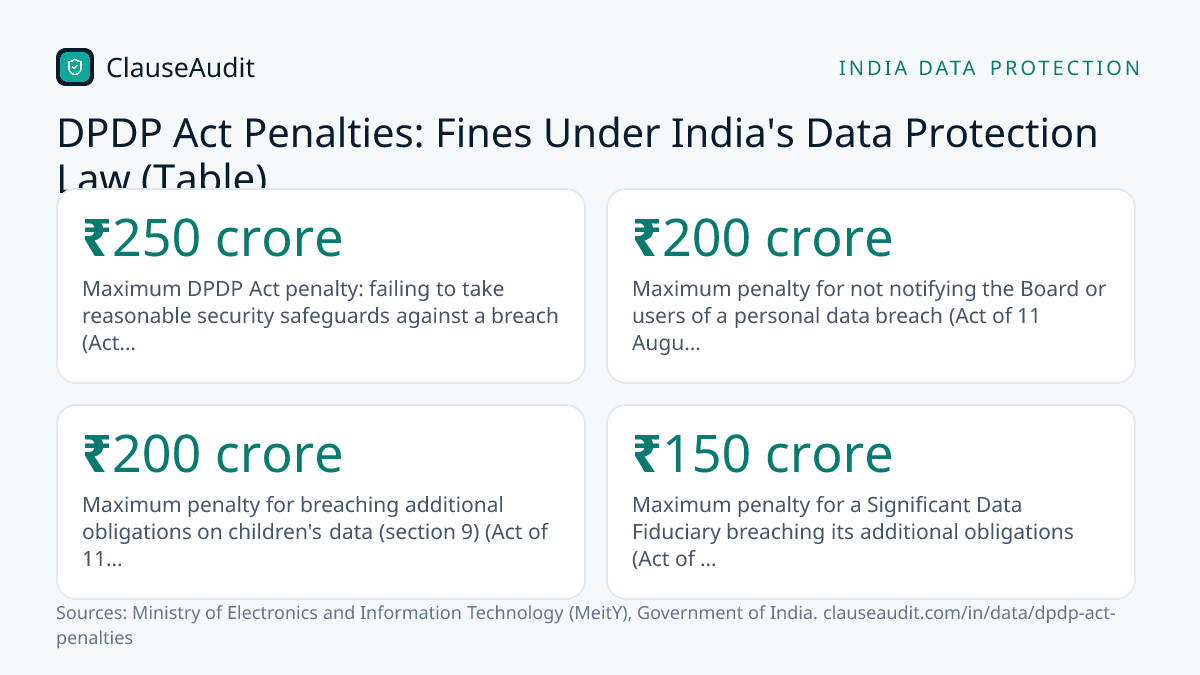
The biggest DPDP Act penalty is up to ₹250 crore, for failing to take reasonable security safeguards against a personal data breach. Missing a breach notice or breaking the children's data rules can cost up to ₹200 crore each. The Data Protection Board sets the actual amount, and these are caps, not fixed fines.

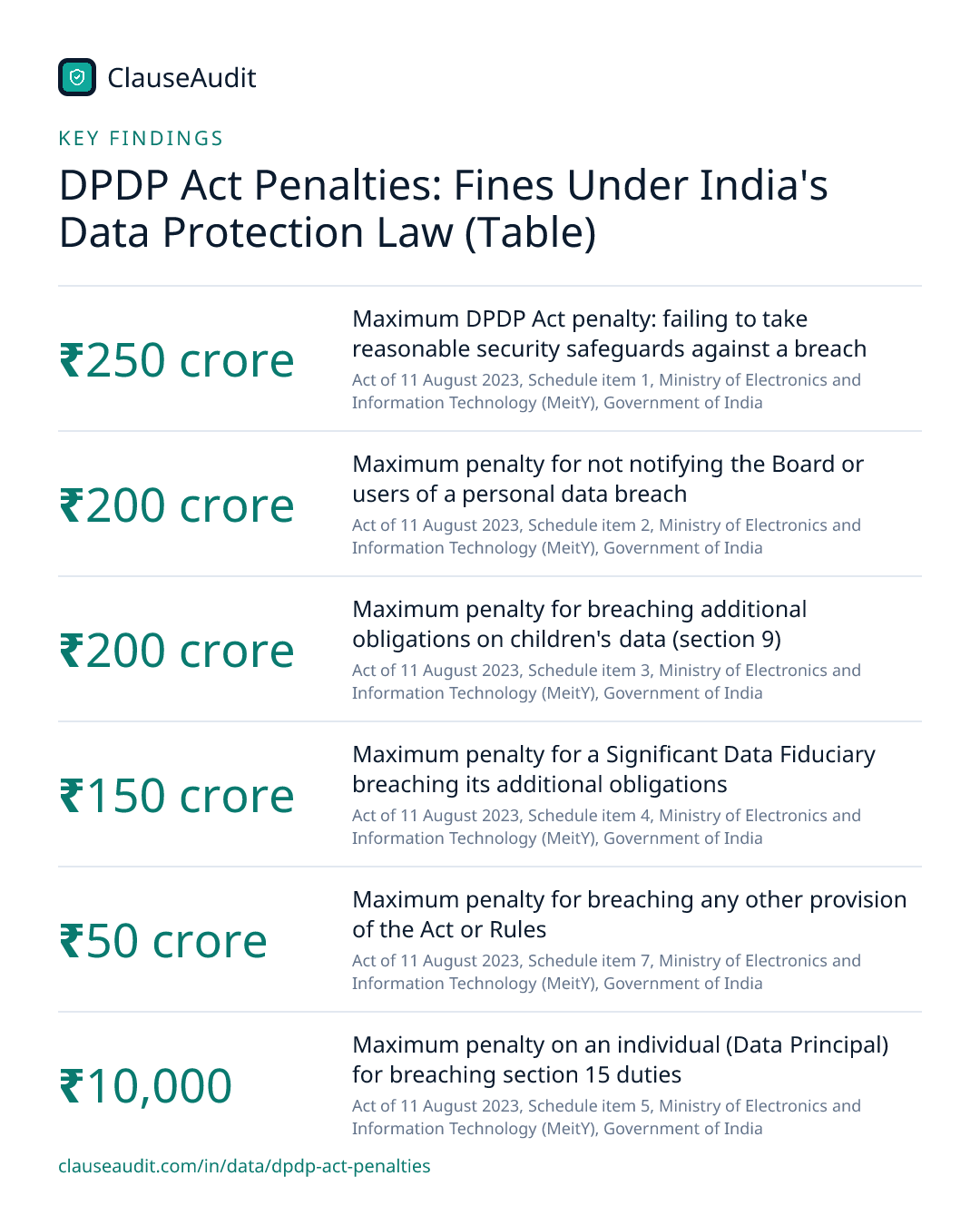
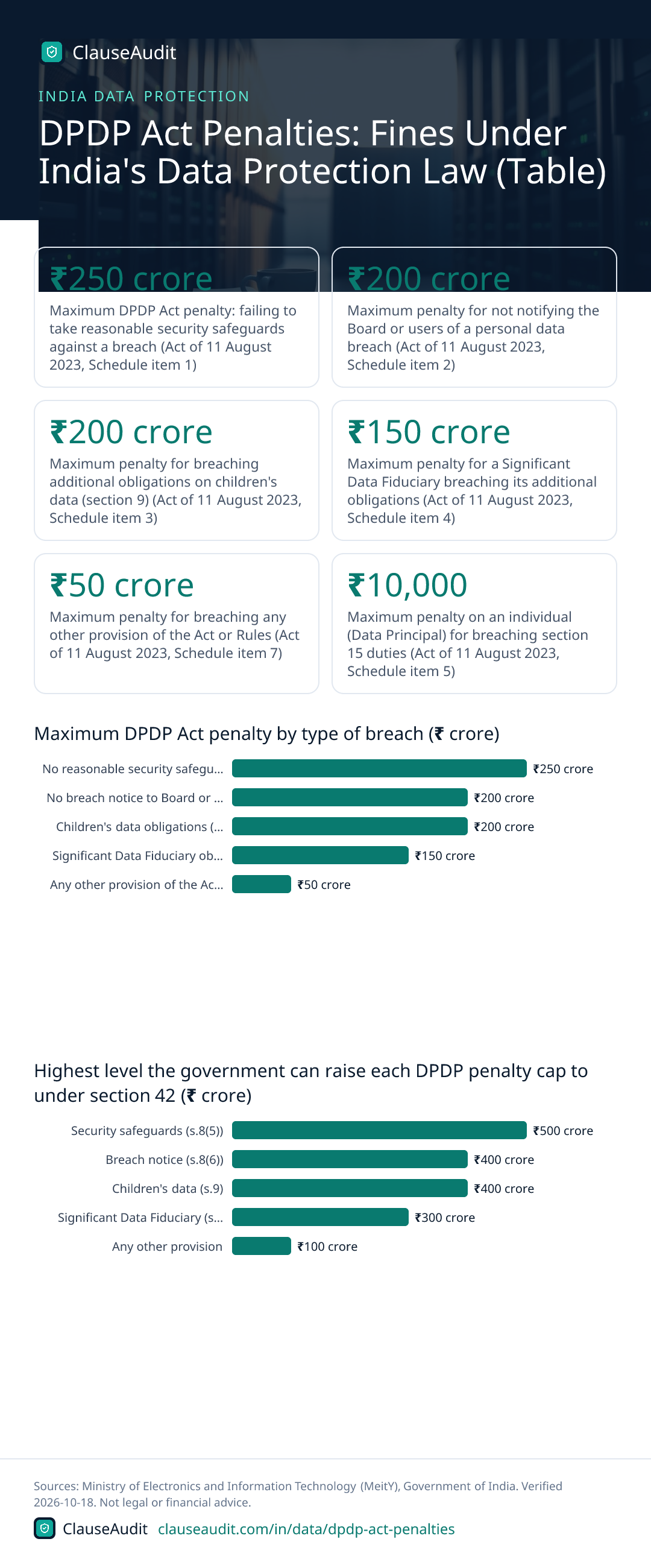
- Maximum DPDP Act penalty: failing to take reasonable security safeguards against a breach (Act of 11 August 2023, Schedule item 1, Ministry of Electronics and Information Technology (MeitY), Government of India)
- ₹250 crore
- Maximum penalty for not notifying the Board or users of a personal data breach (Act of 11 August 2023, Schedule item 2, Ministry of Electronics and Information Technology (MeitY), Government of India)
- ₹200 crore
- Maximum penalty for breaching additional obligations on children's data (section 9) (Act of 11 August 2023, Schedule item 3, Ministry of Electronics and Information Technology (MeitY), Government of India)
- ₹200 crore
- Maximum penalty for a Significant Data Fiduciary breaching its additional obligations (Act of 11 August 2023, Schedule item 4, Ministry of Electronics and Information Technology (MeitY), Government of India)
- ₹150 crore
- Maximum penalty for breaching any other provision of the Act or Rules (Act of 11 August 2023, Schedule item 7, Ministry of Electronics and Information Technology (MeitY), Government of India)
- ₹50 crore
- Maximum penalty on an individual (Data Principal) for breaching section 15 duties (Act of 11 August 2023, Schedule item 5, Ministry of Electronics and Information Technology (MeitY), Government of India)
- ₹10,000
- Deadline to give the Board a detailed personal data breach report (DPDP Rules 2025, rule 7(2)(b), Ministry of Electronics and Information Technology (MeitY), Government of India)
- 72 hours
- Time after notification before most DPDP Rules obligations take effect (Rules published 13 November 2025, Ministry of Electronics and Information Technology (MeitY), Government of India)
- 18 months
India's Digital Personal Data Protection Act, 2023 doesn't set fixed fines. It sets ceilings. The Schedule lists what each kind of failure can cost, from ₹10,000 for an individual who files a false complaint up to ₹250 crore for a business that leaves personal data poorly protected.
Most of the operational rules sit in the DPDP Rules 2025, published on 13 November 2025, and the bulk of them bite 18 months later, in May 2027. That gap is your window to fix contracts, vendor terms and breach plans before the Board can start penalising failures under them.
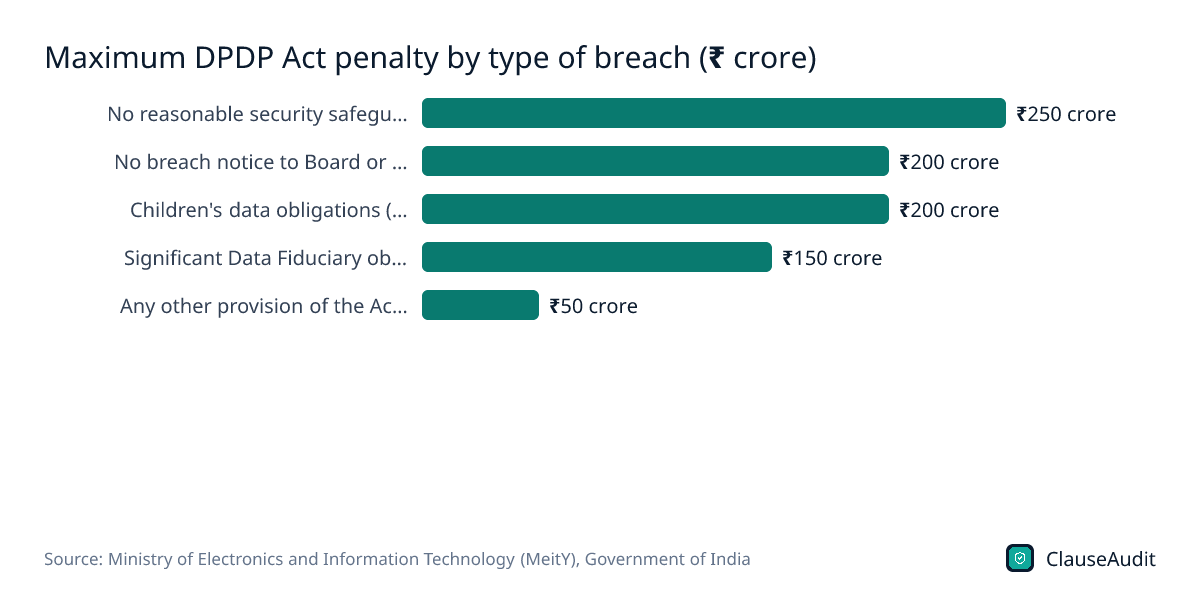
Maximum DPDP Act penalty by type of breach (₹ crore)
Chart data
| Label | Value |
|---|---|
| No reasonable security safeguards (s.8(5)) | ₹250 crore |
| No breach notice to Board or users (s.8(6)) | ₹200 crore |
| Children's data obligations (s.9) | ₹200 crore |
| Significant Data Fiduciary obligations (s.10) | ₹150 crore |
| Any other provision of the Act or Rules | ₹50 crore |
Security and breach response carry the heaviest caps, so the costliest mistake is usually a quiet one: weak safeguards, then a slow or missing notice. The ₹50 crore catch-all covers everything the Schedule doesn't name.
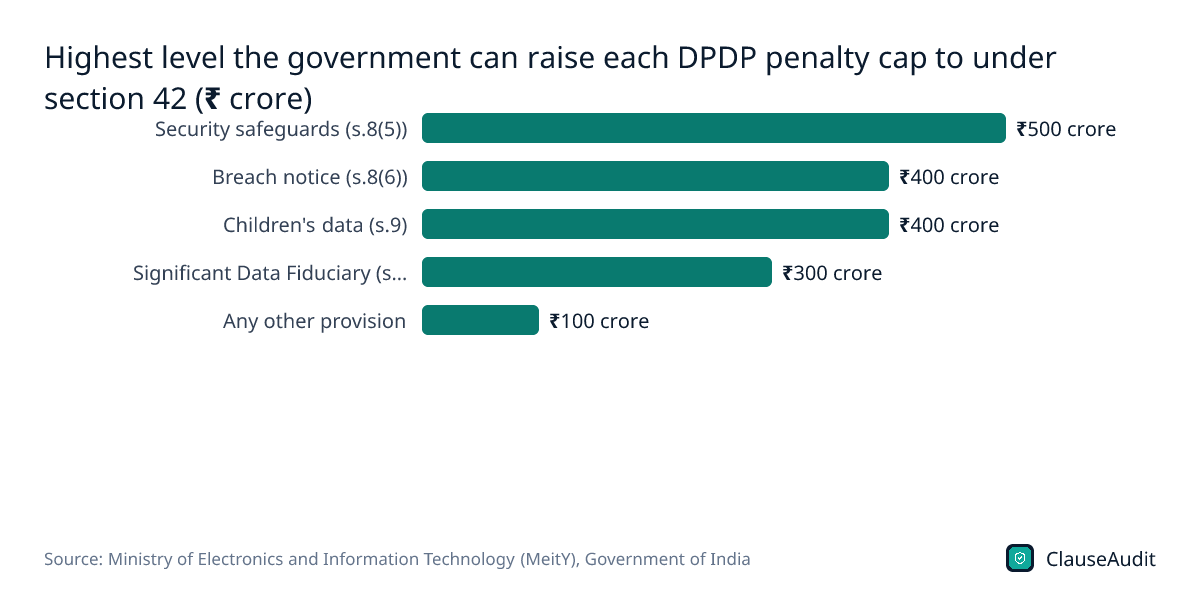
Download this chart (PNG)Highest level the government can raise each DPDP penalty cap to under section 42 (₹ crore)
Chart data
| Label | Value |
|---|---|
| Security safeguards (s.8(5)) | ₹500 crore |
| Breach notice (s.8(6)) | ₹400 crore |
| Children's data (s.9) | ₹400 crore |
| Significant Data Fiduciary (s.10) | ₹300 crore |
| Any other provision | ₹100 crore |
These are not today's fines. They show how far the government could raise each cap by notification, since section 42 stops any increase at twice the original amount.
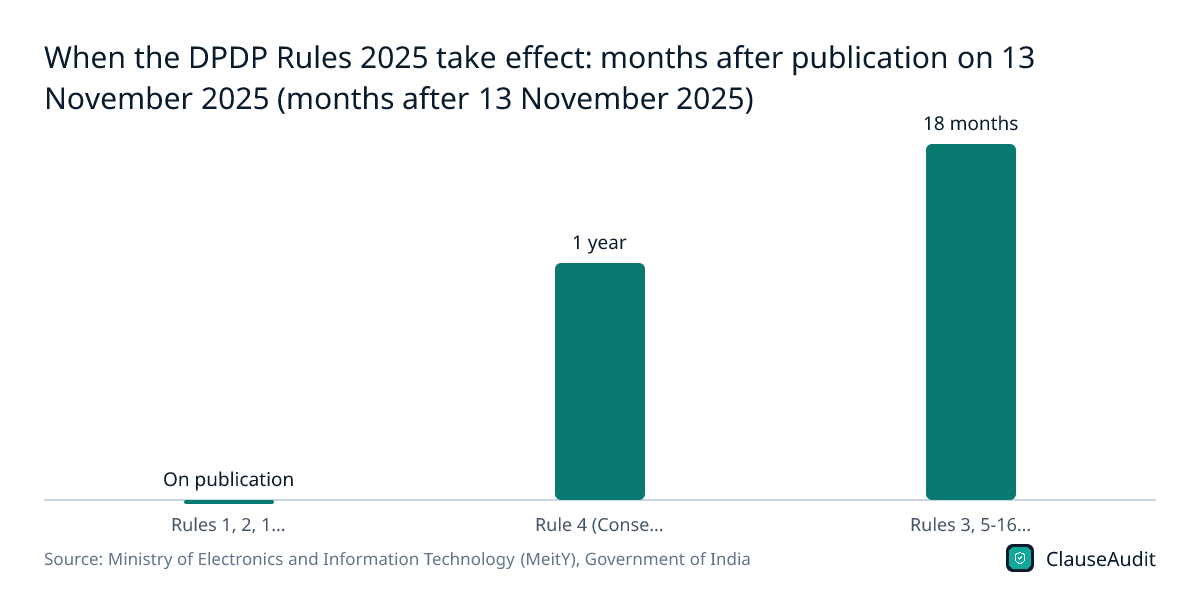
Download this chart (PNG)When the DPDP Rules 2025 take effect: months after publication on 13 November 2025 (months after 13 November 2025)
Chart data
| Label | Value (months after 13 November 2025) |
|---|---|
| Rules 1, 2, 17-21 (Data Protection Board) | On publication |
| Rule 4 (Consent Managers) | 1 year |
| Rules 3, 5-16, 22, 23 (notice, security, breach, children, SDF duties) | 18 months |
The rules setting up the Board applied on publication, so the enforcement machinery is already in place. Most duties a business has to meet, from notices to breach reporting, start in May 2027.
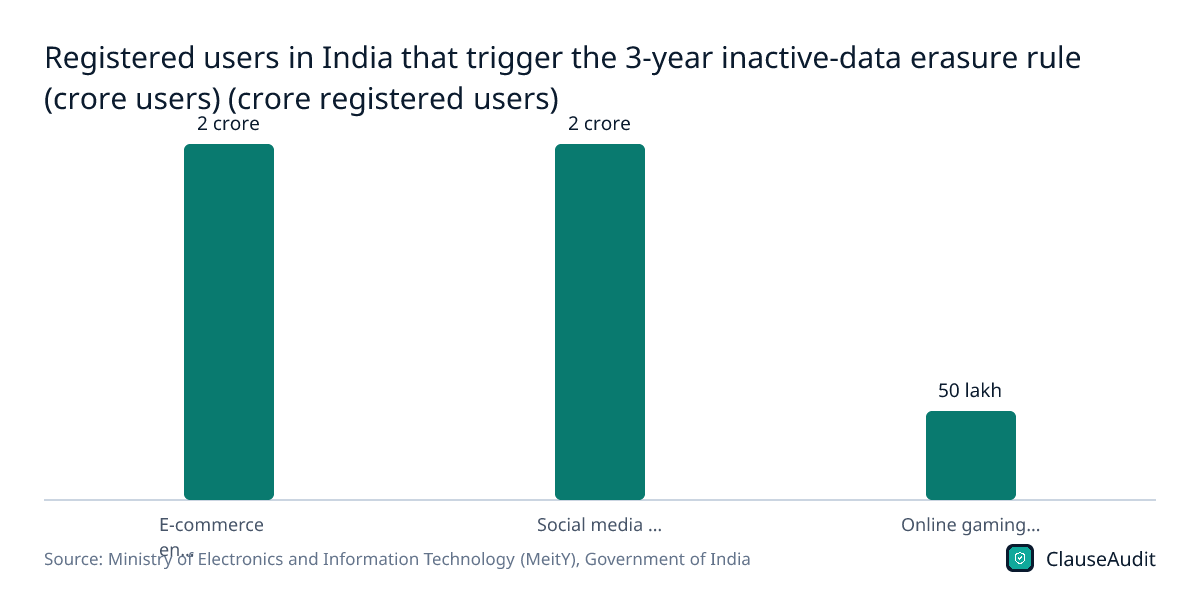
Download this chart (PNG)Registered users in India that trigger the 3-year inactive-data erasure rule (crore users) (crore registered users)
Chart data
| Label | Value (crore registered users) |
|---|---|
| E-commerce entity | 2 crore |
| Social media intermediary | 2 crore |
| Online gaming intermediary | 50 lakh |
Only large e-commerce, social media and gaming platforms face the 3-year inactive-data erasure rule. Gaming platforms hit it at 50 lakh users, far sooner than the other two.
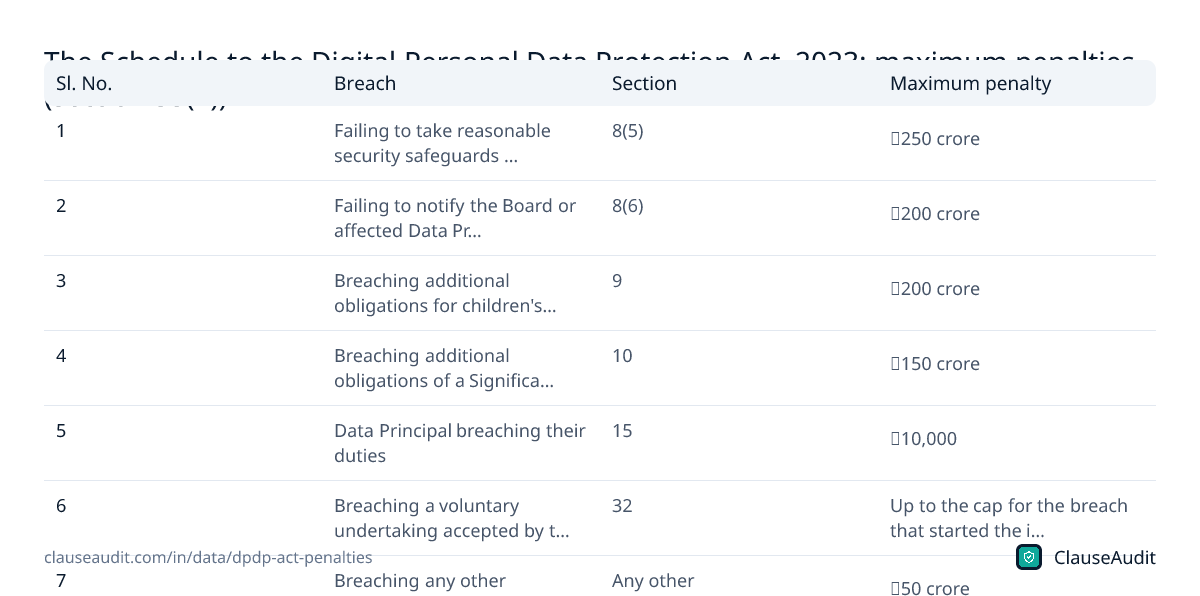
Download this chart (PNG)The Schedule to the Digital Personal Data Protection Act, 2023: maximum penalties (section 33(1))
| Sl. No. | Breach | Section | Maximum penalty |
|---|---|---|---|
| 1 | Failing to take reasonable security safeguards to prevent a personal data breach | 8(5) | ₹250 crore |
| 2 | Failing to notify the Board or affected Data Principals of a personal data breach | 8(6) | ₹200 crore |
| 3 | Breaching additional obligations for children's personal data | 9 | ₹200 crore |
| 4 | Breaching additional obligations of a Significant Data Fiduciary | 10 | ₹150 crore |
| 5 | Data Principal breaching their duties | 15 | ₹10,000 |
| 6 | Breaching a voluntary undertaking accepted by the Board | 32 | Up to the cap for the breach that started the inquiry |
| 7 | Breaching any other provision of the Act or Rules | Any other | ₹50 crore |
Source: Ministry of Electronics and Information Technology (MeitY), Government of India, The Digital Personal Data Protection Act, 2023 (No. 22 of 2023), Gazette of India Extraordinary. Download as image
What the Data Protection Board must consider when setting a penalty (section 33(2))
| Clause | Factor |
|---|---|
| (a) | Nature, gravity and duration of the breach |
| (b) | Type and nature of the personal data affected |
| (c) | Whether the breach is repetitive |
| (d) | Whether the person gained or avoided a loss from the breach |
| (e) | Action taken to mitigate the breach, and how timely and effective it was |
| (f) | Whether the penalty is proportionate and effective as a deterrent |
| (g) | Likely impact of the penalty on the person |
Source: Ministry of Electronics and Information Technology (MeitY), Government of India, The Digital Personal Data Protection Act, 2023 (No. 22 of 2023), Gazette of India Extraordinary. Download as image
Key DPDP deadlines that affect penalty exposure
| Obligation | Deadline | Where it is set |
|---|---|---|
| Detailed breach report to the Data Protection Board | 72 hours after becoming aware (Board may extend on written request) | Rules 2025, rule 7(2)(b) |
| Breach notice to each affected person and initial notice to the Board | Without delay | Rules 2025, rule 7(1) and 7(2)(a) |
| Warning to user before inactive-data erasure | At least 48 hours before erasure | Rules 2025, rule 8(2) |
| Keep processing logs and traffic data | At least 1 year from processing | Rules 2025, rule 8(3) |
| Respond to Data Principal grievances | Within a period not exceeding 90 days | Rules 2025, rule 14(3) |
| Significant Data Fiduciary DPIA and audit | Once every 12 months | Rules 2025, rule 13(1) |
| Appeal a Board order to the Appellate Tribunal (TDSAT) | Within 60 days of receiving the order | Act, section 29(2) |
| Appellate Tribunal to decide the appeal | Endeavour to dispose within 6 months | Act, section 29(6) |
Source: Ministry of Electronics and Information Technology (MeitY), Government of India, The Digital Personal Data Protection Act, 2023 (No. 22 of 2023), Gazette of India Extraordinary; Ministry of Electronics and Information Technology (MeitY), Government of India, Digital Personal Data Protection Rules, 2025 (G.S.R. 846(E)), Gazette of India Extraordinary No. 760. Download as image
Other penalty rules in the DPDP Act, 2023
| Rule | What the Act says | Section |
|---|---|---|
| Threshold for a penalty | The Board imposes a penalty only if, after an inquiry, it finds the breach is significant, and after a hearing | 33(1) |
| Where penalty money goes | Credited to the Consolidated Fund of India (not paid to affected users) | 34 |
| Voluntary undertaking | Accepted undertaking bars proceedings on its contents; breaching it is treated as a breach of the Act | 32 |
| Blocking after repeat penalties | If penalties are imposed on a Data Fiduciary in two or more instances, the Board can advise the government to block public access to its platform | 37(1) |
| Raising the caps | Government may amend the Schedule but not raise any penalty above twice the original amount | 42(1) |
| IT Act compensation route (section 43A) | The Act provides that section 43A of the Information Technology Act, 2000 “shall be omitted”; this takes effect only when section 44(2) is brought into force by government notification (commencement date not confirmed here) | 44(2)(a) |
Source: Ministry of Electronics and Information Technology (MeitY), Government of India, The Digital Personal Data Protection Act, 2023 (No. 22 of 2023), Gazette of India Extraordinary. Download as image
How much is the penalty under the DPDP Act?
It depends on what went wrong. The Act groups failures into seven items and gives each a cap. The top one, ₹250 crore, is for not taking reasonable security safeguards to prevent a personal data breach. Not telling the Board and affected users about a breach can cost up to ₹200 crore. So can breaking the extra rules on children's data.
A Significant Data Fiduciary that ignores its additional duties faces up to ₹150 crore. Anything else in the Act or the Rules, such as a sloppy privacy notice or an ignored grievance, falls into a ₹50 crore bucket.
Notice the pattern. Two of the three biggest caps are about breaches: one for letting it happen through weak security, one for staying quiet afterwards. A single incident can expose you to both.
Will the Data Protection Board actually fine the full amount?
Not automatically. Section 33(2) makes the Board weigh the gravity and duration of the breach, the kind of data involved, whether it keeps happening, whether you gained from it, how fast and how well you contained it, and what the penalty would do to you. The fine has to be proportionate.
The Board also can't fine you on a whim. It has to hold an inquiry, decide the breach is significant, and give you a hearing first. If you disagree with the order, you get 60 days to appeal to the Appellate Tribunal (TDSAT), which aims to decide within 6 months.
Two details matter more than people expect. First, the money goes to the Consolidated Fund of India, not to the people whose data leaked. Second, a business penalised in two or more instances can find the Board advising the government to block public access to its platform. For an app or a SaaS product, that is worse than any fine.
When do the DPDP penalties start applying?
The Act became law on 11 August 2023, but it does very little without its Rules. Those were published on 13 November 2025 and arrive in three stages. The rules setting up the Board applied immediately. The Consent Manager rule follows after one year. Most of the rest, including notices, security safeguards, breach reporting, children's data and Significant Data Fiduciary duties, start 18 months after publication, which lands in May 2027.
Don't read that date as breathing room for contracts you're signing today. A vendor deal or client agreement signed now will probably still be running in May 2027. If it says nothing about breach reporting or data deletion, you'll be renegotiating under pressure later. Put a clause in now that lets either side update the data terms when the Rules take effect, and you avoid that fight.
What the 72-hour breach rule means in practice
Once rule 7 is in force, a breach starts two clocks. You must tell the Board and every affected person without delay, then send the Board a detailed report within 72 hours of becoming aware. The Board can extend that on a written request, but you can't count on it.
Here's where most businesses get caught. If your customer data sits with a hosting provider, a CRM or a payroll vendor, you only learn about a breach when they tell you. If their contract gives them a week, or just says they'll notify you "promptly", your own 72 hours may be gone before you hear anything. The fine for a missed notice, up to ₹200 crore, lands on you as the Data Fiduciary, not on them.
Who carries the risk: fiduciary, processor or platform?
The big caps apply to the Data Fiduciary, the business that decides why and how personal data is used. If you run an online store, the customer list is yours, so the duty to protect it is yours too, even when the data physically sits on someone else's servers.
A processor, such as a cloud host, an email tool or a freelance developer working on your app, acts on your instructions. The Act puts the penalty on you, then leaves you to recover your loss from the processor under your contract. That's why the vendor agreement matters so much. Without a clear indemnity and a sensible liability cap, a breach caused by your vendor can leave you paying the fine with nothing to claim back.
Some businesses face more. A company notified as a Significant Data Fiduciary has extra duties, including a data protection impact assessment and an audit once every 12 months, and breaking them can cost up to ₹150 crore. Any business that processes children's data must meet the section 9 rules, with a ₹200 crore cap behind them.
If you're unsure which role you play in a given deal, assume the client will try to make you the one who pays, and read the contract with that in mind.
What to do now if you run a business, freelance or work with data
- Businesses: list every vendor that touches personal data and check each contract for a breach notice deadline well inside 72 hours, a security standard, and a deletion duty at the end of the deal.
- SaaS founders: expect your enterprise customers to push those same terms onto you. Decide now what notice period and liability you can actually support.
- Freelancers and agencies handling client user data: you are likely a processor, not the fiduciary. Read whether the client is trying to shift its entire DPDP liability onto you through an unlimited indemnity.
- Large platforms: if you run an e-commerce or social media service with at least 2 crore registered users in India, or a gaming platform with at least 50 lakh, plan the 3-year erasure process and the 48-hour warning to users.
- Every Data Fiduciary: keep processing logs for at least 1 year and set up a grievance process that answers within 90 days. Both are duties under the Rules, and both start in May 2027.
- Individuals: you can be fined too, up to ₹10,000, for things like impersonating someone or filing a false or frivolous complaint.
How ClauseAudit helps
DPDP penalties fall on whoever decides why and how personal data is used. But the breach that triggers them often starts with a vendor, and the only thing that makes that vendor act fast is the contract. An automated review of your SaaS or service agreement flags the data clauses that decide how exposed you are.
Upload the agreement and you'll see each risky clause in plain English, with a suggested fix you can send back before you sign.
- Breach notification: whether the vendor must tell you fast enough for you to meet the 72-hour report to the Board
- Security safeguards: whether the contract names real standards or just says "industry standard" measures
- Liability cap: whether a data breach is capped at a small fee amount while your penalty exposure runs into crores
- Indemnity: who pays if the Board penalises you for a failure that happened on the vendor's side
- Data deletion and export on termination: whether your data is returned and erased when the deal ends
- Auto-renewal and term: if the deal locks you in past May 2027 without a right to renegotiate the data terms
Frequently asked questions
What is the maximum penalty under the DPDP Act, 2023?
Up to ₹250 crore, for failing to take reasonable security safeguards to prevent a personal data breach under section 8(5). That is the highest single cap in the Schedule. The Data Protection Board decides the actual figure after an inquiry and a hearing, using the factors in section 33(2).
Is the ₹250 crore penalty per breach or per year?
The Act sets the cap per type of failure found in an inquiry, not as an annual total. One incident can involve several items, for example weak security plus a missed breach notice, each with its own cap. The Board has to keep the overall penalty proportionate, so stacking to the maximum is not automatic.
Can individuals be fined under the DPDP Act?
Yes, but only lightly. A Data Principal who breaches the section 15 duties can be fined up to ₹10,000. Those duties include not impersonating another person and not filing a false or frivolous grievance or complaint with a business or the Board.
Do affected users get compensation from DPDP penalties?
No. Section 34 sends penalty money to the Consolidated Fund of India. The Act also provides for omitting section 43A of the IT Act, the old compensation route, though that change takes effect only when section 44(2) comes into force. If you want money back after a vendor breach, your contract's indemnity clause is what counts.
When does the 72-hour breach reporting rule start?
Rule 7 of the DPDP Rules 2025 is among the rules that take effect 18 months after publication on 13 November 2025, which falls in May 2027. From then on you must notify the Board and affected people without delay and file a detailed report with the Board within 72 hours of becoming aware.
Can the government increase DPDP penalties?
Yes, within a limit. Section 42 lets the Central Government amend the Schedule by notification, but no penalty can go above twice its original amount. So the ₹250 crore cap could rise to at most ₹500 crore, and the ₹50 crore catch-all to at most ₹100 crore.
What happens if a company is penalised more than once?
If the Board has imposed penalties on a Data Fiduciary in two or more instances, it can advise the Central Government to block public access to that business's platform under section 37. For an online business, losing access to Indian users would hurt far more than the fine itself.
Can I appeal a Data Protection Board penalty?
Yes. You can appeal to the Appellate Tribunal, which is TDSAT, within 60 days of receiving the Board's order. The Tribunal is expected to try to decide the appeal within 6 months. Keep records of your safeguards and your breach response, because mitigation is one of the factors the Board weighs.
Use this data
Every chart and card below is free to reuse under CC BY 4.0. Download what you need and link back to this page.
 Stat cards
 Key findings card
 Infographic
 Maximum DPDP Act penalty by type of breach (₹ crore)
 Highest level the government can raise each DPDP penalty cap to under section 42 (₹ crore)
 When the DPDP Rules 2025 take effect: months after publication on 13 November 2025 (months after 13 November 2025)
 Registered users in India that trigger the 3-year inactive-data erasure rule (crore users) (crore registered users)
 The Schedule to the Digital Personal Data Protection Act, 2023: maximum penalties (section 33(1))
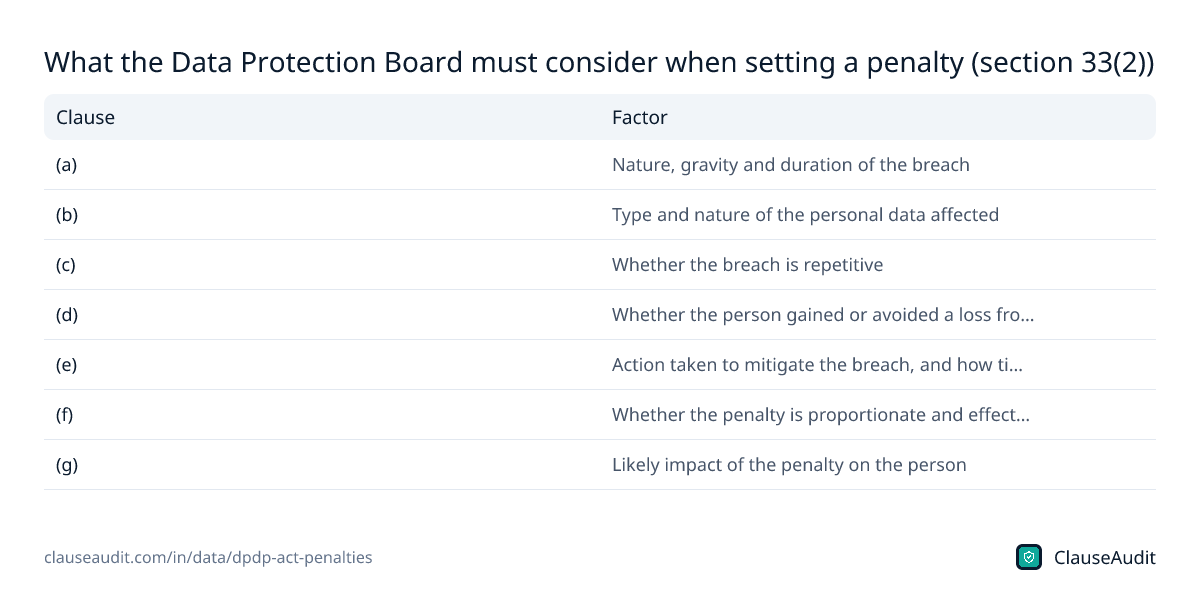 What the Data Protection Board must consider when setting a penalty (section 33(2))
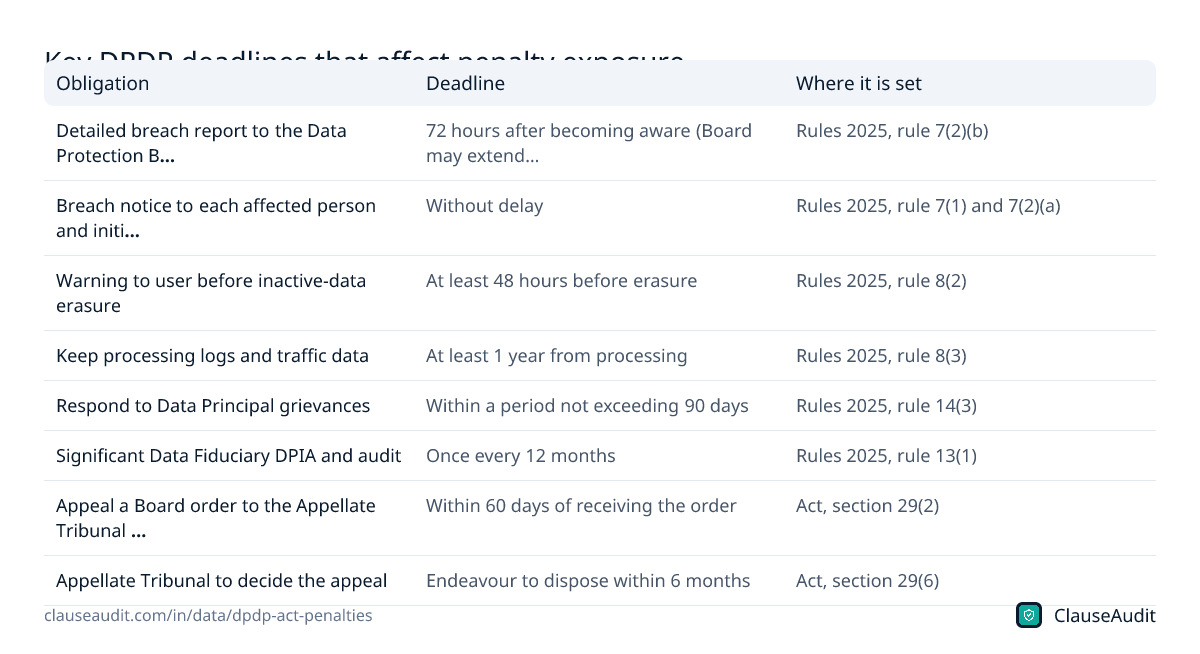 Key DPDP deadlines that affect penalty exposure
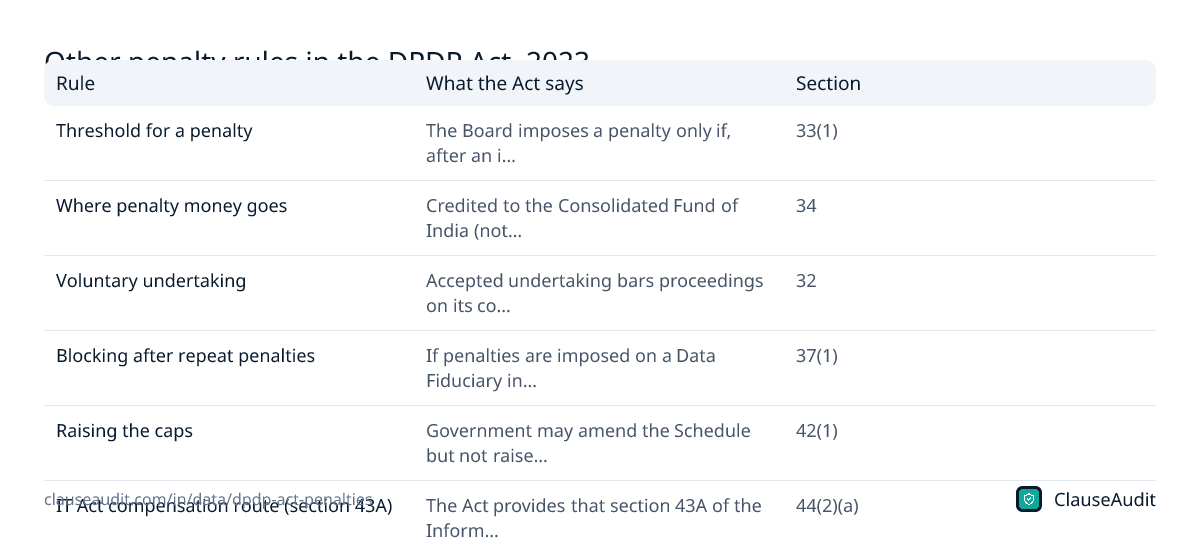 Other penalty rules in the DPDP Act, 2023
Embed the infographic
Free to share on your site, blog or slides under CC BY 4.0. Please keep the credit link.
Sources and method
Every number on this page comes from the sources below, each opened and read on or before October 18, 2026. A second, independent review checked every figure against its source and corrected anything that did not match. Figures that could not be confirmed were left out.
- Ministry of Electronics and Information Technology (MeitY), Government of India, The Digital Personal Data Protection Act, 2023 (No. 22 of 2023), Gazette of India Extraordinary (Assented and published 11 August 2023 (read 18 October 2026))
- Ministry of Electronics and Information Technology (MeitY), Government of India, Digital Personal Data Protection Rules, 2025 (G.S.R. 846(E)), Gazette of India Extraordinary No. 760 (13 November 2025 (read 18 October 2026))
Cite this page
ClauseAudit, “DPDP Act Penalties: Fines Under India's Data Protection Law (Table)”, updated October 18, 2026, https://clauseaudit.com/in/data/dpdp-act-penalties. Free to reuse with a link back (CC BY 4.0).
This page summarises published data and law as checked on October 18, 2026. Figures are updated as new editions are released, and your own situation may differ. It is general information, not legal, tax or financial advice.