Non-Competes in the Sale of a Business: Enforceability by State
By ClauseAudit Research · 30 sources ·
Is a non-compete clause in a sale of business enforceable?
Yes, a seller's non-compete is usually enforceable, and courts give it far more room than an employee's. Florida presumes up to 3 years reasonable. Tennessee and Georgia presume 5 years, or the payout period if longer. Even California, which voids most non-competes, allows one when you sell your business and its goodwill.

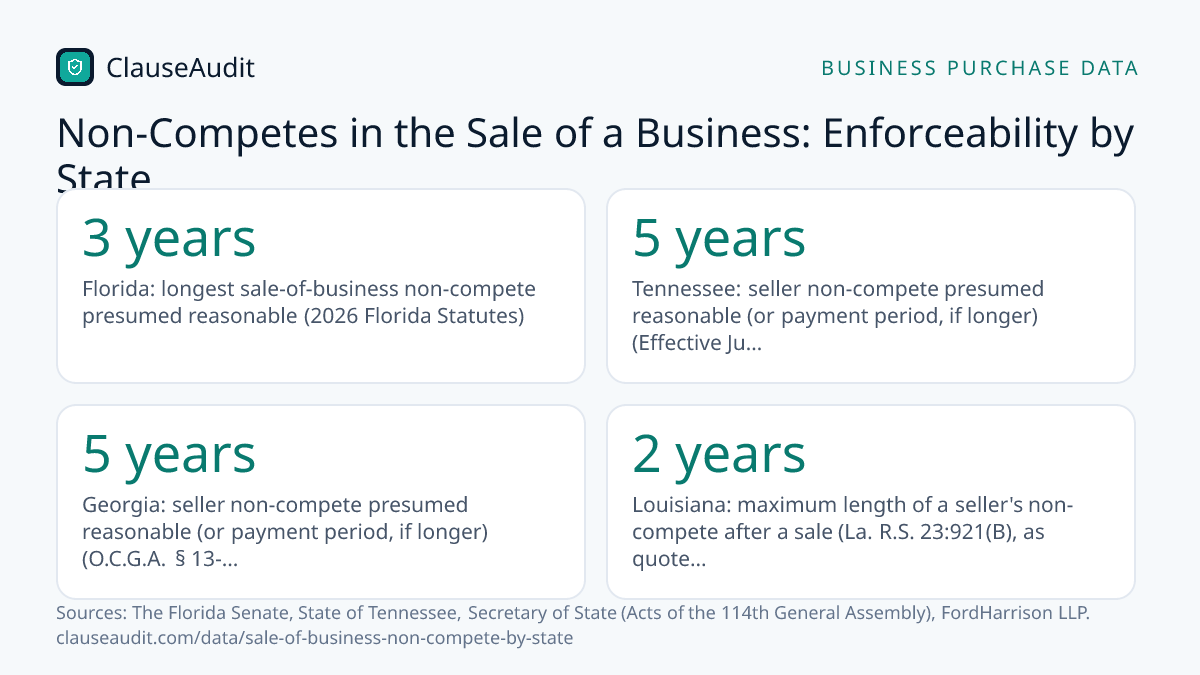
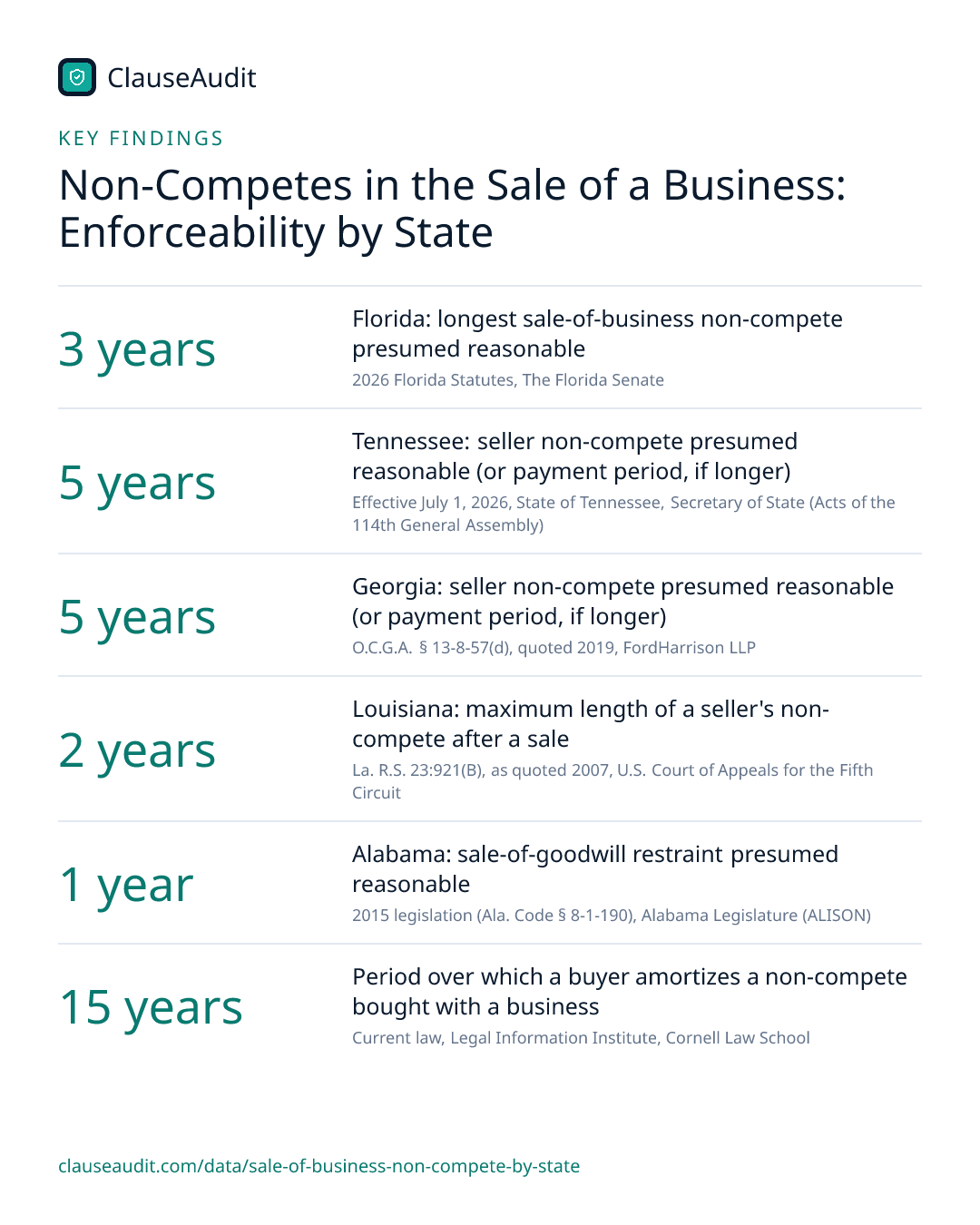
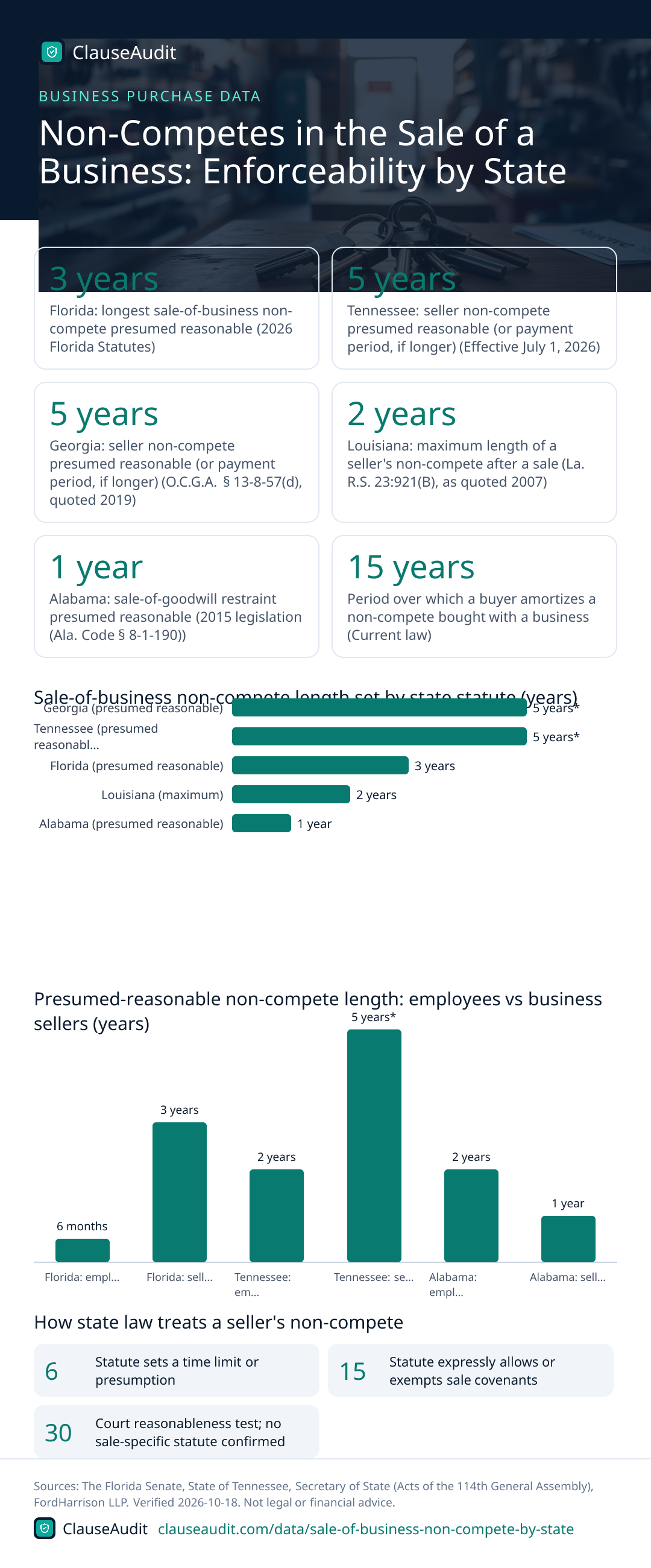
- Florida: longest sale-of-business non-compete presumed reasonable (2026 Florida Statutes, The Florida Senate)
- 3 years
- Tennessee: seller non-compete presumed reasonable (or payment period, if longer) (Effective July 1, 2026, State of Tennessee, Secretary of State (Acts of the 114th General Assembly))
- 5 years
- Georgia: seller non-compete presumed reasonable (or payment period, if longer) (O.C.G.A. § 13-8-57(d), quoted 2019, FordHarrison LLP)
- 5 years
- Louisiana: maximum length of a seller's non-compete after a sale (La. R.S. 23:921(B), as quoted 2007, U.S. Court of Appeals for the Fifth Circuit)
- 2 years
- Alabama: sale-of-goodwill restraint presumed reasonable (2015 legislation (Ala. Code § 8-1-190), Alabama Legislature (ALISON))
- 1 year
- Period over which a buyer amortizes a non-compete bought with a business (Current law, Legal Information Institute, Cornell Law School)
- 15 years
- Washington: ownership stake a seller needs for the sale-of-business carve-out (RCW 49.62.010, current and from June 30, 2027, Washington State Legislature)
- 1% or more
- Seller ownership threshold the FTC proposed, then dropped from its final rule (Proposed January 2023; final May 2024, Federal Trade Commission (Federal Register, via GovInfo))
- 25%
When you sell a business, the buyer is paying for more than equipment and a client list. They are paying for the customers to keep coming back. A non-compete is how they make sure you don't open a shop across the street the month after closing and take those customers with you.
Because of that, every state treats a seller's non-compete more kindly than one signed by an employee. The details still vary a lot. A few states write a number into the statute, some carve sales out of a broader ban, and most leave it to a judge to decide what is reasonable. Here is how that plays out, and what to look for in your own deal.
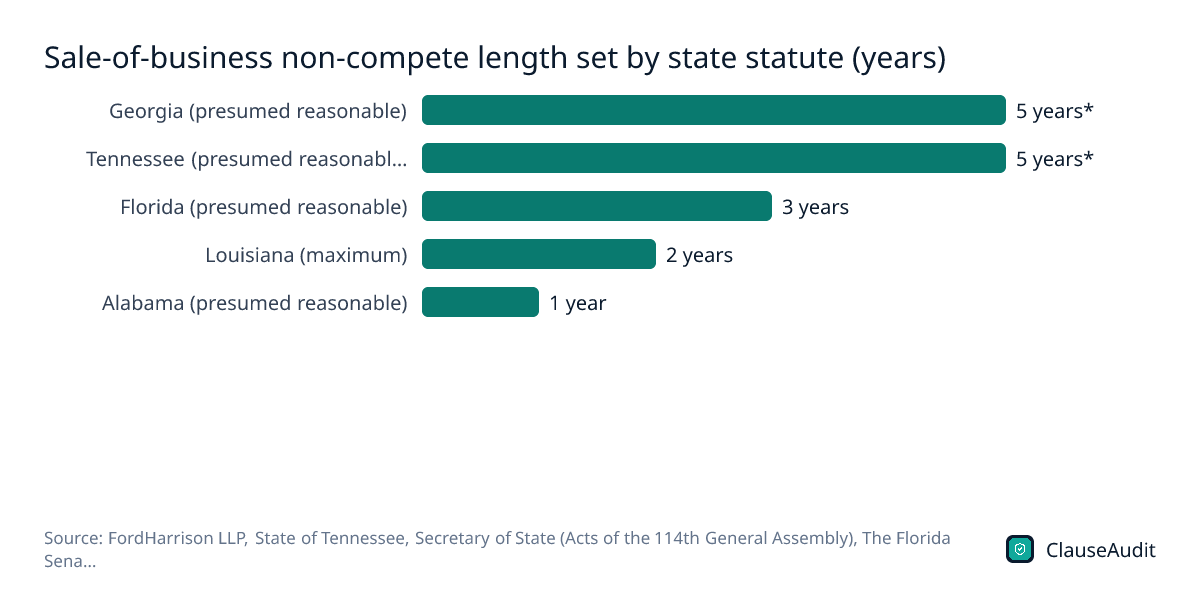
Sale-of-business non-compete length set by state statute (years)
Chart data
| Label | Value |
|---|---|
| Georgia (presumed reasonable) | 5 years* |
| Tennessee (presumed reasonable, from July 2026) | 5 years* |
| Florida (presumed reasonable) | 3 years |
| Louisiana (maximum) | 2 years |
| Alabama (presumed reasonable) | 1 year |
Only a handful of states put a number on it. Georgia and Tennessee also tie the presumption to the payment period, so a long seller note can stretch the time a court will accept.
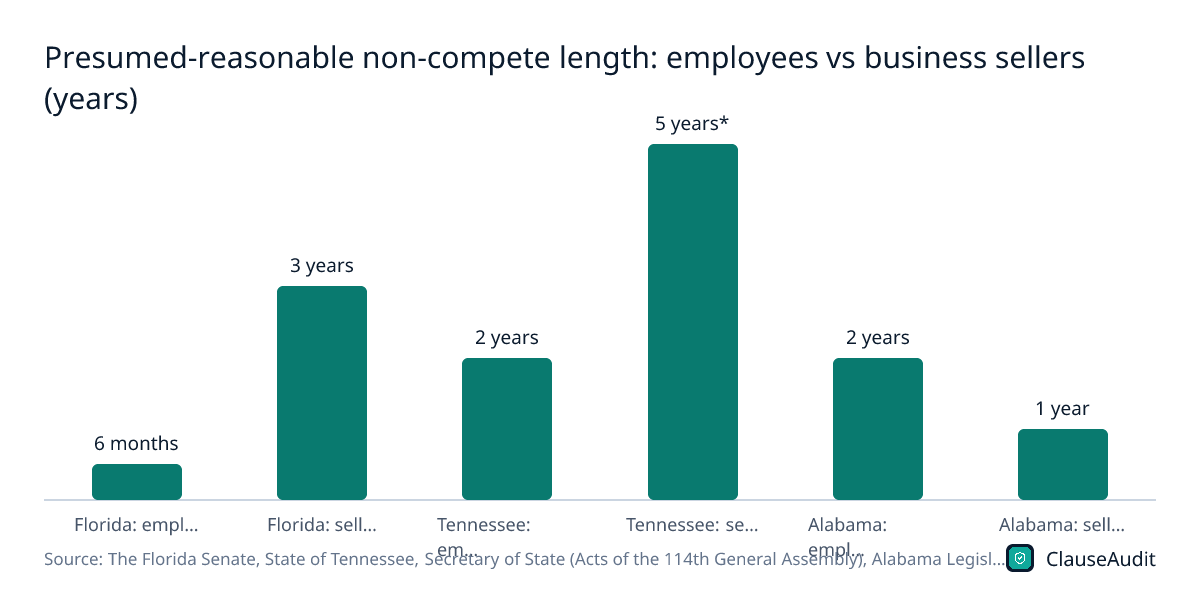
Download this chart (PNG)Presumed-reasonable non-compete length: employees vs business sellers (years)
Chart data
| Label | Value |
|---|---|
| Florida: employee | 6 months |
| Florida: seller | 3 years |
| Tennessee: employee | 2 years |
| Tennessee: seller | 5 years* |
| Alabama: employee | 2 years |
| Alabama: seller | 1 year |
In Florida and Tennessee a seller can be held much longer than an employee. Alabama runs the other way, so don't assume the seller rule is always the looser one.
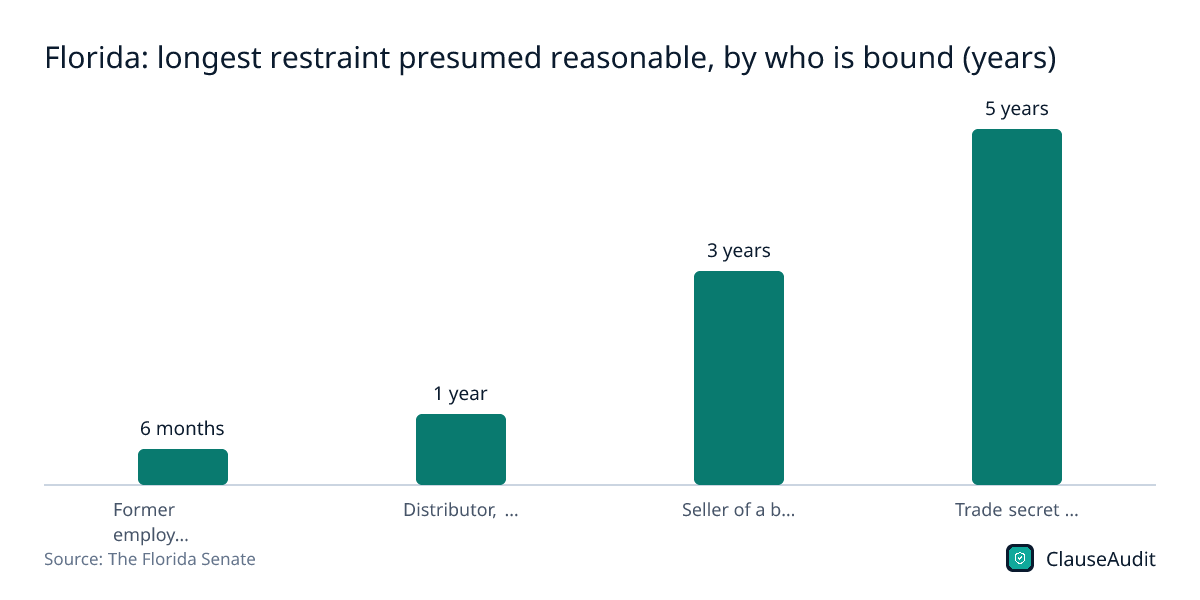
Download this chart (PNG)Florida: longest restraint presumed reasonable, by who is bound (years)
Chart data
| Label | Value |
|---|---|
| Former employee | 6 months |
| Distributor, dealer, franchisee or licensee | 1 year |
| Seller of a business | 3 years |
| Trade secret protection | 5 years |
Florida sorts covenants by who signs them. A seller sits near the top, with 3 years presumed reasonable versus 6 months for a former employee.
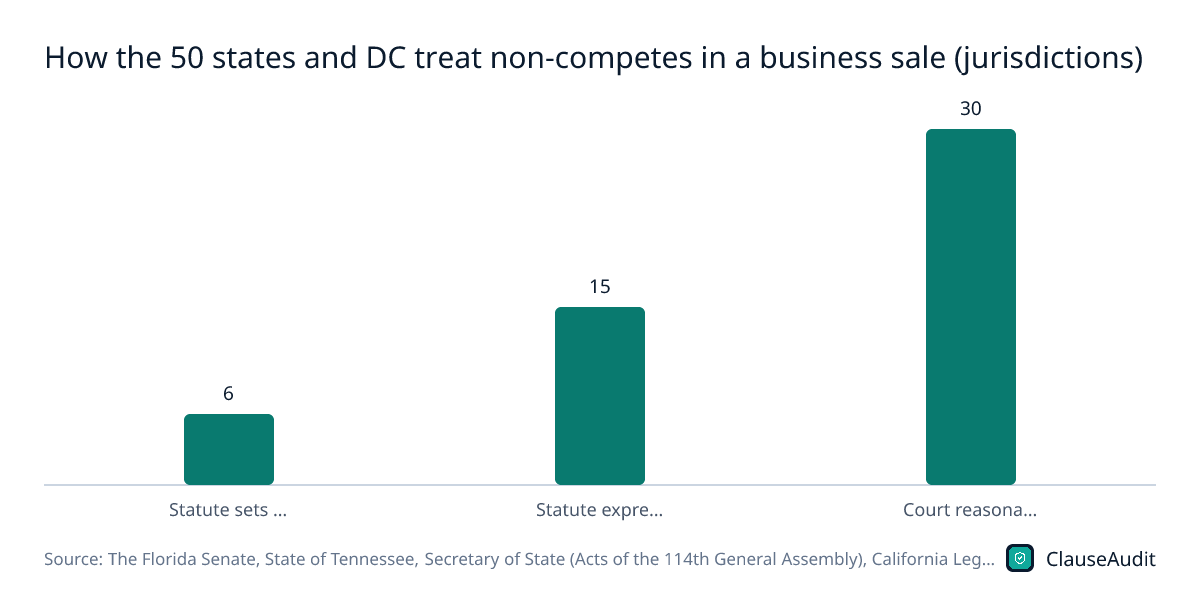
Download this chart (PNG)How the 50 states and DC treat non-competes in a business sale (jurisdictions)
Chart data
| Label | Value (jurisdictions) |
|---|---|
| Statute sets a time limit or presumption | 6 |
| Statute expressly allows or exempts sale covenants | 15 |
| Court reasonableness test; no sale-specific statute confirmed | 30 |
Most states have no sale-specific statute and rely on a reasonableness test. That means the drafting matters more than the map: a tight area and scope is what holds up.
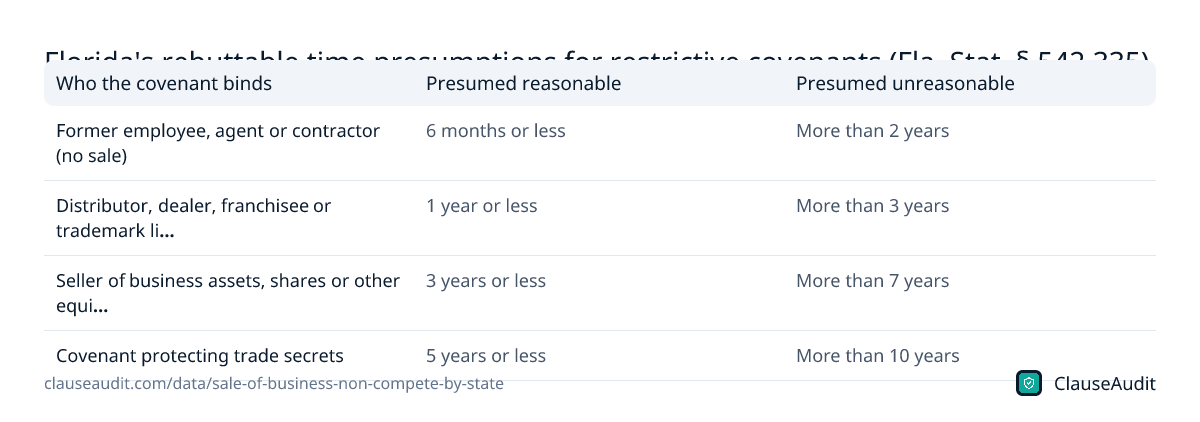
Download this chart (PNG)Florida's rebuttable time presumptions for restrictive covenants (Fla. Stat. § 542.335)
| Who the covenant binds | Presumed reasonable | Presumed unreasonable |
|---|---|---|
| Former employee, agent or contractor (no sale) | 6 months or less | More than 2 years |
| Distributor, dealer, franchisee or trademark licensee (no sale) | 1 year or less | More than 3 years |
| Seller of business assets, shares or other equity | 3 years or less | More than 7 years |
| Covenant protecting trade secrets | 5 years or less | More than 10 years |
Source: The Florida Senate, Fla. Stat. § 542.335 Valid restraints of trade or commerce. Download as image
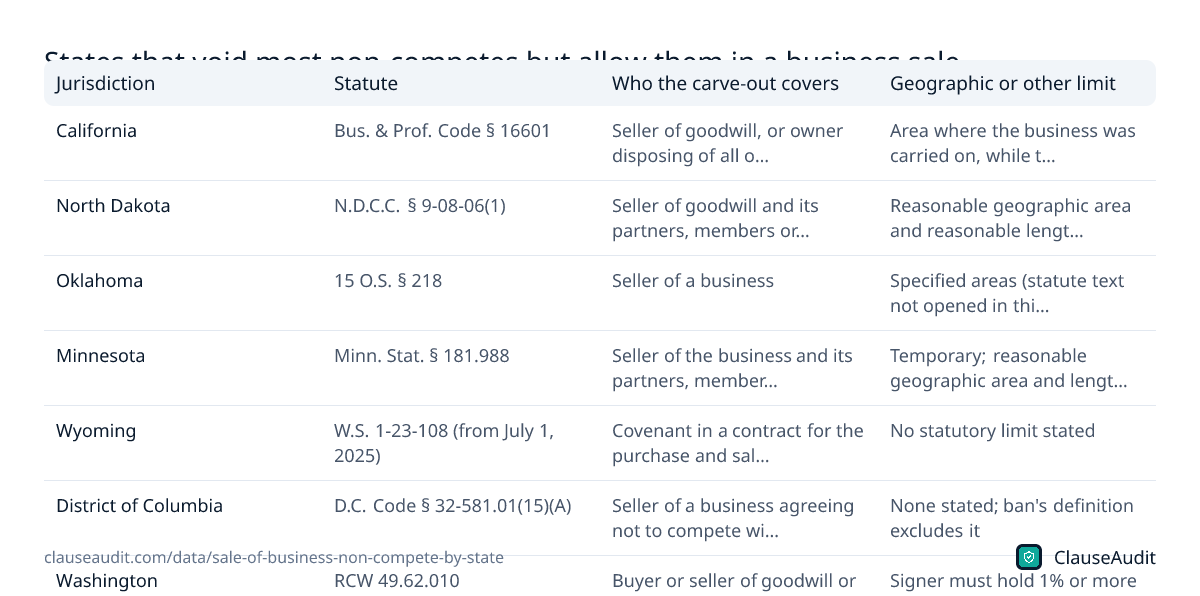
States that void most non-competes but allow them in a business sale
| Jurisdiction | Statute | Who the carve-out covers | Geographic or other limit |
|---|---|---|---|
| California | Bus. & Prof. Code § 16601 | Seller of goodwill, or owner disposing of all ownership interest, or entity selling substantially all operating assets | Area where the business was carried on, while the buyer carries on a like business there |
| North Dakota | N.D.C.C. § 9-08-06(1) | Seller of goodwill and its partners, members or shareholders | Reasonable geographic area and reasonable length of time |
| Oklahoma | 15 O.S. § 218 | Seller of a business | Specified areas (statute text not opened in this review) |
| Minnesota | Minn. Stat. § 181.988 | Seller of the business and its partners, members or shareholders | Temporary; reasonable geographic area and length of time |
| Wyoming | W.S. 1-23-108 (from July 1, 2025) | Covenant in a contract for the purchase and sale of a business or its assets | No statutory limit stated |
| District of Columbia | D.C. Code § 32-581.01(15)(A) | Seller of a business agreeing not to compete with the buyer | None stated; ban's definition excludes it |
| Washington | RCW 49.62.010 | Buyer or seller of goodwill or an ownership interest | Signer must hold 1% or more of the business |
Source: California Legislative Information (California Legislature), Cal. Bus. & Prof. Code § 16601; North Dakota Legislative Branch, Century Code chapter 9-08, N.D.C.C. § 9-08-06 In restraint of business void - Exceptions; Federal Trade Commission (Federal Register, via GovInfo), Non-Compete Clause Rule, Notice of Proposed Rulemaking, 88 FR 3482; Minnesota Office of the Revisor of Statutes, Minn. Stat. § 181.988 Covenants not to compete void in employment agreements; Wyoming Legislature, Enrolled Act No. 87 (SF0107), W.S. 1-23-108; Council of the District of Columbia, D.C. Law Library, D.C. Code § 32-581.01 Definitions (Ban on Non-compete Agreements); Washington State Legislature, RCW 49.62.010 Definitions (versions effective until and from June 30, 2027). Download as image
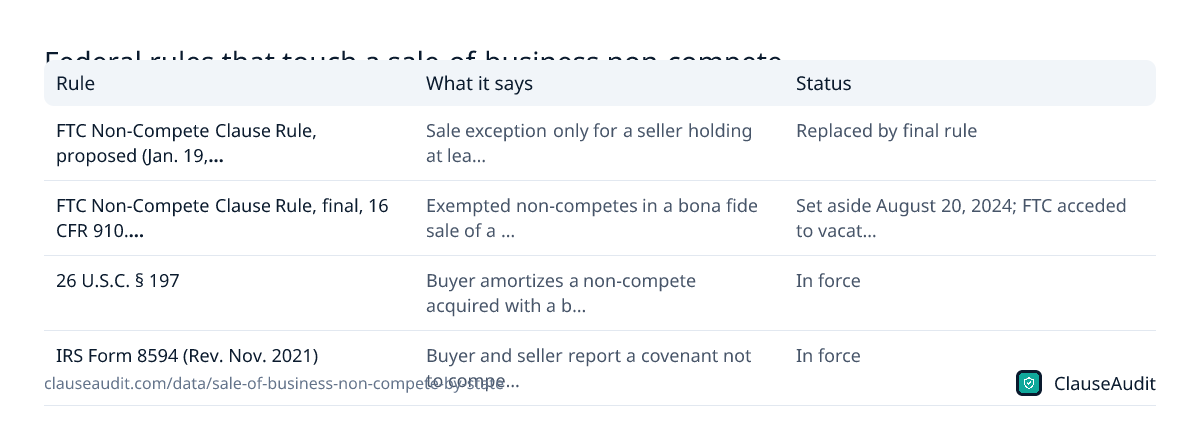
Federal rules that touch a sale-of-business non-compete
| Rule | What it says | Status |
|---|---|---|
| FTC Non-Compete Clause Rule, proposed (Jan. 19, 2023) | Sale exception only for a seller holding at least 25% ownership | Replaced by final rule |
| FTC Non-Compete Clause Rule, final, 16 CFR 910.3(a) (May 7, 2024) | Exempted non-competes in a bona fide sale of a business, ownership interest, or substantially all operating assets; no 25% threshold | Set aside August 20, 2024; FTC acceded to vacatur September 5, 2025; removed from the CFR effective February 12, 2026 (91 FR 6507) |
| 26 U.S.C. § 197 | Buyer amortizes a non-compete acquired with a business over 15 years | In force |
| IRS Form 8594 (Rev. Nov. 2021) | Buyer and seller report a covenant not to compete in an asset acquisition | In force |
Source: Federal Trade Commission (Federal Register, via GovInfo), Non-Compete Clause Rule, Notice of Proposed Rulemaking, 88 FR 3482; Federal Trade Commission (Federal Register, via GovInfo), Non-Compete Clause Rule, Final Rule, 89 FR 38342; Electronic Code of Federal Regulations (eCFR), 16 CFR Part 910, § 910.3 Exceptions; Federal Trade Commission, FTC Announces Rule Banning Noncompetes; Federal Trade Commission, Federal Trade Commission Files to Accede to Vacatur of Non-Compete Clause Rule; Legal Information Institute, Cornell Law School, 26 U.S. Code § 197 Amortization of goodwill and certain other intangibles; Internal Revenue Service, Instructions for Form 8594, Asset Acquisition Statement Under Section 1060; Federal Trade Commission (Federal Register), Revision of the Negative Option Rule, Withdrawal of the CARS Rule, Removal of the Non-Compete Rule To Conform These Rules to Federal Court Decisions, 91 FR 6507 (FR Doc. 2026-02866). Download as image
How state law treats a seller's non-compete by state
- 6Statute sets a time limit or presumption
- 15Statute expressly allows or exempts sale covenants
- 30Court reasonableness test; no sale-specific statute confirmed
- Statute sets a time limit or presumption6
- Statute expressly allows or exempts sale covenants15
- Court reasonableness test; no sale-specific statute confirmed30
| State | Rule for a seller's non-compete | Time limit | Area and other limits | Source |
|---|---|---|---|---|
| Alabama | Allowed for a seller of goodwill | 1 year or less presumed reasonable | Specified geographic area while the buyer carries on a like business; reasonable time and place | Ala. Code § 8-1-190(b)(3) |
| Alaska | Allowed if reasonable in time, area and scope | No statutory number; set by courts | Must protect the goodwill the buyer paid for | FTC Non-Compete Clause Rule NPRM, 88 FR 3482 (Jan. 19, 2023): general description of state law; no state-specific sale statute confirmed in this review |
| Arizona | Allowed if reasonable in time, area and scope | No statutory number; set by courts | Must protect the goodwill the buyer paid for | FTC Non-Compete Clause Rule NPRM, 88 FR 3482 (Jan. 19, 2023): general description of state law; no state-specific sale statute confirmed in this review |
| Arkansas | Allowed if reasonable in time, area and scope | No statutory number; set by courts | Must protect the goodwill the buyer paid for | FTC Non-Compete Clause Rule NPRM, 88 FR 3482 (Jan. 19, 2023): general description of state law; no state-specific sale statute confirmed in this review |
| California | Allowed only under the sale-of-business exception; most other non-competes void | No statutory number | Area where the business was carried on, while the buyer carries on a like business there | Cal. Bus. & Prof. Code § 16601 |
| Colorado | Excluded from the non-compete ban: a covenant related to the purchase and sale of a business, a direct or indirect ownership share in a business, or all or substantially all of its assets, restricting an owner of an interest | No fixed number. For a minority owner who received the share as equity compensation or for services: years may not exceed total sale consideration received divided by average annualized cash compensation from the business (including ownership income) over the preceding 2 years or the affiliation period, whichever is shorter | Otherwise reasonableness under general law | C.R.S. 8-2-113(3)(c), as amended by SB 25-083 |
| Connecticut | Allowed if reasonable in time, area and scope | No statutory number; set by courts | Must protect the goodwill the buyer paid for | FTC Non-Compete Clause Rule NPRM, 88 FR 3482 (Jan. 19, 2023): general description of state law; no state-specific sale statute confirmed in this review |
| Delaware | Allowed if reasonable in time, area and scope | No statutory number; set by courts | Must protect the goodwill the buyer paid for | FTC Non-Compete Clause Rule NPRM, 88 FR 3482 (Jan. 19, 2023): general description of state law; no state-specific sale statute confirmed in this review |
| District of Columbia | Seller-buyer covenants are excluded from the non-compete ban | No statutory number | Provision must be in or signed with the sale agreement | D.C. Code § 32-581.01(15)(A) |
| Florida | Enforceable if reasonable and supported by a legitimate business interest | 3 years or less presumed reasonable; over 7 presumed unreasonable | Applies to sellers of assets, shares, partnership, LLC or other equity interests | Fla. Stat. § 542.335(1)(d)3 |
| Georgia | Enforceable under a more lenient statutory test for sellers | Longer of 5 years or the payment period presumed reasonable | Reasonable area and scope | O.C.G.A. § 13-8-57(d) |
| Hawaii | Statute permits a transferor's non-compete in a sale | Reasonable period of time | Reasonable area | HRS § 480-4(c)(1) |
| Idaho | Allowed if reasonable in time, area and scope | No statutory number; set by courts | Must protect the goodwill the buyer paid for | FTC Non-Compete Clause Rule NPRM, 88 FR 3482 (Jan. 19, 2023): general description of state law; no state-specific sale statute confirmed in this review |
| Illinois | Covenants tied to buying or selling an ownership interest are outside the Freedom to Work Act | No statutory number | Courts still require reasonableness | 820 ILCS 90/5 |
| Indiana | Allowed if reasonable in time, area and scope | No statutory number; set by courts | Must protect the goodwill the buyer paid for | FTC Non-Compete Clause Rule NPRM, 88 FR 3482 (Jan. 19, 2023): general description of state law; no state-specific sale statute confirmed in this review |
| Iowa | Allowed if reasonable in time, area and scope | No statutory number; set by courts | Must protect the goodwill the buyer paid for | FTC Non-Compete Clause Rule NPRM, 88 FR 3482 (Jan. 19, 2023): general description of state law; no state-specific sale statute confirmed in this review |
| Kansas | Allowed if reasonable in time, area and scope | No statutory number; set by courts | Must protect the goodwill the buyer paid for | FTC Non-Compete Clause Rule NPRM, 88 FR 3482 (Jan. 19, 2023): general description of state law; no state-specific sale statute confirmed in this review |
| Kentucky | Allowed if reasonable in time, area and scope | No statutory number; set by courts | Must protect the goodwill the buyer paid for | FTC Non-Compete Clause Rule NPRM, 88 FR 3482 (Jan. 19, 2023): general description of state law; no state-specific sale statute confirmed in this review |
| Louisiana | Allowed for a seller of goodwill | 2 years maximum from the date of sale | Specified parishes or municipalities, while the buyer carries on a like business there | La. R.S. 23:921(B) |
| Maine | Allowed if reasonable in time, area and scope | No statutory number; set by courts | Must protect the goodwill the buyer paid for | FTC Non-Compete Clause Rule NPRM, 88 FR 3482 (Jan. 19, 2023): general description of state law; no state-specific sale statute confirmed in this review |
| Maryland | Allowed if reasonable in time, area and scope | No statutory number; set by courts | Must protect the goodwill the buyer paid for | FTC Non-Compete Clause Rule NPRM, 88 FR 3482 (Jan. 19, 2023): general description of state law; no state-specific sale statute confirmed in this review |
| Massachusetts | Sale-of-business covenants are excluded from the Noncompetition Agreement Act's definition | No statutory number | Reasonableness under general law | M.G.L. c. 149, § 24L (definition of noncompetition agreement) |
| Michigan | Allowed if reasonable in time, area and scope | No statutory number; set by courts | Must protect the goodwill the buyer paid for | FTC Non-Compete Clause Rule NPRM, 88 FR 3482 (Jan. 19, 2023): general description of state law; no state-specific sale statute confirmed in this review |
| Minnesota | Valid when agreed during the sale of a business; otherwise void | Reasonable length of time | Temporary and limited to a reasonable geographic area | Minn. Stat. § 181.988, subd. 2(b)(1) |
| Mississippi | Allowed if reasonable in time, area and scope | No statutory number; set by courts | Must protect the goodwill the buyer paid for | FTC Non-Compete Clause Rule NPRM, 88 FR 3482 (Jan. 19, 2023): general description of state law; no state-specific sale statute confirmed in this review |
| Missouri | Allowed if reasonable in time, area and scope | No statutory number; set by courts | Must protect the goodwill the buyer paid for | FTC Non-Compete Clause Rule NPRM, 88 FR 3482 (Jan. 19, 2023): general description of state law; no state-specific sale statute confirmed in this review |
| Montana | Allowed for a seller of goodwill | No statutory number | City or county of the principal office, or adjacent cities and counties | Mont. Code Ann. § 28-2-704 |
| Nebraska | Allowed if reasonable in time, area and scope | No statutory number; set by courts | Must protect the goodwill the buyer paid for | FTC Non-Compete Clause Rule NPRM, 88 FR 3482 (Jan. 19, 2023): general description of state law; no state-specific sale statute confirmed in this review |
| Nevada | State antitrust chapter does not apply to a seller's restrictive covenant in a sale | Reasonable period of time | Reasonable market area | NRS 598A.040(5)(a) |
| New Hampshire | Allowed if reasonable in time, area and scope | No statutory number; set by courts | Must protect the goodwill the buyer paid for | FTC Non-Compete Clause Rule NPRM, 88 FR 3482 (Jan. 19, 2023): general description of state law; no state-specific sale statute confirmed in this review |
| New Jersey | Allowed if reasonable in time, area and scope | No statutory number; set by courts | Must protect the goodwill the buyer paid for | FTC Non-Compete Clause Rule NPRM, 88 FR 3482 (Jan. 19, 2023): general description of state law; no state-specific sale statute confirmed in this review |
| New Mexico | Allowed if reasonable in time, area and scope | No statutory number; set by courts | Must protect the goodwill the buyer paid for | FTC Non-Compete Clause Rule NPRM, 88 FR 3482 (Jan. 19, 2023): general description of state law; no state-specific sale statute confirmed in this review |
| New York | Allowed if reasonable in time, area and scope | No statutory number; set by courts | Must protect the goodwill the buyer paid for | FTC Non-Compete Clause Rule NPRM, 88 FR 3482 (Jan. 19, 2023): general description of state law; no state-specific sale statute confirmed in this review |
| North Carolina | Allowed if reasonable in time, area and scope | No statutory number; set by courts | Must protect the goodwill the buyer paid for | FTC Non-Compete Clause Rule NPRM, 88 FR 3482 (Jan. 19, 2023): general description of state law; no state-specific sale statute confirmed in this review |
| North Dakota | Allowed for a seller of goodwill; most other non-competes void | Reasonable length of time | Reasonable geographic area, while the buyer carries on a like business there | N.D.C.C. § 9-08-06(1) |
| Ohio | Allowed if reasonable in time, area and scope | No statutory number; set by courts | Must protect the goodwill the buyer paid for | FTC Non-Compete Clause Rule NPRM, 88 FR 3482 (Jan. 19, 2023): general description of state law; no state-specific sale statute confirmed in this review |
| Oklahoma | Allowed for a seller of a business; employee non-competes void | No statutory number confirmed | Specified areas (statute text not opened in this review) | 15 O.S. § 218 |
| Oregon | Allowed if reasonable in time, area and scope | No statutory number; set by courts | Must protect the goodwill the buyer paid for | FTC Non-Compete Clause Rule NPRM, 88 FR 3482 (Jan. 19, 2023): general description of state law; no state-specific sale statute confirmed in this review |
| Pennsylvania | Allowed if reasonable in time, area and scope | No statutory number; set by courts | Must protect the goodwill the buyer paid for | FTC Non-Compete Clause Rule NPRM, 88 FR 3482 (Jan. 19, 2023): general description of state law; no state-specific sale statute confirmed in this review |
| Rhode Island | Sale-of-business covenants are excluded from the Noncompetition Agreement Act | No statutory number | Reasonableness under general law | R.I. Gen. Laws § 28-59-2(8)(iii) |
| South Carolina | Allowed if reasonable in time, area and scope | No statutory number; set by courts | Must protect the goodwill the buyer paid for | FTC Non-Compete Clause Rule NPRM, 88 FR 3482 (Jan. 19, 2023): general description of state law; no state-specific sale statute confirmed in this review |
| South Dakota | Allowed for a seller of goodwill | No statutory number | Specified county, city or other area, while the buyer carries on a like business there | S.D. Codified Laws § 53-9-9 |
| Tennessee | Enforceable if reasonable; statutory presumption for sellers | Longer of 5 years or the payment period presumed reasonable | Applies to owners or sellers of all or a material part of a business | Tenn. Code Ann. § 50-1-210 (Pub. Ch. 934) |
| Texas | Enforceable if ancillary to an otherwise enforceable agreement and reasonable | No statutory number | Reasonable time, area and scope | Tex. Bus. & Com. Code § 15.50 |
| Utah | Post-employment restrictive covenant law permits covenants related to a sale of a business | No statutory number | Reasonableness under general law | Utah Code §§ 34-51-101 to 301 |
| Vermont | Allowed if reasonable in time, area and scope | No statutory number; set by courts | Must protect the goodwill the buyer paid for | FTC Non-Compete Clause Rule NPRM, 88 FR 3482 (Jan. 19, 2023): general description of state law; no state-specific sale statute confirmed in this review |
| Virginia | Allowed if reasonable in time, area and scope | No statutory number; set by courts | Must protect the goodwill the buyer paid for | FTC Non-Compete Clause Rule NPRM, 88 FR 3482 (Jan. 19, 2023): general description of state law; no state-specific sale statute confirmed in this review |
| Washington | Covenants in a sale are excluded from the noncompetition law if the signer holds 1% or more | No statutory number | Signer must buy, sell, acquire or dispose of at least 1% of the business | RCW 49.62.010 |
| West Virginia | Allowed if reasonable in time, area and scope | No statutory number; set by courts | Must protect the goodwill the buyer paid for | FTC Non-Compete Clause Rule NPRM, 88 FR 3482 (Jan. 19, 2023): general description of state law; no state-specific sale statute confirmed in this review |
| Wisconsin | Allowed if reasonable in time, area and scope | No statutory number; set by courts | Must protect the goodwill the buyer paid for | FTC Non-Compete Clause Rule NPRM, 88 FR 3482 (Jan. 19, 2023): general description of state law; no state-specific sale statute confirmed in this review |
| Wyoming | Covenants in a contract to buy and sell a business or its assets are exempt from the 2025 ban | No statutory number | Reasonableness under general law | W.S. 1-23-108 |
Is a non-compete enforceable when you sell your business?
Almost always, if it is drafted with some restraint. The FTC noted in 2023 that all states permit seller-buyer non-competes to some degree. The reason is simple. A court looking at an employee's non-compete worries that a worker is being kept from earning a living. A court looking at a seller's non-compete sees someone who was paid, often well, for goodwill, and who is now trying to take it back.
That doesn't mean anything goes. In the 30 jurisdictions where we found no sale-specific statute, judges ask whether the time, area and scope are reasonable and whether the restriction protects the goodwill the buyer actually bought. Say a dry cleaner sells one location and agrees never to work in any service business anywhere in the country. A court could well throw that out. If the same seller agrees to stay out of dry cleaning in the same county for a few years, expect it to stick.
If you are the buyer, this cuts the other way. An overreaching covenant is the one most likely to be thrown out or trimmed, and in some states a judge will strike it rather than rewrite it. Asking for less, and tying it closely to the customers and services you are paying for, is often the safer way to get protection that actually holds up. Spell out the reason for the restriction in the agreement too, since courts look for the goodwill being protected.
How long can a sale-of-business non-compete last?
Six states put a time limit, presumption or formula in a statute. Florida presumes 3 years or less reasonable for a seller and over 7 years unreasonable. Tennessee, for agreements made on or after July 1, 2026, presumes the longer of 5 years or the period the seller is being paid. Georgia uses the same 5-years-or-payment-period test. Louisiana caps a seller at 2 years from the date of sale, and Alabama presumes 1 year or less reasonable for a sale of goodwill. Colorado uses a formula for some minority owners, covered below.
Two things trip people up here. First, a presumption is not a cap. In Florida or Tennessee, a buyer can argue for longer and a seller can argue for shorter; the presumption just decides who has to make the case. Louisiana is different, because its 2 years is a hard limit.
Second, the payment-period rule in Tennessee and Georgia links your non-compete to your earnout or seller note. If you agree to take part of the price over many years, the restriction a court will presume reasonable can run that long too. Sellers who negotiate a stretched payout to get a better price sometimes don't notice they have also stretched their non-compete.
Why do states that ban non-competes still allow them in a sale?
California, North Dakota, Oklahoma and Minnesota void most non-competes, and Wyoming and the District of Columbia have passed broad bans of their own. Each one keeps a carve-out for the sale of a business. The logic is that the ban protects workers, and a seller who cashed out is not in the same position.
The carve-outs have limits worth reading closely. California's covers a seller of goodwill, an owner disposing of all of their ownership interest, or a company selling substantially all of its operating assets, and only for the area where the business operated. If you sell part of your stake and keep the rest, you may not fit.
Ownership size matters in other places too. Washington's carve-out only applies if the signer buys or sells 1% or more of the business, and its near-total ban taking effect June 30, 2027 keeps that rule. Colorado goes further for minority owners who got their shares as pay: the number of years is capped by a formula based on what they received in the sale compared with their cash compensation. Founders, early employees with equity, and anyone being bought out alongside a majority owner should check these rules before assuming the sale exception applies to them.
Does the FTC non-compete ban affect a business sale?
No. The FTC's 2024 rule would have banned most non-competes nationwide, but it exempted bona fide sales of a business. It also dropped the 25% ownership threshold the agency had proposed in 2023. The point is now moot. A federal court set the rule aside on August 20, 2024, the FTC moved to accept that result in 2025, and the rule was removed from the Code of Federal Regulations effective February 12, 2026. State law is what governs your deal.
How is a non-compete treated for taxes in a business sale?
This is where buyers and sellers often want opposite things. The buyer amortizes a non-compete acquired with a business over 15 years under Section 197, no matter how long the covenant actually runs. Both sides report it on Form 8594 in an asset purchase. Money allocated to the non-compete can also be taxed differently for the seller than money allocated to goodwill, so the split is worth a conversation with your accountant before the purchase agreement is final, not after.
What to check before you sign
- Find which state's law governs the agreement and look it up in the table above. If it is Louisiana, anything past 2 years is a problem.
- Make sure the restricted activity matches the business you sold, not every business you might ever run.
- Tie the area to where the business really had customers. A single-county shop does not need a national restriction.
- Check whether the clock starts at closing or at the end of any consulting or employment period with the buyer. Those can stack.
- If you are paid over time, ask what happens to the non-compete if the buyer stops paying. In Tennessee and Georgia, the payment period can lengthen it.
- Read the non-solicit and confidentiality terms next to the non-compete. They often reach further than the headline restriction.
- If you own a small or minority stake, confirm the sale exception covers you under your state's rule.
How ClauseAudit helps
In a business sale the non-compete is rarely one tidy paragraph. It shows up in the purchase agreement, again in a consulting or transition agreement, and sometimes a third time in a separate restrictive covenant agreement, each with its own length and start date.
Upload your letter of intent or purchase agreement and the automated review flags each restriction, explains it in plain English and suggests what to ask for before closing.
- Non-compete length, start date and whether it stacks with a post-closing employment or consulting term
- Geographic area and restricted activity compared with what the business actually did
- Earnout or seller note terms that can extend the restriction or survive a buyer's missed payment
- Non-solicit and no-hire clauses covering customers, suppliers and staff
- Purchase price allocation to the covenant versus goodwill
- Governing law and venue clauses that pick a state friendlier to the buyer
Frequently asked questions
Can I open a competing business after selling mine?
Only if your purchase agreement allows it or the non-compete you signed is unenforceable. Most sale agreements include one, and courts enforce seller covenants more readily than employee ones. Read the restricted activity, area and time closely. Starting something in a different line of work or outside the covered area is often fine, but check the non-solicit too, since it may bar you from calling old customers even where you can legally compete.
Does California allow a non-compete when you sell a business?
Yes. California voids most non-competes, but Business and Professions Code section 16601 allows one when you sell the goodwill of a business, dispose of all of your ownership interest, or the company sells substantially all of its operating assets. The restriction is limited to the area where the business operated, and only while the buyer carries on a like business there. Selling only part of your stake may not qualify.
What is a reasonable length for a sale-of-business non-compete?
Where a statute sets a number, Florida presumes 3 years or less reasonable, Tennessee and Georgia presume 5 years or the payment period if longer, Louisiana caps it at 2 years, and Alabama presumes 1 year or less. Elsewhere a judge decides, looking at what the buyer paid for and how long that goodwill realistically takes to transfer.
Does the non-compete start at closing?
It depends on the wording. Some agreements start the clock at closing. Others start it when your consulting or employment with the buyer ends, which can add years to the restriction. Louisiana's statute measures from the date of sale. If the agreement is unclear, ask for a fixed end date written in plainly so nobody has to argue about it later.
Is the FTC non-compete ban in effect?
No. A federal court set the rule aside on August 20, 2024, and it was removed from the Code of Federal Regulations effective February 12, 2026. Even when it was on the books, it exempted non-competes signed in a bona fide sale of a business. State law decides if your covenant holds up.
I own a small stake that is being bought out. Am I bound like the main seller?
Possibly not. Washington's sale exception only covers someone buying or selling 1% or more of the business. Colorado limits how long a minority owner who got shares as compensation can be restricted, using a formula based on sale proceeds and past cash pay. California's exception needs you to dispose of all of your interest. Check your state before assuming the covenant applies to you in full.
How does the buyer deduct a non-compete?
Under Section 197, a buyer amortizes a non-compete acquired with a business over 15 years, even if the covenant itself lasts much less. Both sides report it on Form 8594 in an asset purchase. Because the seller may be taxed differently on money assigned to the covenant than on goodwill, agree on the allocation in the purchase agreement with your accountant involved.
What happens to my non-compete if the buyer stops paying me?
If the agreement is silent, you could end up still bound by the non-compete while the buyer is behind on your seller note. That is a bad position to be in. Ask for language that ends or suspends the restriction if the buyer misses payments and fails to cure. In Tennessee and Georgia, where the payment period can extend the presumed term, this matters even more.
Use this data
Every chart and card below is free to reuse under CC BY 4.0. Download what you need and link back to this page.
 Stat cards
 Key findings card
 Infographic
 Sale-of-business non-compete length set by state statute (years)
 Presumed-reasonable non-compete length: employees vs business sellers (years)
 Florida: longest restraint presumed reasonable, by who is bound (years)
 How the 50 states and DC treat non-competes in a business sale (jurisdictions)
 Florida's rebuttable time presumptions for restrictive covenants (Fla. Stat. § 542.335)
 States that void most non-competes but allow them in a business sale
 Federal rules that touch a sale-of-business non-compete
Embed the infographic
Free to share on your site, blog or slides under CC BY 4.0. Please keep the credit link.
Sources and method
Every number on this page comes from the sources below, each opened and read on or before October 18, 2026. A second, independent review checked every figure against its source and corrected anything that did not match. 51 of 51 state entries were confirmed; any that could not be are marked "Not yet confirmed" and left out of every count and chart.
- California Legislative Information (California Legislature), Cal. Bus. & Prof. Code § 16601 (Amended by Stats. 2006, Ch. 495 (current text as read 2026-10-18))
- North Dakota Legislative Branch, Century Code chapter 9-08, N.D.C.C. § 9-08-06 In restraint of business void - Exceptions (Current chapter PDF as read 2026-10-18)
- Minnesota Office of the Revisor of Statutes, Minn. Stat. § 181.988 Covenants not to compete void in employment agreements (2023 c 53 art 6 s 1 (current text as read 2026-10-18))
- Montana Legislature, Mont. Code Ann. § 28-2-704 Exception -- sale of goodwill of business (Montana Code Annotated 2025)
- South Dakota Legislature, S.D. Codified Laws § 53-9-9 Sale of good will--Seller's agreement with buyer to refrain from carrying on similar business (Current text as read 2026-10-18 (SL 1997, ch 274))
- Wyoming Legislature, Enrolled Act No. 87 (SF0107), W.S. 1-23-108 (2025 General Session; applies to contracts entered into on and after July 1, 2025)
- Council of the District of Columbia, D.C. Law Library, D.C. Code § 32-581.01 Definitions (Ban on Non-compete Agreements) (Current text as read 2026-10-18)
- Washington State Legislature, RCW 49.62.010 Definitions (versions effective until and from June 30, 2027) (Current text as read 2026-10-18)
- Washington State Legislature, ESHB 1155 (2025-26), Prohibiting noncompetition agreements, session law and bill summary (Signed March 23, 2026 (C 149 L 26); effective June 30, 2027)
- The Florida Senate, Fla. Stat. § 542.335 Valid restraints of trade or commerce (2026 Florida Statutes)
- Nevada.Public.Law (reproduction of the Nevada Revised Statutes), NRS 598A.040 Applicability of chapter (Text accessed by publisher May 26, 2025; read 2026-10-18)
- Texas.Public.Law (reproduction of the Texas statutes), Tex. Bus. & Com. Code § 15.50 Criteria for Enforceability of Covenants Not to Compete (Text accessed by publisher May 26, 2025; read 2026-10-18)
- Oregon.Public.Law (reproduction of the Oregon Revised Statutes), ORS 653.295 Noncompetition agreements (Current text as read 2026-10-18)
- State of Tennessee, Secretary of State (Acts of the 114th General Assembly), Public Chapter No. 934 (House Bill No. 1034), covenants not to compete (Passed April 20, 2026; effective July 1, 2026)
- Alabama Legislature (ALISON), HB352 (2015 Regular Session), engrossed: restrictive covenants (Ala. Code § 8-1-190 et seq.) (2015 Regular Session, engrossed version)
- U.S. Court of Appeals for the Fifth Circuit, Security Alarm Financing Enterprises, Inc. v. Green, No. 06-30332 (quoting La. R.S. 23:921(B)) (March 2, 2007)
- Louisiana Law Review (LSU Law Center), Jacob Ecker, Policymaking Without Regard for Policy: Louisiana Business-Sale Noncompetes (March 30, 2015)
- FordHarrison LLP, Non-Compete News: Georgia Court Interprets Non-Compete Statute's Sale of a Business Provision (September 4, 2019)
- Hawaii State Legislature, H.B. No. 1090, C.D. 1 (2015), showing existing text of HRS § 480-4(c)(1) (2015 (Twenty-Eighth Legislature))
- Hinshaw & Culbertson LLP, Frequently Asked Questions About the Illinois Freedom to Work Act (June 9, 2021)
- Katz Banks Kumin LLP, U.S. Noncompete Agreement Restrictions 50 State Survey (Current as of March 1, 2026)
- Federal Trade Commission (Federal Register, via GovInfo), Non-Compete Clause Rule, Notice of Proposed Rulemaking, 88 FR 3482 (January 19, 2023)
- Federal Trade Commission (Federal Register, via GovInfo), Non-Compete Clause Rule, Final Rule, 89 FR 38342 (May 7, 2024)
- Electronic Code of Federal Regulations (eCFR), 16 CFR Part 910, § 910.3 Exceptions (Version as of September 4, 2024)
- Federal Trade Commission, FTC Announces Rule Banning Noncompetes (April 23, 2024 (page notes enforcement stopped August 20, 2024))
- Federal Trade Commission, Federal Trade Commission Files to Accede to Vacatur of Non-Compete Clause Rule (September 5, 2025)
- Legal Information Institute, Cornell Law School, 26 U.S. Code § 197 Amortization of goodwill and certain other intangibles (Current text as read 2026-10-18)
- Internal Revenue Service, Instructions for Form 8594, Asset Acquisition Statement Under Section 1060 (Rev. November 2021)
- Colorado General Assembly, SB 25-083 Limitations on Restrictive Employment Agreements (signed act) (Signed June 3, 2025 (2025 Session Laws ch. 366); effective August 6, 2025)
- Federal Trade Commission (Federal Register), Revision of the Negative Option Rule, Withdrawal of the CARS Rule, Removal of the Non-Compete Rule To Conform These Rules to Federal Court Decisions, 91 FR 6507 (FR Doc. 2026-02866) (February 12, 2026 (effective February 12, 2026))
Cite this page
ClauseAudit, “Non-Competes in the Sale of a Business: Enforceability by State”, updated October 18, 2026, https://clauseaudit.com/data/sale-of-business-non-compete-by-state. Free to reuse with a link back (CC BY 4.0).
This page summarises published data and law as checked on October 18, 2026. Figures are updated as new editions are released, and your own situation may differ. It is general information, not legal, tax or financial advice.