Franchise Termination and Non-Renewal Laws by State (Good Cause, Notice and Cure Periods)
By ClauseAudit Research · 30 sources ·
What are the franchise termination laws by state?
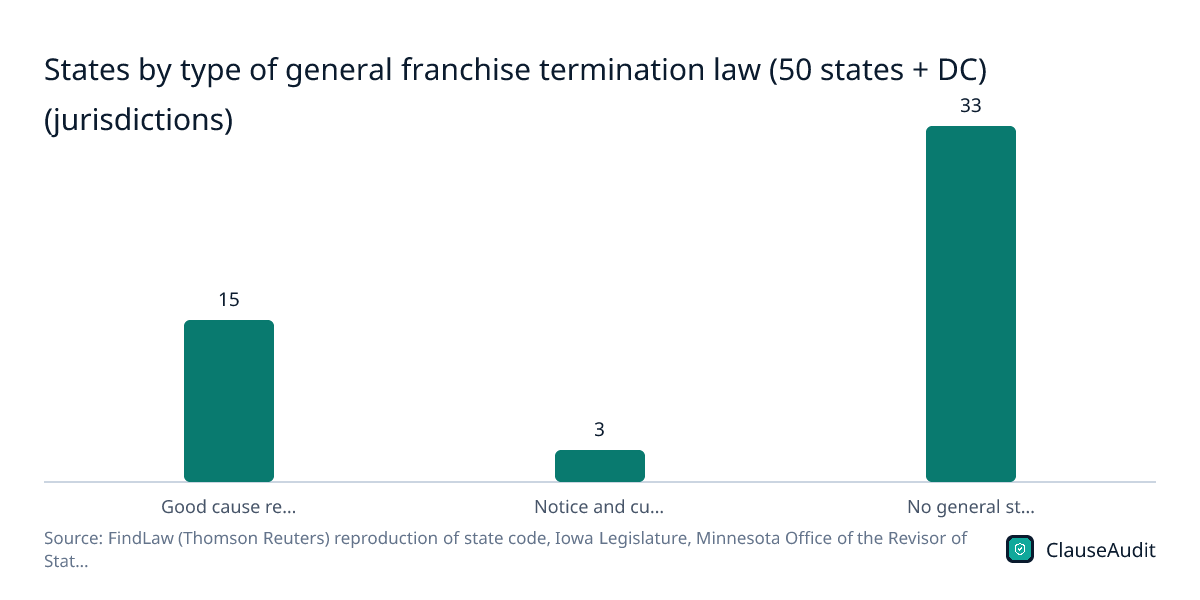
Most franchisees have no special state protection. In 33 of 51 jurisdictions (the 50 states plus DC), no general statute limits termination, so the contract controls. Fifteen states require good cause, and California, for example, gives at least 60 days to cure a default and 180 days' notice before refusing to renew.

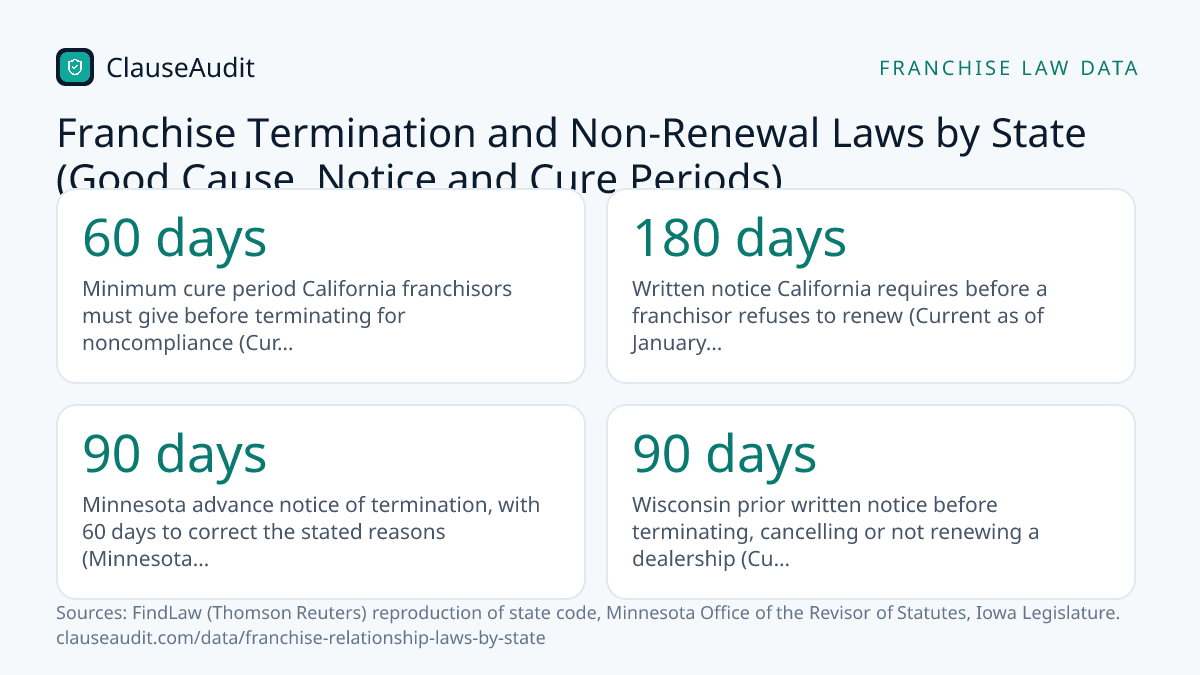
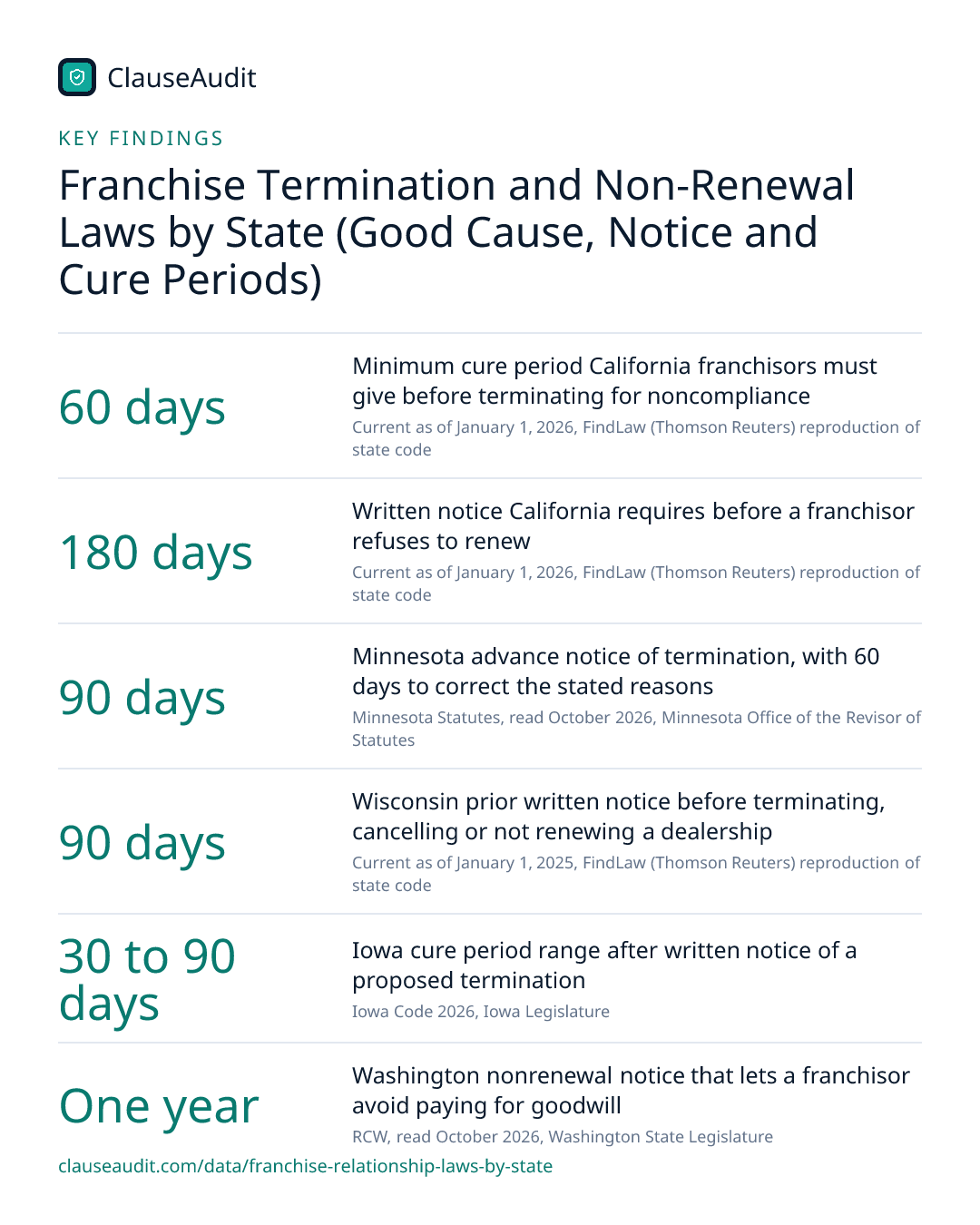
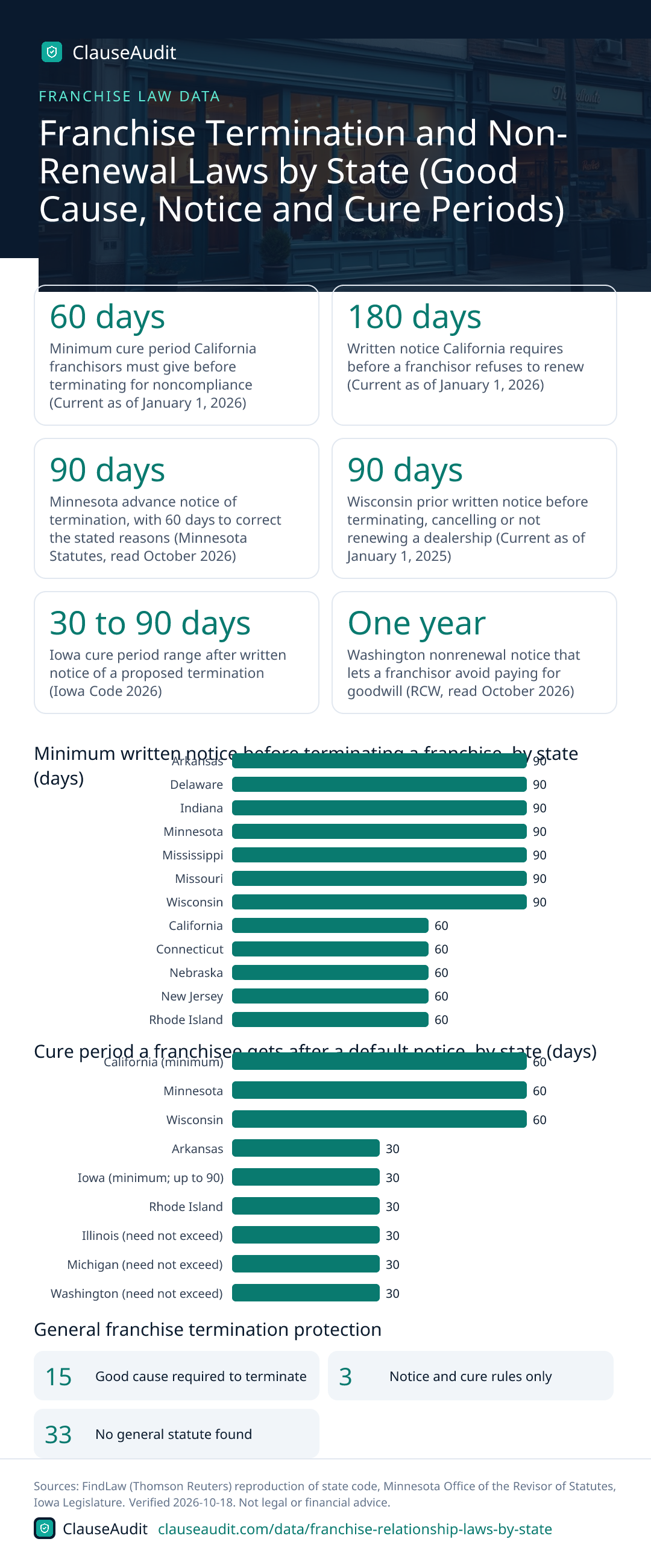
- Minimum cure period California franchisors must give before terminating for noncompliance (Current as of January 1, 2026, FindLaw (Thomson Reuters) reproduction of state code)
- 60 days
- Written notice California requires before a franchisor refuses to renew (Current as of January 1, 2026, FindLaw (Thomson Reuters) reproduction of state code)
- 180 days
- Minnesota advance notice of termination, with 60 days to correct the stated reasons (Minnesota Statutes, read October 2026, Minnesota Office of the Revisor of Statutes)
- 90 days
- Wisconsin prior written notice before terminating, cancelling or not renewing a dealership (Current as of January 1, 2025, FindLaw (Thomson Reuters) reproduction of state code)
- 90 days
- Iowa cure period range after written notice of a proposed termination (Iowa Code 2026, Iowa Legislature)
- 30 to 90 days
- Washington nonrenewal notice that lets a franchisor avoid paying for goodwill (RCW, read October 2026, Washington State Legislature)
- One year
- Federal notice before terminating or not renewing a gasoline station franchise (U.S. Code, read October 2026, Legal Information Institute, Cornell Law School)
- 90 days
- US franchise establishments forecast for 2026, up 1.5% (2026 forecast, International Franchise Association)
- 845,000
A franchise agreement usually runs for years, and you often sink your savings into the build-out before the first sale. So the clauses that let the franchisor end the deal early, or decline to renew it, matter more than almost anything else in the document.
A minority of states step in with relationship laws that require good cause, written notice and a chance to fix the problem. Everywhere else, the agreement you sign is the whole story. Here is what those laws do, where they apply, and how to protect yourself if your state has none.
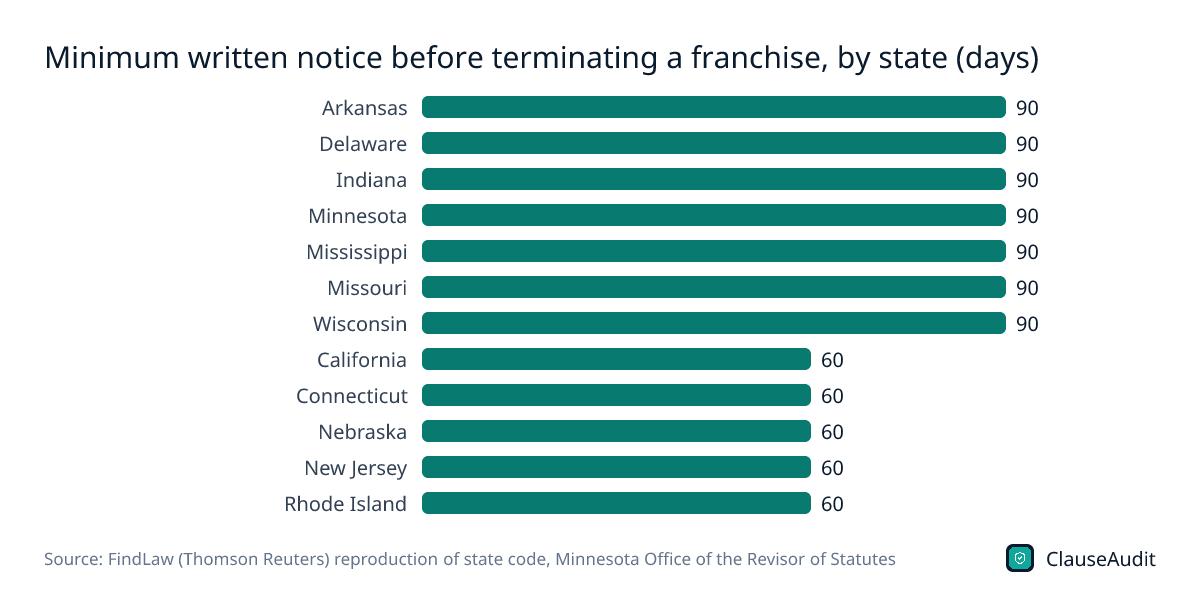
Minimum written notice before terminating a franchise, by state (days)
Chart data
| Label | Value |
|---|---|
| Arkansas | 90 |
| Delaware | 90 |
| Indiana | 90 |
| Minnesota | 90 |
| Mississippi | 90 |
| Missouri | 90 |
| Wisconsin | 90 |
| California | 60 |
| Connecticut | 60 |
| Nebraska | 60 |
| New Jersey | 60 |
| Rhode Island | 60 |
These are the states that write a fixed notice period into the statute. Notice is not the same as protection: most of these laws let the franchisor skip it for abandonment, bankruptcy or certain criminal convictions.
Download this chart (PNG)Cure period a franchisee gets after a default notice, by state (days)
Chart data
| Label | Value |
|---|---|
| California (minimum) | 60 |
| Minnesota | 60 |
| Wisconsin | 60 |
| Arkansas | 30 |
| Iowa (minimum; up to 90) | 30 |
| Rhode Island | 30 |
| Illinois (need not exceed) | 30 |
| Michigan (need not exceed) | 30 |
| Washington (need not exceed) | 30 |
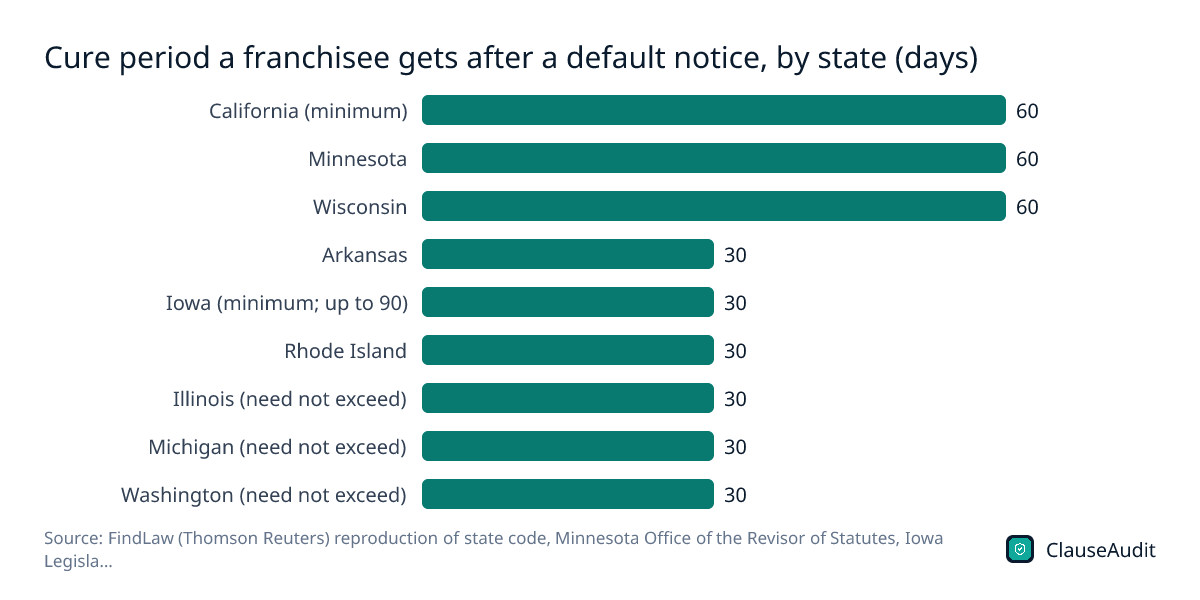
Read the labels carefully. California sets a floor of 60 days, while Illinois, Michigan and Washington set a ceiling, so the franchisor there can give you less than 30 days if that is reasonable.
Download this chart (PNG)States by type of general franchise termination law (50 states + DC) (jurisdictions)
Chart data
| Label | Value (jurisdictions) |
|---|---|
| Good cause required | 15 |
| Notice and cure only | 3 |
| No general statute found | 33 |
In 33 jurisdictions, a franchisee relies on contract terms alone. If you are buying in one of those states, and no industry-specific law covers your business, the cure and renewal language in your agreement is your only safety net.
Download this chart (PNG)Notice and conditions before a franchisor refuses to renew
| State | Nonrenewal rule | Statute |
|---|---|---|
| California | At least 180 days prior written notice, plus one listed condition | Bus. & Prof. Code § 20025 |
| Minnesota | At least 180 days written notice, and time to recover fair market value | § 80C.14 subd. 4 |
| Connecticut | At least 60 days written notice with cause stated; 6 months only for nonrenewal under § 42-133f(e) (franchisor-leased premises sold, leased, converted or lease lost) | § 42-133f(a), (e) |
| Iowa | At least 6 months notice, plus good cause or another listed ground | § 523H.8 |
| Illinois | Compensate franchisee unless 6 months notice given and noncompete waived | 815 ILCS 705/20 |
| Michigan | Compensation if under 6 months notice or noncompete enforced (terms under 5 years) | § 445.1527(d) |
| Washington | Pay for goodwill unless 1 year notice given and noncompete waived | RCW 19.100.180(2)(i) |
| Arkansas, Delaware, Indiana, Mississippi, Missouri, Wisconsin | 90 days notice | See state table |
| Nebraska, New Jersey, Rhode Island | 60 days notice | See state table |
Source: FindLaw (Thomson Reuters) reproduction of state code, Cal. Bus. & Prof. Code § 20025 (California Franchise Relations Act, nonrenewal); Minnesota Office of the Revisor of Statutes, Minn. Stat. § 80C.14 (Minnesota Franchise Act, unfair practices); FindLaw (Thomson Reuters) reproduction of state code, Conn. Gen. Stat. § 42-133f (Connecticut Franchise Act); Iowa Legislature, Iowa Code § 523H.8 (Nonrenewal of a franchise); FindLaw (Thomson Reuters) reproduction of state code, 815 ILCS 705/20 (Illinois Franchise Disclosure Act, nonrenewal); FindLaw (Thomson Reuters) reproduction of state code, Mich. Comp. Laws § 445.1527 (Michigan Franchise Investment Law, void provisions); Washington State Legislature, RCW 19.100.180 (Washington Franchise Investment Protection Act); FindLaw (Thomson Reuters) reproduction of state code, Ark. Code § 4-72-204 (Arkansas Franchise Practices Act); FindLaw (Thomson Reuters) reproduction of state code, 6 Del. C. § 2555 (Delaware Franchise Security Law, notice); FindLaw (Thomson Reuters) reproduction of state code, Ind. Code § 23-2-2.7-3 (notice of termination or nonrenewal); FindLaw (Thomson Reuters) reproduction of state code, Miss. Code § 75-24-53 (franchise termination notice); FindLaw (Thomson Reuters) reproduction of state code, Mo. Rev. Stat. § 407.405 (franchise termination notice); FindLaw (Thomson Reuters) reproduction of state code, Wis. Stat. § 135.04 (Wisconsin Fair Dealership Law, notice); FindLaw (Thomson Reuters) reproduction of state code, Neb. Rev. Stat. § 87-404 (Nebraska Franchise Practices Act); FindLaw (Thomson Reuters) reproduction of state code, N.J.S.A. 56:10-5 (New Jersey Franchise Practices Act); FindLaw (Thomson Reuters) reproduction of state code, R.I. Gen. Laws § 6-50-4 (Rhode Island Fair Dealership Act). Download as image
US franchise sector, 2026 IFA Franchising Economic Outlook
| Measure | Prior year | 2026 forecast | Change |
|---|---|---|---|
| Franchise establishments | 832,521 | 845,000 | +1.5% |
| Franchise output | $907.3 billion | $921.4 billion | +1.6% |
| Franchise GDP | $549.9 billion | $558.4 billion | +1.8% |
| Franchise employment | Not stated | Nearly 8.9 million | +1.8% (more than 150,000 jobs) |
Source: International Franchise Association, 2026 Franchising Economic Outlook (prepared by FRANdata). Download as image
General franchise termination protection by state
- 15Good cause required to terminate
- 3Notice and cure rules only
- 33No general statute found
- Good cause required to terminate15
- Notice and cure rules only3
- No general statute found33
| State | Good cause | Termination notice | Cure period | Nonrenewal | Source |
|---|---|---|---|---|---|
| Alabama | No general franchise relationship statute found | - | - | Contract terms govern | U.S. Federal Trade Commission, A Consumer's Guide to Buying a Franchise (September 2020) |
| Alaska | No general franchise relationship statute found | - | - | Contract terms govern | U.S. Federal Trade Commission, A Consumer's Guide to Buying a Franchise (September 2020) |
| Arizona | No general franchise relationship statute found | - | - | Contract terms govern | U.S. Federal Trade Commission, A Consumer's Guide to Buying a Franchise (September 2020) |
| Arkansas | Yes | 90 days written notice | 30 days | 90 days notice; good cause or non-arbitrary policy | Ark. Code § 4-72-204 |
| California | Yes (substantial noncompliance) | 60 days | At least 60 days, max 75 unless separately agreed | 180 days written notice plus a listed condition | Cal. Bus. & Prof. Code §§ 20020, 20025 |
| Colorado | No general franchise relationship statute found | - | - | Contract terms govern | U.S. Federal Trade Commission, A Consumer's Guide to Buying a Franchise (September 2020) |
| Connecticut | Yes | 60 days written notice | No express cure period | 60 days written notice, cause stated (6 months for nonrenewal under § 42-133f(e), franchisor-leased premises) | Conn. Gen. Stat. § 42-133f |
| Delaware | Yes (no termination without good cause or in bad faith) | 90 days notice | Not specified | 90 days notice; no unjust nonrenewal | 6 Del. C. §§ 2552, 2555 |
| District of Columbia | No general franchise relationship statute found | - | - | Contract terms govern | U.S. Federal Trade Commission, A Consumer's Guide to Buying a Franchise (September 2020) |
| Florida | No general franchise relationship statute found | - | - | Contract terms govern | U.S. Federal Trade Commission, A Consumer's Guide to Buying a Franchise (September 2020) |
| Georgia | No general franchise relationship statute found | - | - | Contract terms govern | U.S. Federal Trade Commission, A Consumer's Guide to Buying a Franchise (September 2020) |
| Hawaii | Yes, or under uniform current standards | Not specified | Reasonable period after written notice | Good cause or uniformly applied current standards; goodwill compensation if nonrenewal is to convert to franchisor-owned (§ 482E-6(3)) | Haw. Rev. Stat. § 482E-6 |
| Idaho | No general franchise relationship statute found | - | - | Contract terms govern | U.S. Federal Trade Commission, A Consumer's Guide to Buying a Franchise (September 2020) |
| Illinois | Yes | Not specified | Reasonable, need not exceed 30 days | 6 months notice, or compensate unless noncompete waived | 815 ILCS 705/19, 705/20 |
| Indiana | Yes (bans contract terms allowing termination without good cause or in bad faith) | 90 days, unless the agreement provides otherwise | Not specified | 90 days, unless the agreement provides otherwise | Ind. Code §§ 23-2-2.7-1(7), 23-2-2.7-3 |
| Iowa | Yes (legitimate business reason) | Written notice of basis | 30 to 90 days (30 for nonpayment) | 6 months notice plus good cause or other listed ground | Iowa Code §§ 523H.7, 523H.8 |
| Kansas | No general franchise relationship statute found | - | - | Contract terms govern | U.S. Federal Trade Commission, A Consumer's Guide to Buying a Franchise (September 2020) |
| Kentucky | No general franchise relationship statute found | - | - | Contract terms govern | U.S. Federal Trade Commission, A Consumer's Guide to Buying a Franchise (September 2020) |
| Louisiana | No general franchise relationship statute found | - | - | Contract terms govern | U.S. Federal Trade Commission, A Consumer's Guide to Buying a Franchise (September 2020) |
| Maine | No general franchise relationship statute found | - | - | Contract terms govern | U.S. Federal Trade Commission, A Consumer's Guide to Buying a Franchise (September 2020) |
| Maryland | No general franchise relationship statute found | - | - | Contract terms govern | U.S. Federal Trade Commission, A Consumer's Guide to Buying a Franchise (September 2020) |
| Massachusetts | No general franchise relationship statute found | - | - | Contract terms govern | U.S. Federal Trade Commission, A Consumer's Guide to Buying a Franchise (September 2020) |
| Michigan | Yes (contrary clause is void) | Not specified | Reasonable, need not exceed 30 days | Compensation if under 6 months notice or noncompete enforced (terms under 5 years) | Mich. Comp. Laws § 445.1527(c), (d) |
| Minnesota | Yes | 90 days written notice | 60 days | 180 days written notice | Minn. Stat. § 80C.14 subds. 3-4 |
| Mississippi | No general good-cause rule found | 90 days written notice | Not specified | 90 days | Miss. Code § 75-24-53 |
| Missouri | No general good-cause rule found | 90 days written notice | Not specified | 90 days | Mo. Rev. Stat. § 407.405 |
| Montana | No general franchise relationship statute found | - | - | Contract terms govern | U.S. Federal Trade Commission, A Consumer's Guide to Buying a Franchise (September 2020) |
| Nebraska | Yes | 60 days written notice (15 days for abandonment) | Not specified | 60 days; good cause required | Neb. Rev. Stat. § 87-404 |
| Nevada | No general franchise relationship statute found | - | - | Contract terms govern | U.S. Federal Trade Commission, A Consumer's Guide to Buying a Franchise (September 2020) |
| New Hampshire | No general franchise relationship statute found | - | - | Contract terms govern | U.S. Federal Trade Commission, A Consumer's Guide to Buying a Franchise (September 2020) |
| New Jersey | Yes (substantial noncompliance) | 60 days written notice (15 days for abandonment) | Not specified | 60 days; good cause required | N.J.S.A. 56:10-5 |
| New Mexico | No general franchise relationship statute found | - | - | Contract terms govern | U.S. Federal Trade Commission, A Consumer's Guide to Buying a Franchise (September 2020) |
| New York | No general franchise relationship statute found | - | - | Contract terms govern | U.S. Federal Trade Commission, A Consumer's Guide to Buying a Franchise (September 2020) |
| North Carolina | No general franchise relationship statute found | - | - | Contract terms govern | U.S. Federal Trade Commission, A Consumer's Guide to Buying a Franchise (September 2020) |
| North Dakota | No general franchise relationship statute found | - | - | Contract terms govern | U.S. Federal Trade Commission, A Consumer's Guide to Buying a Franchise (September 2020) |
| Ohio | No general franchise relationship statute found | - | - | Contract terms govern | U.S. Federal Trade Commission, A Consumer's Guide to Buying a Franchise (September 2020) |
| Oklahoma | No general franchise relationship statute found | - | - | Contract terms govern | U.S. Federal Trade Commission, A Consumer's Guide to Buying a Franchise (September 2020) |
| Oregon | No general franchise relationship statute found | - | - | Contract terms govern | U.S. Federal Trade Commission, A Consumer's Guide to Buying a Franchise (September 2020) |
| Pennsylvania | No general franchise relationship statute found | - | - | Contract terms govern | U.S. Federal Trade Commission, A Consumer's Guide to Buying a Franchise (September 2020) |
| Rhode Island | Listed grounds; no 'good cause' term in § 6-50-4 | 60 days written notice | 30 days (10 for nonpayment; 24 hours for health or safety) | 60 days | R.I. Gen. Laws § 6-50-4 |
| South Carolina | No general franchise relationship statute found | - | - | Contract terms govern | U.S. Federal Trade Commission, A Consumer's Guide to Buying a Franchise (September 2020) |
| South Dakota | No general franchise relationship statute found | - | - | Contract terms govern | U.S. Federal Trade Commission, A Consumer's Guide to Buying a Franchise (September 2020) |
| Tennessee | No general franchise relationship statute found | - | - | Contract terms govern | U.S. Federal Trade Commission, A Consumer's Guide to Buying a Franchise (September 2020) |
| Texas | No general franchise relationship statute found | - | - | Contract terms govern | U.S. Federal Trade Commission, A Consumer's Guide to Buying a Franchise (September 2020) |
| Utah | No general franchise relationship statute found | - | - | Contract terms govern | U.S. Federal Trade Commission, A Consumer's Guide to Buying a Franchise (September 2020) |
| Vermont | No general franchise relationship statute found | - | - | Contract terms govern | U.S. Federal Trade Commission, A Consumer's Guide to Buying a Franchise (September 2020) |
| Virginia | Reasonable cause | Not specified | Not specified | Not specified | Va. Code §§ 13.1-564, 13.1-563, 13.1-559(D) |
| Washington | Yes | Written notice | Reasonable, need not exceed 30 days | Compensate for goodwill unless 1 year notice and noncompete waived | RCW 19.100.180(2)(i)-(j) |
| West Virginia | No general franchise relationship statute found | - | - | Contract terms govern | U.S. Federal Trade Commission, A Consumer's Guide to Buying a Franchise (September 2020) |
| Wisconsin | Yes | 90 days written notice | 60 days (10 days for nonpayment) | 90 days; good cause required | Wis. Stat. §§ 135.03, 135.04 |
| Wyoming | No general franchise relationship statute found | - | - | Contract terms govern | U.S. Federal Trade Commission, A Consumer's Guide to Buying a Franchise (September 2020) |
Can a franchisor terminate a franchise without cause?
It depends on where you are. In the 15 states that require good cause, a franchisor generally has to point to a real failure on your part, such as missing payments or breaking brand standards, before it can end the agreement early. Virginia uses the phrase reasonable cause, but the idea is close.
In the 33 jurisdictions with no general relationship statute, you are back to the contract. If the agreement lets the franchisor terminate for any breach, however small, or on short notice, a court will often enforce it as written. The federal FTC Franchise Rule does not help here. It covers what the franchisor must disclose before you buy, not how it may end the relationship.
Good cause also has limits. California, for instance, lists grounds that allow immediate termination with no cure period at all. Most of the other statutes have a similar list: abandoning the location, bankruptcy, a conviction tied to the business, or a repeat of the same default.
Here is a concrete example. Say you run a sandwich shop and fail a single surprise inspection on uniform rules. In a good cause state, that alone is unlikely to justify ending the franchise, and you would normally get notice and time to fix it. In a state with no statute, a contract that calls any brand standards violation a material default could let the franchisor move straight to termination.
How much notice does a franchisor have to give before terminating?
Where a statute sets a number, it lands at either 60 or 90 days. Minnesota, Wisconsin, Delaware, Arkansas and Indiana sit at 90 days. California, Connecticut, Nebraska, New Jersey and Rhode Island use 60 days. Mississippi and Missouri also require 90 days of written notice even though they do not have a general good cause rule.
The exceptions matter as much as the headline number. Nebraska and New Jersey drop the notice to 15 days for abandonment. Minnesota lets notice take effect immediately in a few cases, including a failure to cure a goodwill-damaging default within 24 hours. Indiana's 90 days applies unless the agreement says otherwise, so a contract can quietly shorten it.
Gas station operators have an extra layer. The federal Petroleum Marketing Practices Act requires 90 days' notice before a motor fuel franchise is ended or not renewed, in every state.
What is a cure period, and how long do you get?
A cure period is the window between a default notice and the actual termination, during which you can fix the problem and keep your franchise. It is the single most useful protection for an operator who hits a bad quarter.
California, Minnesota and Wisconsin give 60 days. California caps its cure period at 75 days unless you agree otherwise. Iowa sets a range of 30 to 90 days, Rhode Island gives 30 days, and Arkansas gives 30 days. Unpaid fees get less time in several states: 10 days in Wisconsin and Rhode Island, and Iowa's cure for nonpayment need not exceed 30 days.
If your state has no cure rule, look for one in the contract. A clause that lets the franchisor terminate on notice with no chance to cure is a serious red flag, and it is one of the easier terms to push back on before you sign.
Pay attention to what counts as a cure. Some agreements say a default is cured only if it never happens again within a set period. That turns a fixable mistake into a strike that can be counted against you later, so ask how repeat defaults are treated before you sign.
Can a franchisor refuse to renew your franchise?
Nonrenewal is where many owners get caught. You may have built the business for a decade, and the agreement simply expires. Several states treat that moment differently from a mid-term termination.
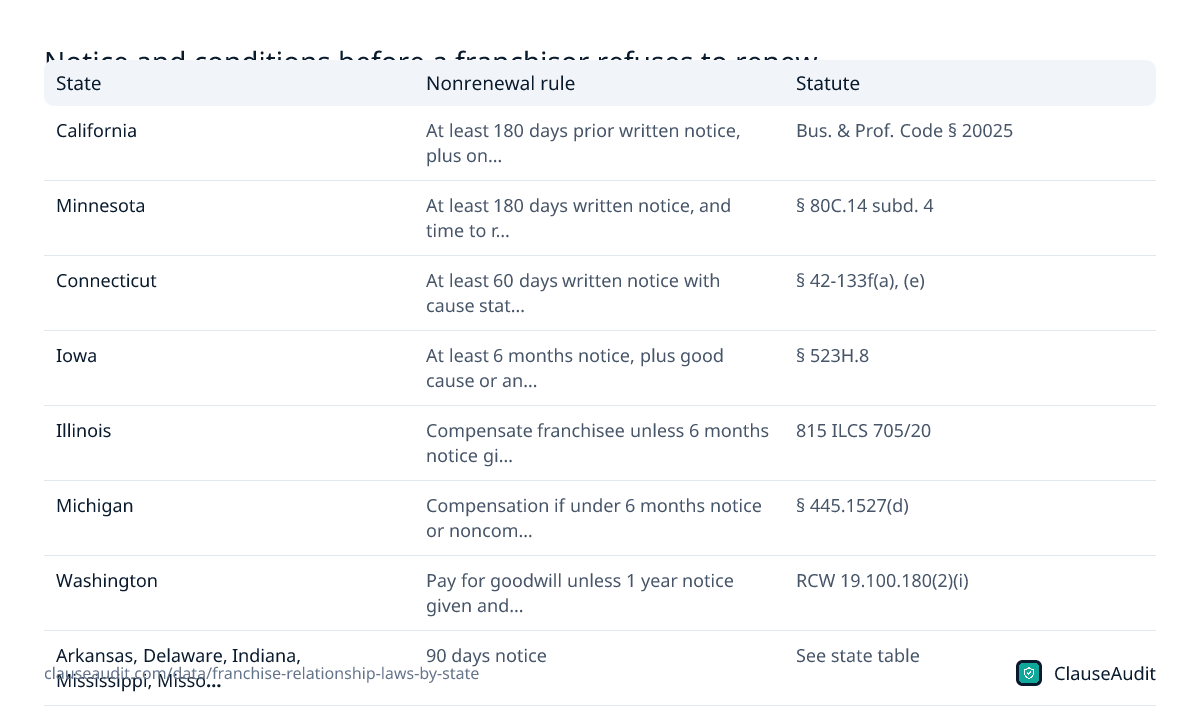
California requires 180 days of written notice and one of a set of listed conditions. Minnesota also requires 180 days. Iowa requires 6 months plus good cause or another listed ground. Illinois, Michigan and Washington take a different route: the franchisor can decline to renew, but it may owe you compensation unless it gives long notice and waives the noncompete. In Washington that notice is one year.
That noncompete link is worth noticing. If the franchisor refuses to renew and also holds you to a post-term noncompete, you lose the business and the ability to keep working in your trade. Some states push back on that combination.
Before your term ends, mark the renewal notice deadline in your calendar. Many agreements require you to ask for renewal in writing within a narrow window, and missing it can give the franchisor a clean reason to say no, even in a state with strong protection.
Why the location of your business decides which rules apply
Relationship laws usually protect franchisees whose business is located in the state, or who live there, depending on how the statute is written. A franchisor based in Texas that sells you a unit in Minnesota generally still has to follow Minnesota's notice and cure rules.
Franchisors know this, so many agreements include a choice-of-law clause pointing to their home state. Many relationship laws say their protections cannot be waived, but a dispute over which law applies still costs time and money. If you are buying in a protected state, make sure nothing in the agreement asks you to give that up.
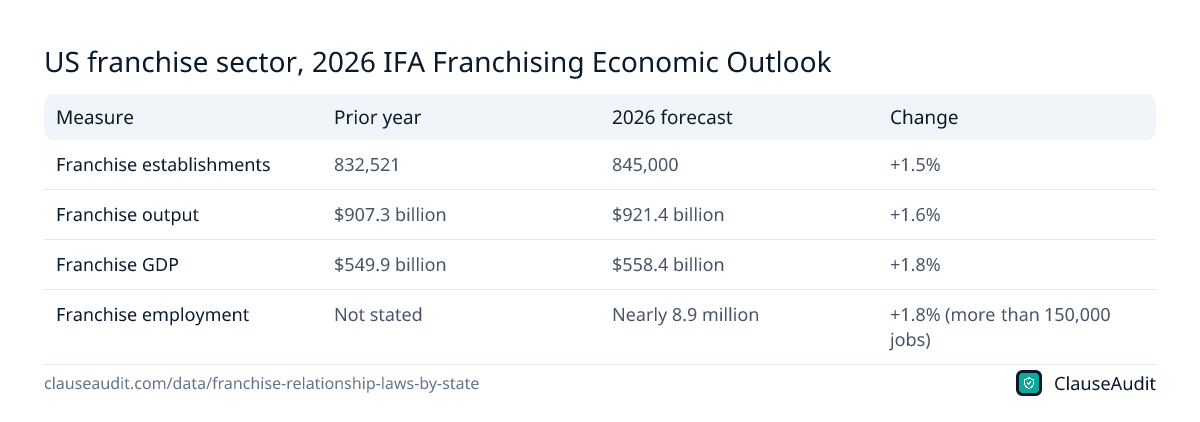
Keep the scale in mind too. The IFA's 2026 outlook forecasts 845,000 US franchise establishments in 2026, up 1.5%, and each franchised unit runs under an agreement with termination terms. Plenty of owners never reread those terms until a dispute starts.
What to do if your state has no franchise relationship law
- Ask for a written cure period for every default that can be fixed, and a longer one than the draft offers.
- Replace vague grounds like failure to meet brand standards with specific, measurable ones.
- Negotiate a renewal right on stated conditions, with a firm notice deadline for any nonrenewal.
- Tie the post-term noncompete to termination for your own breach, not to the franchisor's choice not to renew.
- Check whether a choice-of-law clause points to a state with weaker protection than yours.
- Look for industry rules that still apply, such as the federal gasoline law or a state dealer statute.
How ClauseAudit helps
State law sets the floor, but your franchise agreement decides most of what happens when things go wrong. Our automated review of franchise agreements reads the termination, renewal and post-term sections and flags terms that fall short of your state's rules or leave you with no notice at all.
Upload your agreement and you get each risky clause in plain English, with a suggested change you can bring to the franchisor.
- Termination grounds: whether the franchisor can end the deal for minor or vague breaches
- Notice and cure: how many days you get to fix a default, and whether nonpayment is treated differently
- Renewal rights: the conditions, fees and notice deadline for renewing or refusing to renew
- Post-term noncompete: how long and how far it reaches after termination or nonrenewal
- Choice of law and venue: whether the contract sidesteps your home state's protections
- Cross-default clauses: whether a breach under a lease or another unit can end this franchise
Frequently asked questions
Which states require good cause to terminate a franchise?
Fifteen states have a general good cause rule in this dataset, including California, Minnesota, Wisconsin, Iowa, Illinois, Michigan, Washington, New Jersey and Virginia, which uses reasonable cause. Three more set notice rules without a general good cause test. The remaining 33 jurisdictions leave termination to the contract.
How long is the cure period in California?
California requires at least 60 days from the notice of noncompliance to cure a default before termination. The cure period is capped at 75 days unless a separate agreement says otherwise. California also lists grounds, such as abandonment or bankruptcy, where a franchisor can terminate without giving a cure period.
How much notice is required before a franchise is not renewed?
It varies widely. California and Minnesota require 180 days of written notice. Iowa requires 6 months. Washington franchisors must pay for goodwill unless they give one year of notice and waive the noncompete. Several other states require 60 or 90 days. In states without a statute, the agreement sets the deadline.
Does the FTC Franchise Rule protect against termination?
No. The FTC Franchise Rule is a presale disclosure rule. It requires the franchisor to hand you a disclosure document before you buy, but it does not limit when or how the franchisor can end the relationship. Termination protection comes from state relationship laws or, for gas stations, a separate federal statute.
What is the notice period for terminating a gas station franchise?
The federal Petroleum Marketing Practices Act generally requires 90 days of notice before a motor fuel franchise is terminated or not renewed. It applies in every state, but only to gasoline and motor fuel franchises. Shorter notice is allowed where giving 90 days would not be reasonable.
Does Wisconsin's dealership law cover franchises?
Often, yes. The Wisconsin Fair Dealership Law covers many franchise relationships. It requires 90 days of written notice before terminating, cancelling or not renewing, and gives the dealer 60 days to fix the claimed problem. For nonpayment, the cure window is 10 days. Whether your deal qualifies depends on the facts.
Can a franchise agreement waive state termination protections?
Many relationship laws say their protections cannot be waived, and Michigan treats a contrary clause as void. Some rules have built-in flexibility, though. Indiana's 90-day notice applies unless the agreement provides otherwise. A choice-of-law clause naming another state can also cause disputes, so read it closely.
What should I do if I receive a default notice?
Read the notice for the exact reasons and deadline, then check your agreement and your state's cure rules. Fix what you can in writing and keep proof. If the franchisor gives less time than your state requires, raise that in writing. A franchise attorney can tell you whether the notice is valid.
Use this data
Every chart and card below is free to reuse under CC BY 4.0. Download what you need and link back to this page.
 Stat cards
 Key findings card
 Infographic
 Minimum written notice before terminating a franchise, by state (days)
 Cure period a franchisee gets after a default notice, by state (days)
 States by type of general franchise termination law (50 states + DC) (jurisdictions)
 Notice and conditions before a franchisor refuses to renew
 US franchise sector, 2026 IFA Franchising Economic Outlook
Embed the infographic
Free to share on your site, blog or slides under CC BY 4.0. Please keep the credit link.
Sources and method
Every number on this page comes from the sources below, each opened and read on or before October 18, 2026. A second, independent review checked every figure against its source and corrected anything that did not match. 51 of 51 state entries were confirmed; any that could not be are marked "Not yet confirmed" and left out of every count and chart.
- FindLaw (Thomson Reuters) reproduction of state code, Cal. Bus. & Prof. Code § 20020 (California Franchise Relations Act, termination) (Current as of January 01, 2026)
- FindLaw (Thomson Reuters) reproduction of state code, Cal. Bus. & Prof. Code § 20025 (California Franchise Relations Act, nonrenewal) (Current as of January 01, 2026)
- FindLaw (Thomson Reuters) reproduction of state code, Ark. Code § 4-72-204 (Arkansas Franchise Practices Act) (Current as of March 28, 2024)
- FindLaw (Thomson Reuters) reproduction of state code, Conn. Gen. Stat. § 42-133f (Connecticut Franchise Act) (Current as of January 01, 2025)
- FindLaw (Thomson Reuters) reproduction of state code, 6 Del. C. § 2552 (Delaware Franchise Security Law, unjust termination) (Current as of January 01, 2026)
- FindLaw (Thomson Reuters) reproduction of state code, 6 Del. C. § 2555 (Delaware Franchise Security Law, notice) (Current as of January 01, 2026)
- FindLaw (Thomson Reuters) reproduction of state code, Haw. Rev. Stat. § 482E-6 (Hawaii Franchise Investment Law) (Current as of January 01, 2025)
- FindLaw (Thomson Reuters) reproduction of state code, 815 ILCS 705/19 (Illinois Franchise Disclosure Act, termination) (Current as of January 01, 2025)
- FindLaw (Thomson Reuters) reproduction of state code, 815 ILCS 705/20 (Illinois Franchise Disclosure Act, nonrenewal) (Current as of January 01, 2025)
- FindLaw (Thomson Reuters) reproduction of state code, Ind. Code § 23-2-2.7-1 (Indiana Deceptive Franchise Practices Act) (Current as of January 01, 2026)
- FindLaw (Thomson Reuters) reproduction of state code, Ind. Code § 23-2-2.7-3 (notice of termination or nonrenewal) (Current as of January 01, 2026)
- Iowa Legislature, Iowa Code § 523H.7 (Termination) (Iowa Code 2026)
- Iowa Legislature, Iowa Code § 523H.8 (Nonrenewal of a franchise) (Iowa Code 2026)
- FindLaw (Thomson Reuters) reproduction of state code, Mich. Comp. Laws § 445.1527 (Michigan Franchise Investment Law, void provisions) (Current as of January 01, 2025)
- Minnesota Office of the Revisor of Statutes, Minn. Stat. § 80C.14 (Minnesota Franchise Act, unfair practices) (Minnesota Statutes, history through 1989 c 198 s 1 (read October 2026))
- FindLaw (Thomson Reuters) reproduction of state code, Miss. Code § 75-24-53 (franchise termination notice) (Current as of January 01, 2025)
- FindLaw (Thomson Reuters) reproduction of state code, Mo. Rev. Stat. § 407.405 (franchise termination notice) (Current as of January 01, 2025)
- FindLaw (Thomson Reuters) reproduction of state code, Neb. Rev. Stat. § 87-404 (Nebraska Franchise Practices Act) (Current as of January 01, 2024)
- FindLaw (Thomson Reuters) reproduction of state code, N.J.S.A. 56:10-5 (New Jersey Franchise Practices Act) (Current as of January 01, 2024)
- FindLaw (Thomson Reuters) reproduction of state code, R.I. Gen. Laws § 6-50-4 (Rhode Island Fair Dealership Act) (Current as of January 01, 2026)
- Virginia General Assembly, Legislative Information System, Va. Code § 13.1-564 (Virginia Retail Franchising Act) (1972, c. 561 (read October 2026))
- Washington State Legislature, RCW 19.100.180 (Washington Franchise Investment Protection Act) (Revised Code of Washington (read October 2026))
- FindLaw (Thomson Reuters) reproduction of state code, Wis. Stat. § 135.03 (Wisconsin Fair Dealership Law, good cause) (Current as of January 01, 2025)
- FindLaw (Thomson Reuters) reproduction of state code, Wis. Stat. § 135.04 (Wisconsin Fair Dealership Law, notice) (Current as of January 01, 2025)
- Legal Information Institute, Cornell Law School, 15 U.S.C. § 2804, Petroleum Marketing Practices Act, notification requirements (U.S. Code (read October 2026))
- U.S. Federal Trade Commission, A Consumer's Guide to Buying a Franchise (September 2020)
- International Franchise Association, 2026 Franchising Economic Outlook (prepared by FRANdata) (2026 edition)
- Virginia General Assembly, Legislative Information System, Va. Code § 13.1-563 (Virginia Retail Franchising Act, unlawful offers; amended 2026, cc. 553, 554) (As amended by 2026 Acts cc. 553 and 554 (read October 2026))
- Virginia General Assembly, Legislative Information System, Va. Code § 13.1-559 (Virginia Retail Franchising Act; subsection D added 2026, cc. 553, 554) (As amended by 2026 Acts cc. 553 and 554 (read October 2026))
- DLA Piper, Virginia enacts prohibition of post-termination non-competes in franchise agreements (April 2026)
Cite this page
ClauseAudit, “Franchise Termination and Non-Renewal Laws by State (Good Cause, Notice and Cure Periods)”, updated October 18, 2026, https://clauseaudit.com/data/franchise-relationship-laws-by-state. Free to reuse with a link back (CC BY 4.0).
This page summarises published data and law as checked on October 18, 2026. Figures are updated as new editions are released, and your own situation may differ. It is general information, not legal, tax or financial advice.