Franchise Registration States: Registration, Filing and Business Opportunity States (2026)
By ClauseAudit Research · 31 sources ·
Which states are franchise registration states?
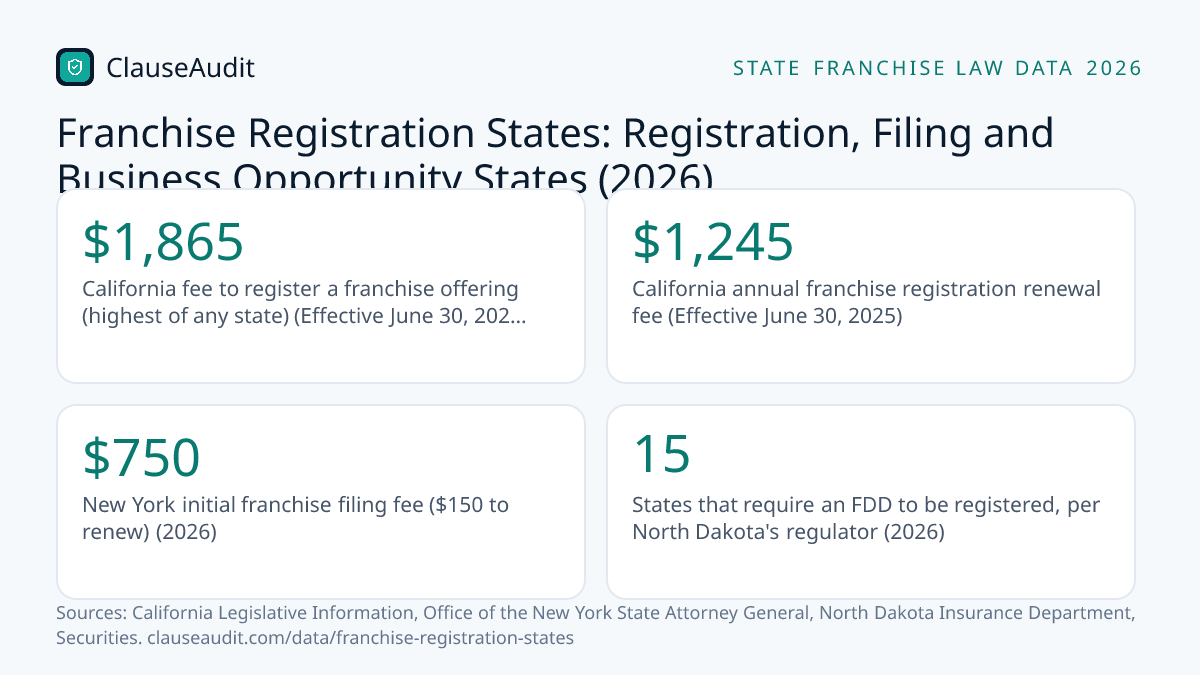
The page's state table lists 11 franchise registration states and 3 notice-filing states, for 14 in total. California charges the most at $1,865 to register, plus $1,245 every year to renew. Another group of business opportunity states, such as Texas and Florida, only want a short exemption filing from franchisors.

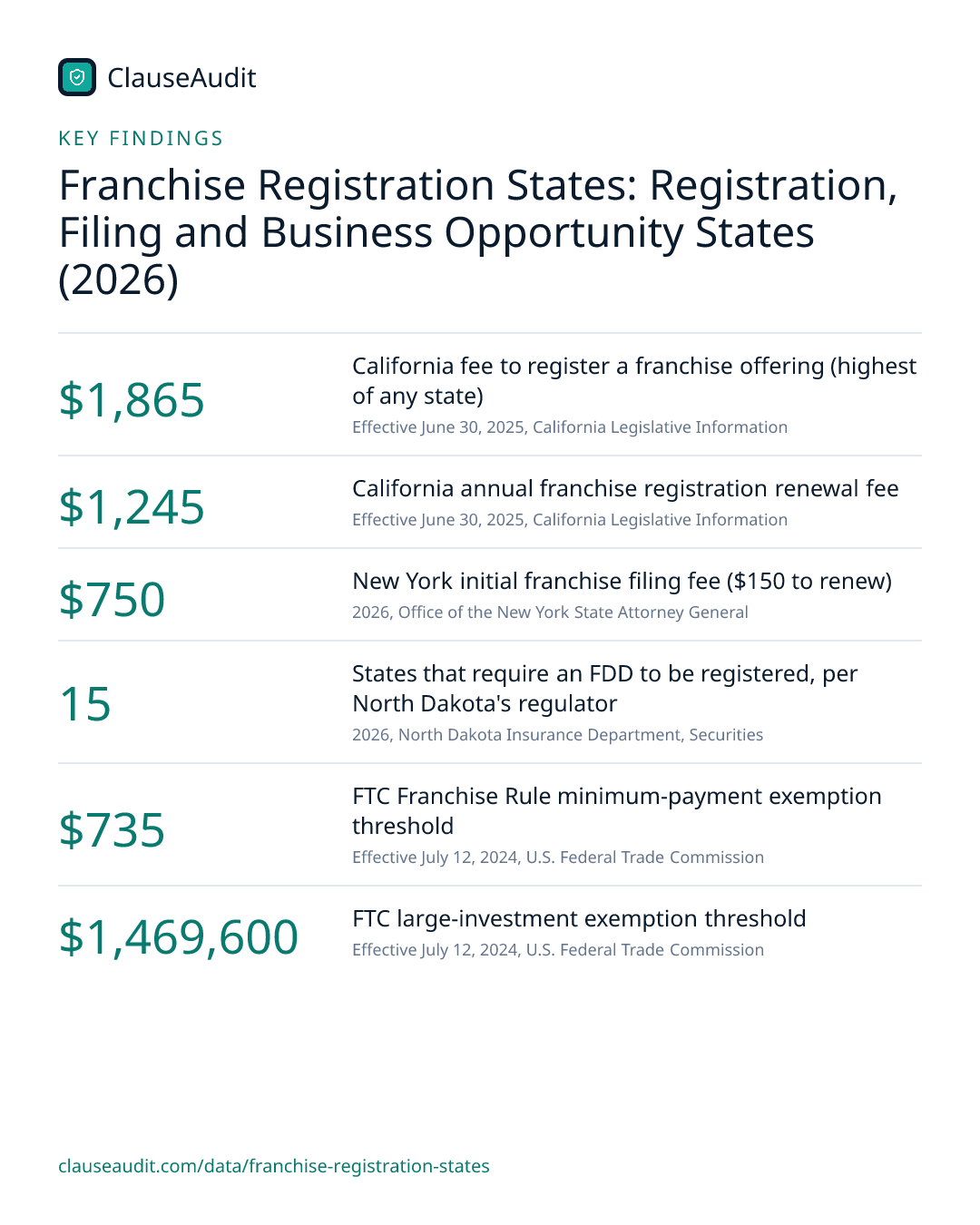
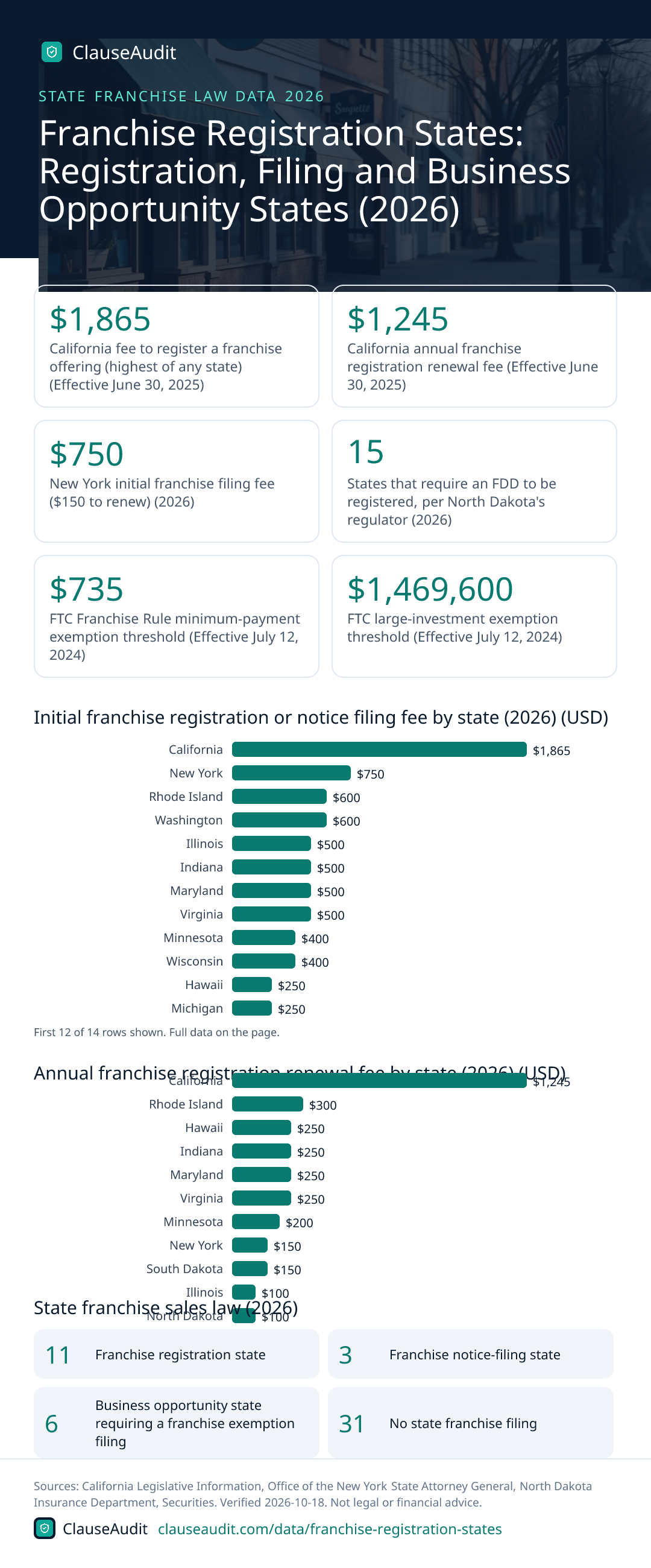
- California fee to register a franchise offering (highest of any state) (Effective June 30, 2025, California Legislative Information)
- $1,865
- California annual franchise registration renewal fee (Effective June 30, 2025, California Legislative Information)
- $1,245
- New York initial franchise filing fee ($150 to renew) (2026, Office of the New York State Attorney General)
- $750
- States that require an FDD to be registered, per North Dakota's regulator (2026, North Dakota Insurance Department, Securities)
- 15
- FTC Franchise Rule minimum-payment exemption threshold (Effective July 12, 2024, U.S. Federal Trade Commission)
- $735
- FTC large-investment exemption threshold (Effective July 12, 2024, U.S. Federal Trade Commission)
- $1,469,600
- FTC large-franchisee net worth exemption threshold (Effective July 12, 2024, U.S. Federal Trade Commission)
- $7,348,000
- Texas one-time business opportunity exemption notice fee for franchisors (2026, Texas Secretary of State)
- $25
Under the FTC Franchise Rule, a US franchisor has to hand buyers a Franchise Disclosure Document unless the sale fits one of the Rule's exemptions. A smaller group of states goes further. They want that FDD filed with a state office, sometimes reviewed line by line, before anyone in the state is offered a franchise.
If you are buying a franchise, this tells you how much outside scrutiny your FDD has had. If you are selling one, it tells you where you can't offer a unit until the paperwork clears, and what each state charges to keep you on its books.
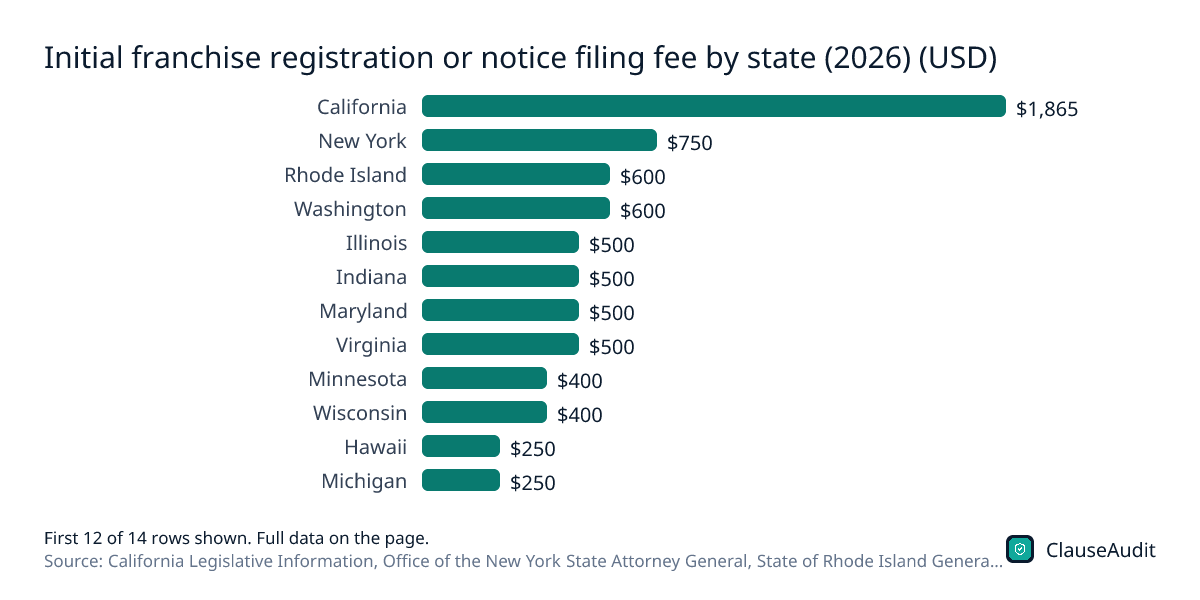
Initial franchise registration or notice filing fee by state (2026) (USD)
Chart data
| Label | Value |
|---|---|
| California | $1,865 |
| New York | $750 |
| Rhode Island | $600 |
| Washington | $600 |
| Illinois | $500 |
| Indiana | $500 |
| Maryland | $500 |
| Virginia | $500 |
| Minnesota | $400 |
| Wisconsin | $400 |
| Hawaii | $250 |
| Michigan | $250 |
| North Dakota | $250 |
| South Dakota | $250 |
California's $1,865 fee is more than double New York's $750, the next highest. Most registration states sit at $500 or below, so the fee is rarely the real cost; the legal work to prepare and amend each state filing is.
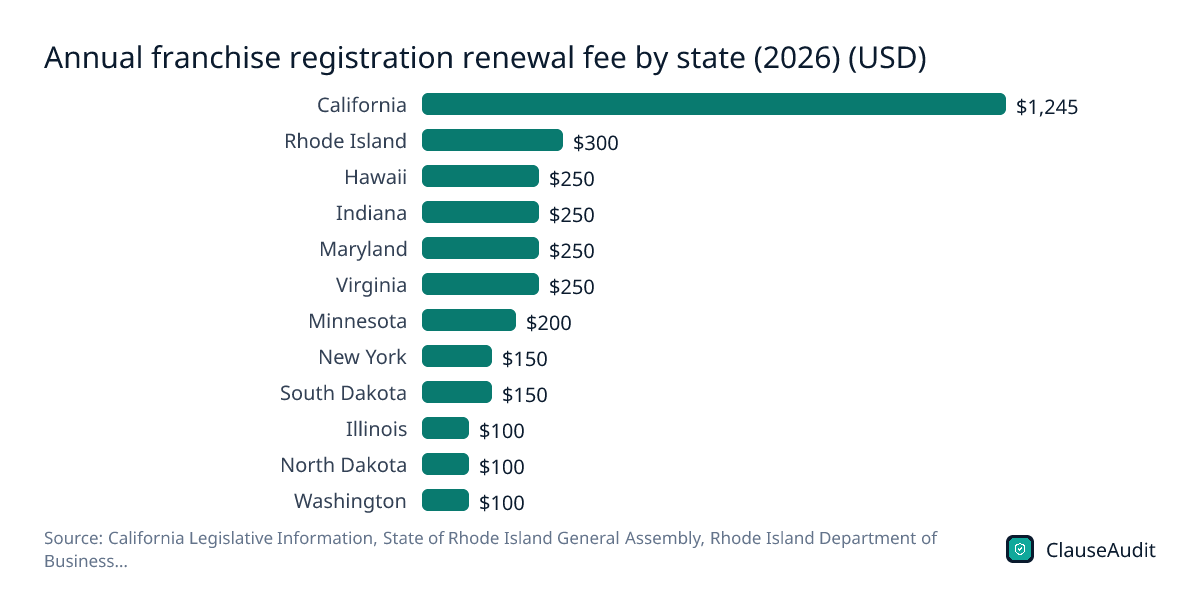
Download this chart (PNG)Annual franchise registration renewal fee by state (2026) (USD)
Chart data
| Label | Value |
|---|---|
| California | $1,245 |
| Rhode Island | $300 |
| Hawaii | $250 |
| Indiana | $250 |
| Maryland | $250 |
| Virginia | $250 |
| Minnesota | $200 |
| New York | $150 |
| South Dakota | $150 |
| Illinois | $100 |
| North Dakota | $100 |
| Washington | $100 |
Renewals are where costs add up over time. California's $1,245 renewal alone is more than any other state charges for an initial filing.
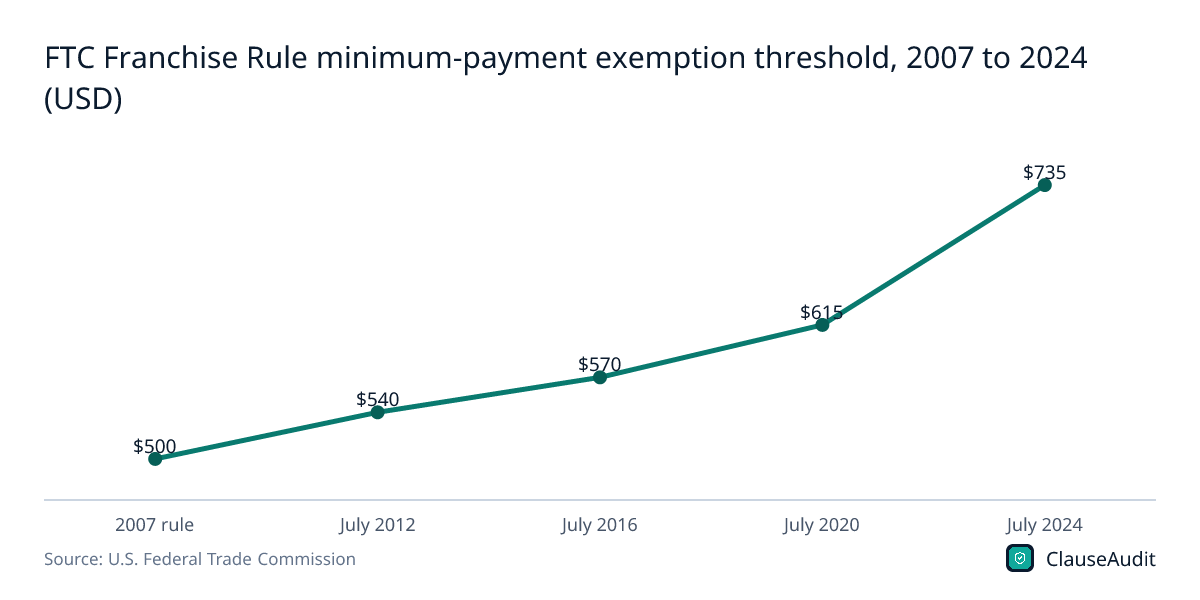
Download this chart (PNG)FTC Franchise Rule minimum-payment exemption threshold, 2007 to 2024 (USD)
Chart data
| Label | Value (USD) |
|---|---|
| 2007 rule | $500 |
| July 2012 | $540 |
| July 2016 | $570 |
| July 2020 | $615 |
| July 2024 | $735 |
If a buyer pays the franchisor less than $735, the deal falls outside the federal Rule. Since the FTC adjusts this every four years, check the date on any guide that quotes an older figure.
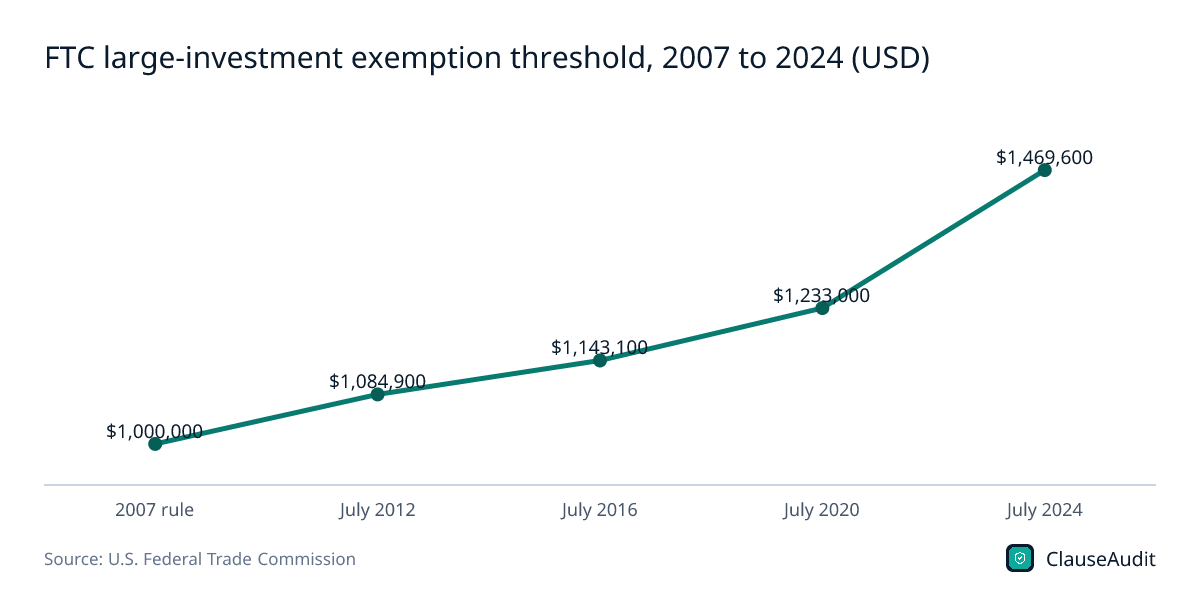
Download this chart (PNG)FTC large-investment exemption threshold, 2007 to 2024 (USD)
Chart data
| Label | Value (USD) |
|---|---|
| 2007 rule | $1,000,000 |
| July 2012 | $1,084,900 |
| July 2016 | $1,143,100 |
| July 2020 | $1,233,000 |
| July 2024 | $1,469,600 |
A buyer investing at least $1,469,600 can lose federal disclosure protection. Unimproved land and franchisor financing don't count toward the total.
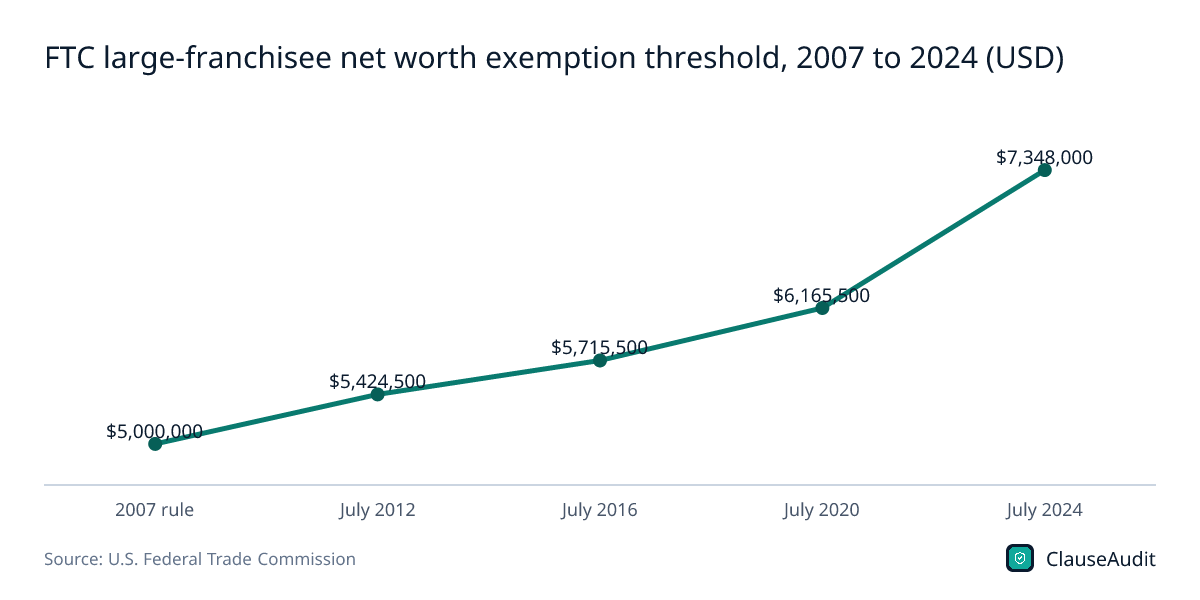
Download this chart (PNG)FTC large-franchisee net worth exemption threshold, 2007 to 2024 (USD)
Chart data
| Label | Value (USD) |
|---|---|
| 2007 rule | $5,000,000 |
| July 2012 | $5,424,500 |
| July 2016 | $5,715,500 |
| July 2020 | $6,165,500 |
| July 2024 | $7,348,000 |
Large franchisees worth at least $7,348,000 and in business for five years can be sold to without an FDD. Most first-time owners are nowhere near this line.
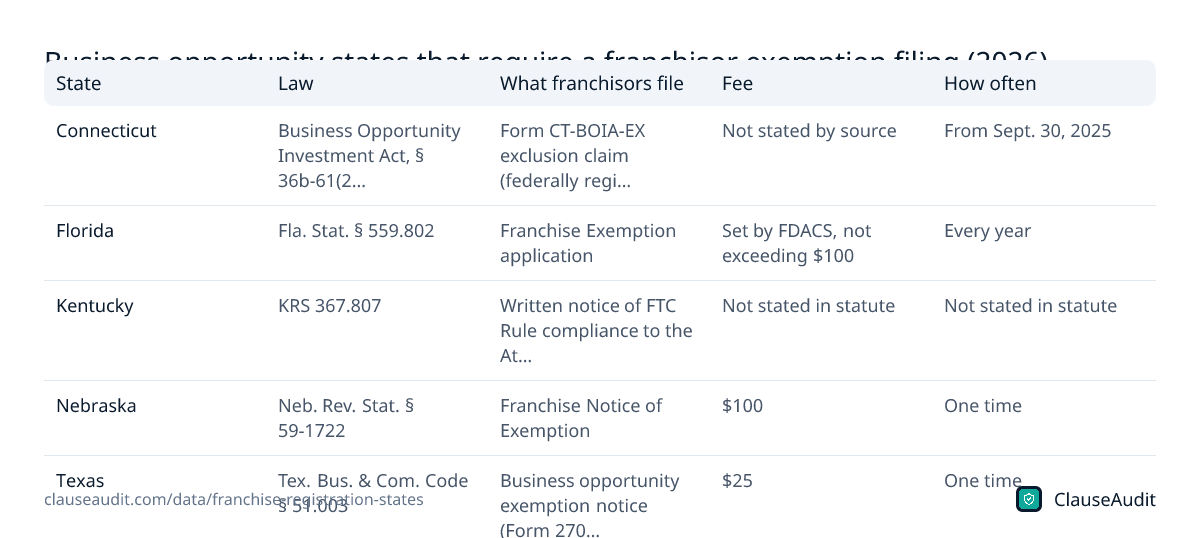
Download this chart (PNG)Business opportunity states that require a franchisor exemption filing (2026)
| State | Law | What franchisors file | Fee | How often |
|---|---|---|---|---|
| Connecticut | Business Opportunity Investment Act, § 36b-61(2)(D) | Form CT-BOIA-EX exclusion claim (federally registered trademark) | Not stated by source | From Sept. 30, 2025 |
| Florida | Fla. Stat. § 559.802 | Franchise Exemption application | Set by FDACS, not exceeding $100 | Every year |
| Kentucky | KRS 367.807 | Written notice of FTC Rule compliance to the Attorney General | Not stated in statute | Not stated in statute |
| Nebraska | Neb. Rev. Stat. § 59-1722 | Franchise Notice of Exemption | $100 | One time |
| Texas | Tex. Bus. & Com. Code § 51.003 | Business opportunity exemption notice (Form 2703) | $25 | One time |
| Utah | Business Opportunity Disclosure Act, Utah Code Title 13, Ch. 15 | Franchise proof of notice filing | $100 (per Division FAQ) | Every year |
Source: Connecticut Department of Banking, Fall 2025 Securities Bulletin; The Florida Legislature, Florida Statutes § 559.802, Franchise exemption; Florida Department of Agriculture and Consumer Services, Sellers of Business Franchises; Kentucky Legislative Research Commission, KRS 367.807 Exemptions from registration; Nebraska Department of Banking and Finance, Seller-Assisted Marketing Plan Act, Neb. Rev. Stat. §§ 59-1701 to 59-1762 (§ 59-1722); Nebraska Department of Banking and Finance, Business Opportunities & Franchises; Texas Secretary of State, Frequently Asked Questions for Form Series 2700 - Business Opportunities; Utah Department of Commerce, Division of Consumer Protection, Business Opportunities - Frequently Asked Questions. Download as image
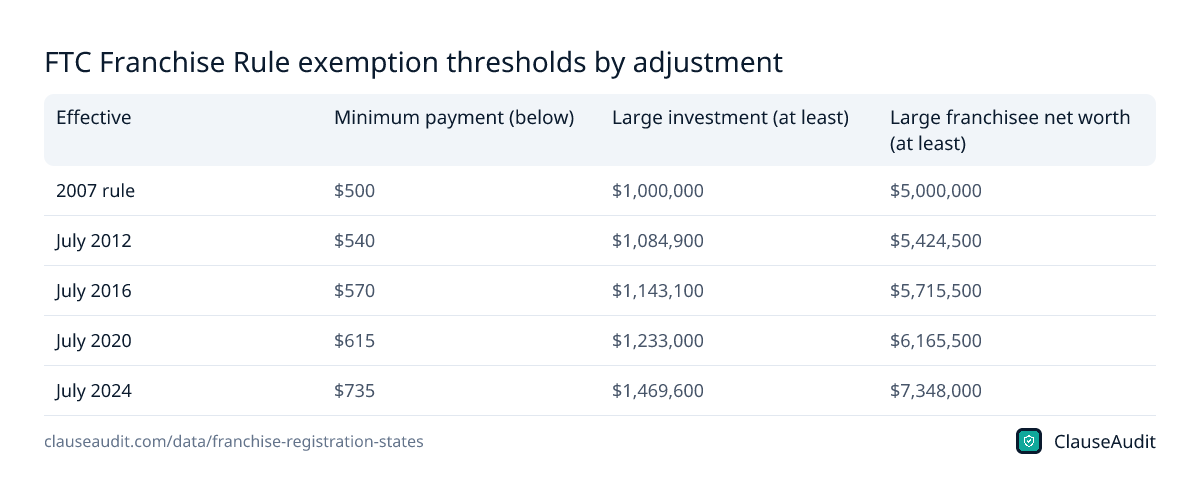
FTC Franchise Rule exemption thresholds by adjustment
| Effective | Minimum payment (below) | Large investment (at least) | Large franchisee net worth (at least) |
|---|---|---|---|
| 2007 rule | $500 | $1,000,000 | $5,000,000 |
| July 2012 | $540 | $1,084,900 | $5,424,500 |
| July 2016 | $570 | $1,143,100 | $5,715,500 |
| July 2020 | $615 | $1,233,000 | $6,165,500 |
| July 2024 | $735 | $1,469,600 | $7,348,000 |
Source: U.S. Federal Trade Commission, FTC Amends Franchise Rule to Revise Monetary Thresholds for Three Exemptions; U.S. Federal Trade Commission, FTC Adjusts Monetary Thresholds for Three Exemptions in Franchise Rule; U.S. Federal Trade Commission, FTC Adjusts Monetary Thresholds for Three Exemptions in Franchise Rule; U.S. Federal Trade Commission, FTC Publishes Inflation-Adjusted Monetary Thresholds for Three Exemptions in Franchise Rule. Download as image
State franchise sales law (2026) by state
- 11Franchise registration state
- 3Franchise notice-filing state
- 6Business opportunity state requiring a franchise exemption filing
- 31No state franchise filing
- Franchise registration state11
- Franchise notice-filing state3
- Business opportunity state requiring a franchise exemption filing6
- No state franchise filing31
| State | Initial filing fee | Renewal | Amendment fee | Regulator | Source |
|---|---|---|---|---|---|
| Alabama | None | None | None | No state franchise filing; FTC Franchise Rule applies | U.S. Federal Trade Commission: Franchise Rule (16 CFR Parts 436 and 437) |
| Alaska | None | None | None | No state franchise filing; FTC Franchise Rule applies | U.S. Federal Trade Commission: Franchise Rule (16 CFR Parts 436 and 437) |
| Arizona | None | None | None | No state franchise filing; FTC Franchise Rule applies | U.S. Federal Trade Commission: Franchise Rule (16 CFR Parts 436 and 437) |
| Arkansas | None | None | None | No state franchise filing; FTC Franchise Rule applies | U.S. Federal Trade Commission: Franchise Rule (16 CFR Parts 436 and 437) |
| California | $1,865 | $1,245 | $50 | Department of Financial Protection and Innovation | Cal. Corp. Code § 31000 et seq.; fees § 31500 |
| Colorado | None | None | None | No state franchise filing; FTC Franchise Rule applies | U.S. Federal Trade Commission: Franchise Rule (16 CFR Parts 436 and 437) |
| Connecticut | Exclusion claim (Form CT-BOIA-EX) | Not stated by source | Not applicable | Department of Banking | Conn. Gen. Stat. ch. 672c, § 36b-61(2)(D) |
| Delaware | None | None | None | No state franchise filing; FTC Franchise Rule applies | U.S. Federal Trade Commission: Franchise Rule (16 CFR Parts 436 and 437) |
| District of Columbia | None | None | None | No state franchise filing; FTC Franchise Rule applies | U.S. Federal Trade Commission: Franchise Rule (16 CFR Parts 436 and 437) |
| Florida | Up to $100 (set by FDACS) | Annual renewal, up to $100 | Not applicable | Department of Agriculture and Consumer Services | Fla. Stat. § 559.802 |
| Georgia | None | None | None | No state franchise filing; FTC Franchise Rule applies | U.S. Federal Trade Commission: Franchise Rule (16 CFR Parts 436 and 437) |
| Hawaii | $250 | $250 | $250 | Department of Commerce and Consumer Affairs | Haw. Rev. Stat. ch. 482E; fees § 482E-11 |
| Idaho | None | None | None | No state franchise filing; FTC Franchise Rule applies | U.S. Federal Trade Commission: Franchise Rule (16 CFR Parts 436 and 437) |
| Illinois | $500 | $100 | $100 (material change) or $25 | Attorney General, Franchise Bureau | 815 ILCS 705; fees 705/40 |
| Indiana | $500 | $250 | Not listed by source | Secretary of State, Securities Division | Ind. Code 23-2-2.5 |
| Iowa | None | None | None | No state franchise filing; FTC Franchise Rule applies | U.S. Federal Trade Commission: Franchise Rule (16 CFR Parts 436 and 437) |
| Kansas | None | None | None | No state franchise filing; FTC Franchise Rule applies | U.S. Federal Trade Commission: Franchise Rule (16 CFR Parts 436 and 437) |
| Kentucky | Not stated in statute | Not stated in statute | Not applicable | Office of the Attorney General | KRS 367.807 |
| Louisiana | None | None | None | No state franchise filing; FTC Franchise Rule applies | U.S. Federal Trade Commission: Franchise Rule (16 CFR Parts 436 and 437) |
| Maine | None | None | None | No state franchise filing; FTC Franchise Rule applies | U.S. Federal Trade Commission: Franchise Rule (16 CFR Parts 436 and 437) |
| Maryland | $500 | $250 | $100 | Attorney General, Securities Division | Md. Code, Bus. Reg. § 14-201 et seq.; §§ 14-215, 14-219, 14-220 |
| Massachusetts | None | None | None | No state franchise filing; FTC Franchise Rule applies | U.S. Federal Trade Commission: Franchise Rule (16 CFR Parts 436 and 437) |
| Michigan | $250 (annual notice) | None; refile each year | Not applicable | Department of Attorney General, Corporate Oversight Division | Mich. Comp. Laws § 445.1501 et seq. (Franchise Investment Law) |
| Minnesota | $400 | $200 (annual report) | $100 | Department of Commerce | Minn. Stat. ch. 80C; §§ 80C.04, 80C.07, 80C.08 |
| Mississippi | None | None | None | No state franchise filing; FTC Franchise Rule applies | U.S. Federal Trade Commission: Franchise Rule (16 CFR Parts 436 and 437) |
| Missouri | None | None | None | No state franchise filing; FTC Franchise Rule applies | U.S. Federal Trade Commission: Franchise Rule (16 CFR Parts 436 and 437) |
| Montana | None | None | None | No state franchise filing; FTC Franchise Rule applies | U.S. Federal Trade Commission: Franchise Rule (16 CFR Parts 436 and 437) |
| Nebraska | $100 (one time) | None | Not applicable | Department of Banking and Finance | Neb. Rev. Stat. § 59-1722 |
| Nevada | None | None | None | No state franchise filing; FTC Franchise Rule applies | U.S. Federal Trade Commission: Franchise Rule (16 CFR Parts 436 and 437) |
| New Hampshire | None | None | None | No state franchise filing; FTC Franchise Rule applies | U.S. Federal Trade Commission: Franchise Rule (16 CFR Parts 436 and 437) |
| New Jersey | None | None | None | No state franchise filing; FTC Franchise Rule applies | U.S. Federal Trade Commission: Franchise Rule (16 CFR Parts 436 and 437) |
| New Mexico | None | None | None | No state franchise filing; FTC Franchise Rule applies | U.S. Federal Trade Commission: Franchise Rule (16 CFR Parts 436 and 437) |
| New York | $750 | $150 | Not listed by source | Attorney General, Investor Protection Bureau | N.Y. Gen. Bus. Law art. 33 (§ 680 et seq.) |
| North Carolina | None | None | None | No state franchise filing; FTC Franchise Rule applies | U.S. Federal Trade Commission: Franchise Rule (16 CFR Parts 436 and 437) |
| North Dakota | $250 | $100 | $50 | Insurance Department, Securities Division (merged July 1, 2025) | N.D.C.C. ch. 51-19 |
| Ohio | None | None | None | No state franchise filing; FTC Franchise Rule applies | U.S. Federal Trade Commission: Franchise Rule (16 CFR Parts 436 and 437) |
| Oklahoma | None | None | None | No state franchise filing; FTC Franchise Rule applies | U.S. Federal Trade Commission: Franchise Rule (16 CFR Parts 436 and 437) |
| Oregon | None | None | None | No state franchise filing; FTC Franchise Rule applies | U.S. Federal Trade Commission: Franchise Rule (16 CFR Parts 436 and 437) |
| Pennsylvania | None | None | None | No state franchise filing; FTC Franchise Rule applies | U.S. Federal Trade Commission: Franchise Rule (16 CFR Parts 436 and 437) |
| Rhode Island | $600 | $300 | $120 | Department of Business Regulation, Securities Division | R.I. Gen. Laws ch. 19-28.1; fees § 19-28.1-29 |
| South Carolina | None | None | None | No state franchise filing; FTC Franchise Rule applies | U.S. Federal Trade Commission: Franchise Rule (16 CFR Parts 436 and 437) |
| South Dakota | $250 | $150 | No filing required | Division of Insurance, Securities Regulation | S.D. Codified Laws ch. 37-5B |
| Tennessee | None | None | None | No state franchise filing; FTC Franchise Rule applies | U.S. Federal Trade Commission: Franchise Rule (16 CFR Parts 436 and 437) |
| Texas | $25 (one time) | None | No fee for updates | Secretary of State | Tex. Bus. & Com. Code § 51.003(b)(8) |
| Utah | $100 | $100 (annual) | Not applicable | Department of Commerce, Division of Consumer Protection | Utah Code Title 13, Ch. 15 (Business Opportunity Disclosure Act) |
| Vermont | None | None | None | No state franchise filing; FTC Franchise Rule applies | U.S. Federal Trade Commission: Franchise Rule (16 CFR Parts 436 and 437) |
| Virginia | $500 | $250 | $100 | State Corporation Commission, Division of Securities and Retail Franchising | Va. Code § 13.1-557 et seq.; fees § 13.1-561 |
| Washington | $600 | $100 | $100 | Department of Financial Institutions, Securities Division | RCW 19.100 |
| West Virginia | None | None | None | No state franchise filing; FTC Franchise Rule applies | U.S. Federal Trade Commission: Franchise Rule (16 CFR Parts 436 and 437) |
| Wisconsin | $400 | None; re-register each year ($400) | $200 | Department of Financial Institutions, Division of Securities | Wis. Stat. ch. 553; fee § 553.72 |
| Wyoming | None | None | None | No state franchise filing; FTC Franchise Rule applies | U.S. Federal Trade Commission: Franchise Rule (16 CFR Parts 436 and 437) |
Which states require franchise registration?
The state table on this page lists 11 registration states: California, Hawaii, Illinois, Indiana, Maryland, Minnesota, New York, North Dakota, Rhode Island, Virginia and Washington. In these states the franchisor files its FDD with a regulator, pays a fee and, in most cases, waits for the state to clear it before selling.
Three more states, Michigan, South Dakota and Wisconsin, take a notice filing instead. The franchisor still files, but the state does not review the document the way a registration state does. Michigan, for example, takes a Notice of Intent each year and the Attorney General does not review the FDD.
You may see other counts. North Dakota's regulator says it is one of 15 states that require an FDD to be registered. The difference comes down to how each source classes the filing-only states, so don't be thrown if a lawyer or a franchisor quotes a slightly different number.
For you, the label matters less than the practical question: did a state office look at this FDD before it reached you? In a full registration state, the answer is usually yes.
What does it cost to register a franchise in each state?
California is the outlier. Since June 30, 2025, its initial fee is $1,865 and its annual renewal is $1,245. New York comes next at $750 to file, but only $150 to renew. Rhode Island and Washington charge $600 each to file, and Illinois, Indiana, Maryland and Virginia charge $500.
For a franchisor selling across all 14 registration and notice states, the filing fees themselves are a manageable line item. The bigger expense is the attorney time to prepare state addenda, answer examiner comments and file amendments whenever something material changes in the FDD.
As a buyer, you will rarely pay these fees directly. But they show up indirectly in the initial franchise fee and in how slowly a new system expands into registration states.
Timing matters too. Indiana's initial registration, for instance, runs for one year from the date the application is received, and most registration states expect a renewal every year. If a franchisor misses a renewal, it generally cannot sell in that state until the filing is current again. Say you are in Minnesota and the salesperson wants a signed agreement this week. Ask when the Minnesota registration was last renewed or updated and check it against the date on the FDD cover page. A mismatch is worth a phone call to the state regulator before any money moves.
Amendments add another layer. Most registration states charge a separate fee, often $100, whenever the franchisor changes something material, such as raising its fees or adding a new lawsuit to the litigation section. Frequent amendments are not a red flag on their own, but they tell you the document has been moving. Make sure the version you receive is the latest one filed.
What are business opportunity states, and why do franchisors file there?
Some states have business opportunity laws written to catch vending machine schemes and work-from-home offers. A franchise can fall inside those laws too, so franchisors file a short exemption or notice to stay out of them.
Texas is the cheapest example: a one-time $25 notice that, according to the Secretary of State, has no expiration date. Nebraska takes a one-time $100 notice. Florida and Utah want a filing every year, and Kentucky asks for written notice that the franchisor follows the FTC Rule. Connecticut lets franchisors with a federally registered trademark claim an exclusion on its own form.
These filings don't involve a review of the FDD the way registration does. They are paperwork, but missing one can expose the franchisor to the state's business opportunity rules, which can be much stricter.
What if your state has no franchise filing at all?
Most states sit in this group, including Georgia, Ohio, Pennsylvania, Massachusetts and New Jersey. That does not mean there are no rules. The FTC Franchise Rule still requires an FDD, and some of these states have franchise relationship laws that limit how a franchisor can terminate or refuse to renew.
What you lose is a second set of eyes. In a registration state, an examiner may have pushed the franchisor to fix a misleading claim or post a bond. Elsewhere, the FDD reaches you as the franchisor wrote it. Read it more carefully, not less.
A simple habit helps. Look up the same brand's FDD as filed in a registration state such as California, Minnesota or Wisconsin, where filed documents are often available to the public. If the version you were handed differs in fees, litigation history or earnings claims, ask why before you sign anything.
When can a franchise sale skip federal disclosure?
The FTC Rule has exemptions, and the latest inflation adjustment to its thresholds took effect on July 12, 2024. A sale where you pay less than $735 is outside the Rule. So is a sale where you invest at least $1,469,600, not counting unimproved land or franchisor financing, or where you are an established business worth at least $7,348,000.
If a franchisor tells you no FDD is needed, ask which exemption it is relying on and get that in writing. State law may still apply even when the federal exemption does.
What should you do before you sign?
- Find your state in the table above. If it is a registration state, ask the franchisor for proof the offering is registered and current.
- Look for the state addendum at the back of the FDD. In registration states it often changes terms in the franchise agreement in your favor.
- Confirm the renewal date. An expired registration can mean the franchisor was not allowed to sell to you.
- If you live in a business opportunity state, ask whether the franchisor made the exemption filing.
- Compare the FDD's governing law and venue clauses with your state's rules. A state addendum may override them.
- Have the franchise agreement itself reviewed, since registration checks disclosure, not whether the deal is fair to you.
How ClauseAudit helps
State registration tells you an FDD was filed. It says nothing about how fairly the franchise agreement treats you. That part is on you.
Upload your franchise agreement or FDD and our automated review flags the clauses that carry the most risk, explains them in plain English and suggests what to ask for.
- Initial fee, royalty and marketing fund terms, including how and when they can rise
- Renewal conditions, including any duty to sign the then-current agreement
- Termination rights, cure periods and what happens to your location after you leave
- Post-term non-compete scope and length
- Governing law, venue and whether a state addendum overrides them
- Personal guarantee and liability for the franchisor's losses
Frequently asked questions
How many states require franchise registration?
The state table here lists 11 registration states and 3 notice-filing states, which makes 14. North Dakota's regulator counts 15 states that require an FDD to be registered. The gap comes from how sources class states that take a filing without a full review. Either way, the same core group of states, led by California, New York and Illinois, shows up on nearly every list you will find.
Which state has the highest franchise registration fee?
California, by a wide margin. Since June 30, 2025, it charges $1,865 to register a franchise offering and $1,245 every year to renew. New York is second for initial filings at $750, though its $150 renewal is far cheaper than California's. Both are paid by the franchisor, not you.
Is Texas a franchise registration state?
No. Texas is a business opportunity state. Franchisors file a one-time exemption notice with the Secretary of State for $25, and the Secretary of State says the notice has no term or expiration date. The state does not review the FDD.
Does Florida require franchise registration?
Florida does not register franchises, but it does ask franchisors to file a Franchise Exemption application under its business opportunity law. The fee is set by the Department of Agriculture and Consumer Services, capped at $100, and the exemption has to be renewed every year.
Does franchise registration mean the state approved the franchise?
No. Registration means the state reviewed the disclosure document and the franchisor met the filing rules. It is not an endorsement of the business, its profits or the fairness of the franchise agreement. You still need to judge the deal yourself.
What happens if a franchisor sells in a registration state without registering?
Selling an unregistered franchise in a registration state usually breaks state law. Depending on the state, the buyer may have the right to cancel the deal and recover money paid, and the franchisor can face penalties. If you suspect this happened, talk to a franchise attorney promptly.
Do I need an FDD if my state has no franchise law?
Yes. The FTC Franchise Rule applies in every state, so a franchisor must give you an FDD unless an exemption applies. Exemptions include sales where you pay less than $735, or where you invest at least $1,469,600, under thresholds effective July 12, 2024.
What is a state addendum in an FDD?
It is a section, usually at the back of the FDD, that changes certain terms to comply with a particular state's law. It might limit a non-compete, change the venue for disputes or add cancellation rights. Always check whether one applies to you and read it alongside the agreement.
Use this data
Every chart and card below is free to reuse under CC BY 4.0. Download what you need and link back to this page.
 Stat cards
 Key findings card
 Infographic
 Initial franchise registration or notice filing fee by state (2026) (USD)
 Annual franchise registration renewal fee by state (2026) (USD)
 FTC Franchise Rule minimum-payment exemption threshold, 2007 to 2024 (USD)
 FTC large-investment exemption threshold, 2007 to 2024 (USD)
 FTC large-franchisee net worth exemption threshold, 2007 to 2024 (USD)
 Business opportunity states that require a franchisor exemption filing (2026)
 FTC Franchise Rule exemption thresholds by adjustment
Embed the infographic
Free to share on your site, blog or slides under CC BY 4.0. Please keep the credit link.
Sources and method
Every number on this page comes from the sources below, each opened and read on or before October 18, 2026. A second, independent review checked every figure against its source and corrected anything that did not match. 51 of 51 state entries were confirmed; any that could not be are marked "Not yet confirmed" and left out of every count and chart.
- California Legislative Information, California Corporations Code § 31500 (Franchise Investment Law fees) (Amended by Stats. 2025, Ch. 20 (AB 137), effective June 30, 2025)
- Office of the New York State Attorney General, Investor protection filing fee guide (Accessed October 2026 (page copyright 2026))
- North Dakota Insurance Department, Securities, Franchise Registration and Renewal (Accessed October 2026)
- Washington State Department of Financial Institutions, Securities Division, Franchises FAQs (Accessed October 2026)
- Minnesota Office of the Revisor of Statutes, Minnesota Statutes chapter 80C (Franchises), §§ 80C.04, 80C.07, 80C.08 (Current edition, Accessed October 2026)
- Virginia General Assembly, Legislative Information System, Code of Virginia § 13.1-561. Procedure for registration; bond; renewal; fee (Current Code of Virginia, Accessed October 2026)
- Maryland General Assembly, Maryland Code, Business Regulation §§ 14-214, 14-215, 14-219, 14-220 (Current statute text, Accessed October 2026)
- Indiana Secretary of State, Securities Division (IN.gov FAQ), What are the initial franchise registration requirements? (Accessed October 2026)
- Indiana Secretary of State, Securities Division (IN.gov FAQ), What are the renewal franchise registration requirements? (Accessed October 2026)
- Illinois General Assembly, 815 ILCS 705/40 (Illinois Franchise Disclosure Act of 1987, fees) (Source: P.A. 96-648, eff. 10-1-09)
- Office of the Illinois Attorney General, Franchise Bureau, Annual Renewal Filing Info. (Accessed October 2026)
- Hawaii State Legislature, Hawaii Revised Statutes chapter 482E, Franchise Investment Law (§ 482E-11 Fees) (2017 HRS compilation; § 482E-11 last amended L 1996, c 181)
- State of Rhode Island General Assembly, R.I. Gen. Laws § 19-28.1-29 (Franchise Investment Act fees) (Current statute text, Accessed October 2026)
- Rhode Island Department of Business Regulation, Securities Division, Franchise Application (Rev 2018) (Rev 2018 form, posted March 2025)
- Michigan Department of Attorney General, Corporate Oversight Division, Franchises (Accessed October 2026)
- South Dakota Department of Labor and Regulation, Division of Insurance, Securities Regulation - Franchise Registration (Accessed October 2026)
- Wisconsin Department of Financial Institutions, Division of Securities, DFI Franchise Frequently Asked Questions (Accessed October 2026)
- Wisconsin State Legislature, Wisconsin Statutes chapter 553, Franchise Investment Law (§ 553.72 fees) (Updated 2023-24 Wis. Stats.)
- The Florida Legislature, Florida Statutes § 559.802, Franchise exemption (2026 Florida Statutes)
- Florida Department of Agriculture and Consumer Services, Sellers of Business Franchises (Accessed October 2026)
- Texas Secretary of State, Frequently Asked Questions for Form Series 2700 - Business Opportunities (Accessed October 2026)
- Utah Department of Commerce, Division of Consumer Protection, Business Opportunities - Frequently Asked Questions (Accessed October 2026)
- Kentucky Legislative Research Commission, KRS 367.807 Exemptions from registration (Effective April 5, 2024)
- Nebraska Department of Banking and Finance, Seller-Assisted Marketing Plan Act, Neb. Rev. Stat. §§ 59-1701 to 59-1762 (§ 59-1722) (Revised 3/2025 (LB251, 2025))
- Nebraska Department of Banking and Finance, Business Opportunities & Franchises (Accessed October 2026)
- Connecticut Department of Banking, Fall 2025 Securities Bulletin (Fall 2025)
- U.S. Federal Trade Commission, FTC Amends Franchise Rule to Revise Monetary Thresholds for Three Exemptions (June 13, 2012)
- U.S. Federal Trade Commission, FTC Adjusts Monetary Thresholds for Three Exemptions in Franchise Rule (May 16, 2016)
- U.S. Federal Trade Commission, FTC Adjusts Monetary Thresholds for Three Exemptions in Franchise Rule (June 3, 2020)
- U.S. Federal Trade Commission, FTC Publishes Inflation-Adjusted Monetary Thresholds for Three Exemptions in Franchise Rule (July 2024 (effective July 12, 2024))
- U.S. Federal Trade Commission, Franchise Rule (16 CFR Parts 436 and 437) (Accessed October 2026)
Cite this page
ClauseAudit, “Franchise Registration States: Registration, Filing and Business Opportunity States (2026)”, updated October 18, 2026, https://clauseaudit.com/data/franchise-registration-states. Free to reuse with a link back (CC BY 4.0).
This page summarises published data and law as checked on October 18, 2026. Figures are updated as new editions are released, and your own situation may differ. It is general information, not legal, tax or financial advice.