SaaS Uptime SLA Benchmarks: What Major Vendors Actually Promise (and Pay)
By ClauseAudit Research · 13 sources ·
What is the industry standard SaaS uptime?
The standard is 99.9% monthly uptime, with infrastructure vendors going higher. Google Workspace, GitHub and Atlassian Premium commit to 99.9%, while Amazon EC2 across zones and Google Compute Engine multi-zone promise 99.99%. Miss the target and the usual first remedy is a 10% credit on that service's monthly fee, not money for your losses.

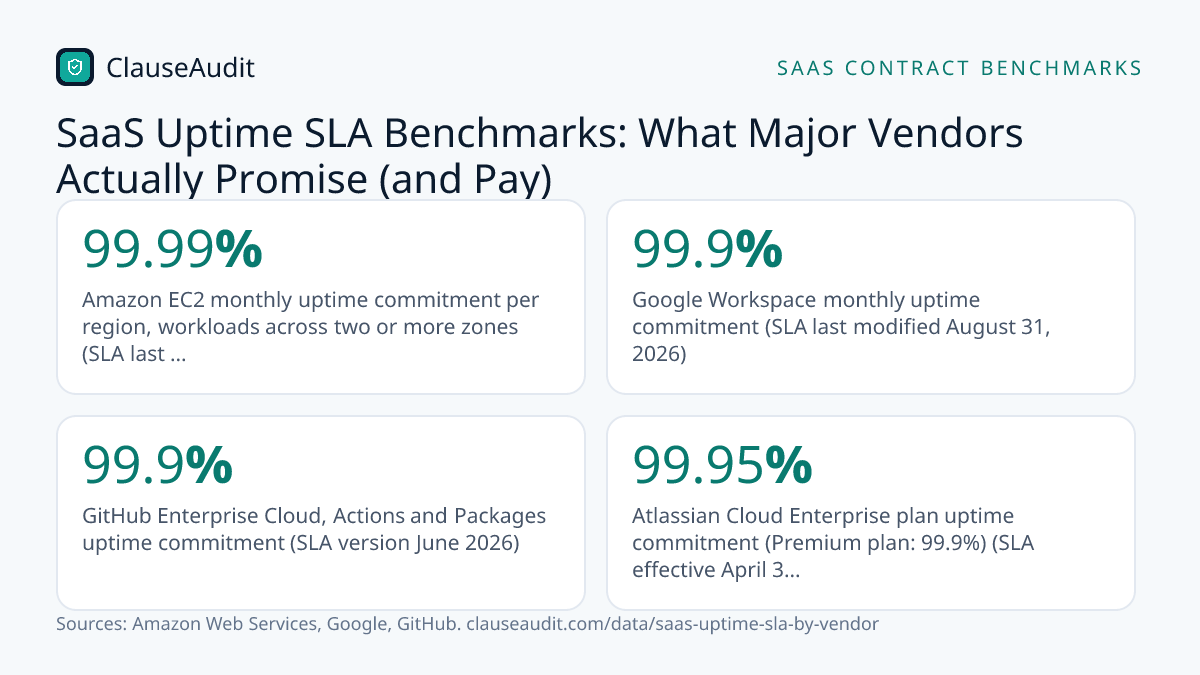
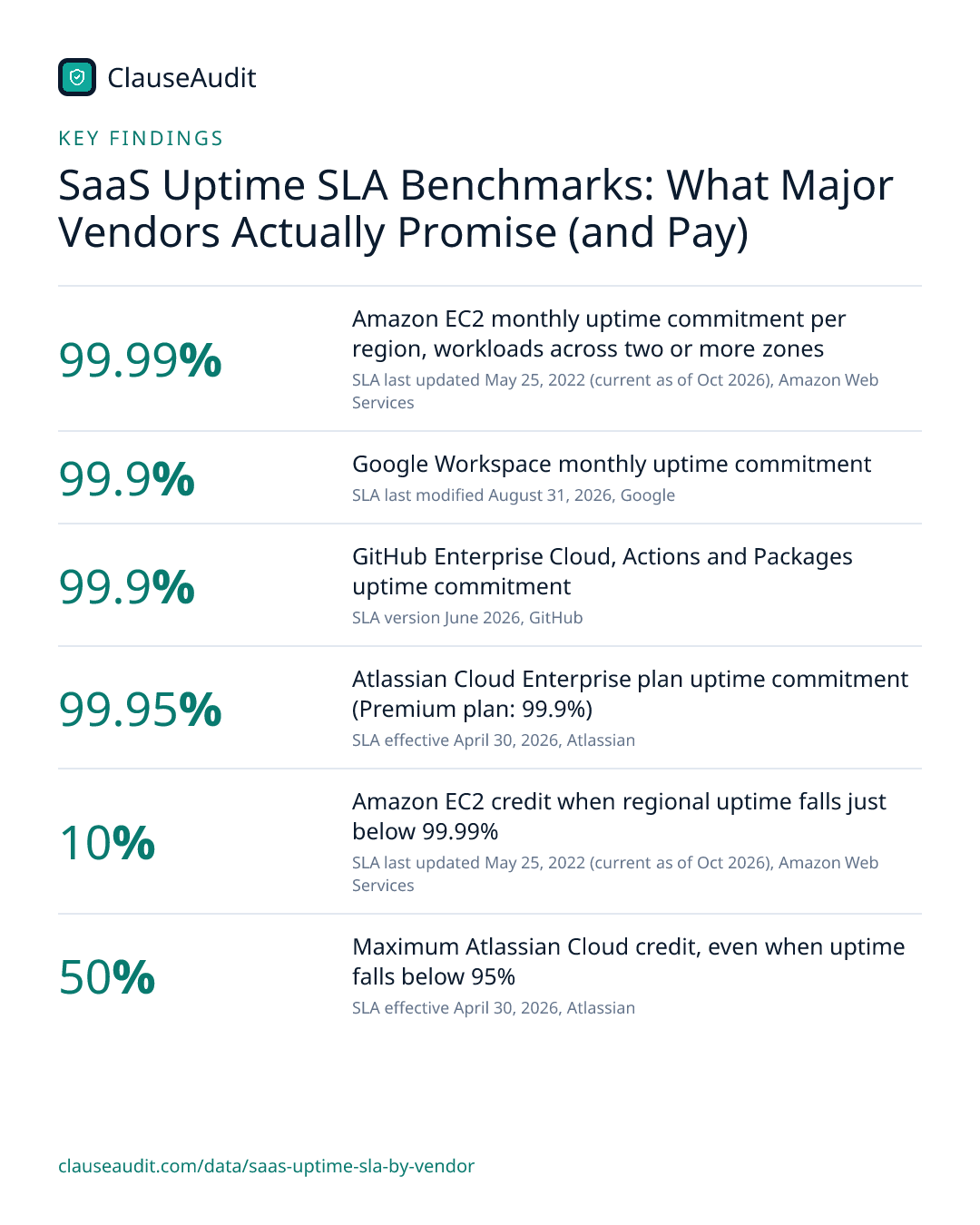
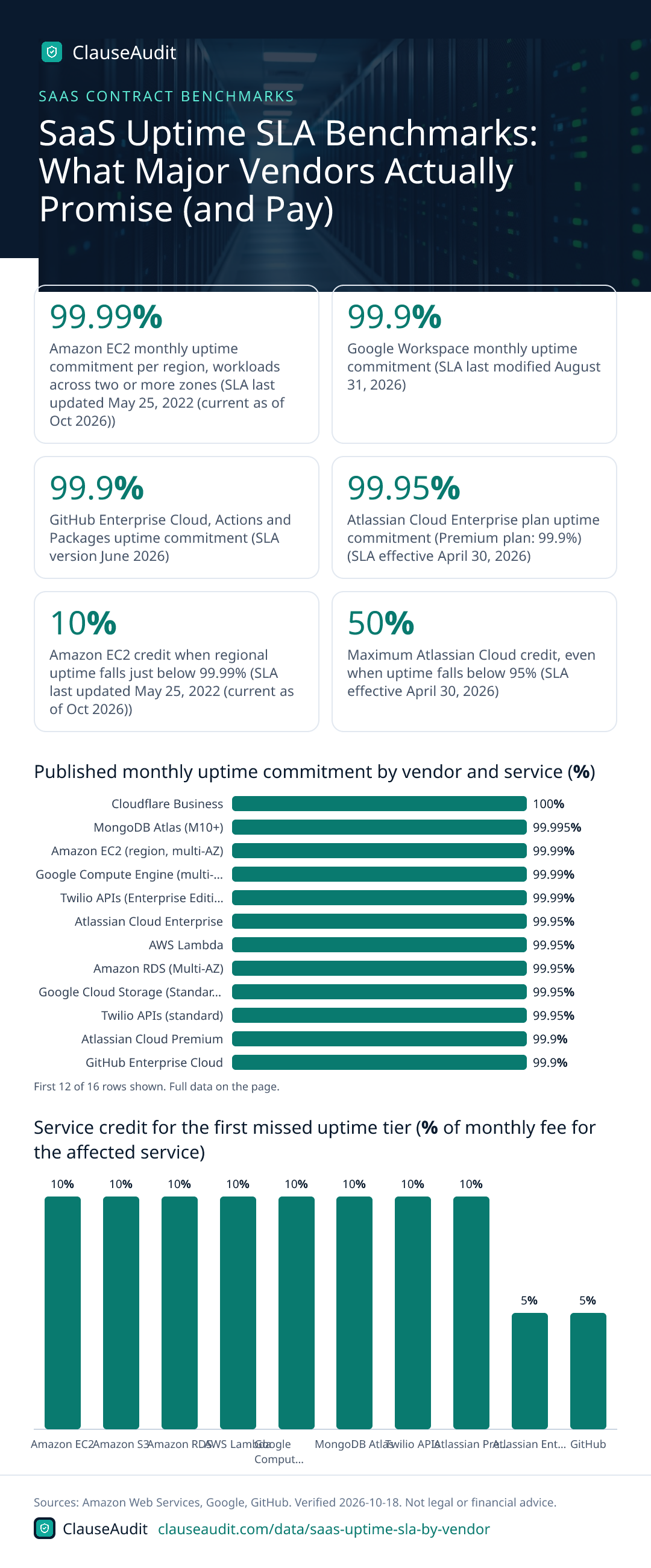
- Amazon EC2 monthly uptime commitment per region, workloads across two or more zones (SLA last updated May 25, 2022 (current as of Oct 2026), Amazon Web Services)
- 99.99%
- Google Workspace monthly uptime commitment (SLA last modified August 31, 2026, Google)
- 99.9%
- GitHub Enterprise Cloud, Actions and Packages uptime commitment (SLA version June 2026, GitHub)
- 99.9%
- Atlassian Cloud Enterprise plan uptime commitment (Premium plan: 99.9%) (SLA effective April 30, 2026, Atlassian)
- 99.95%
- Amazon EC2 credit when regional uptime falls just below 99.99% (SLA last updated May 25, 2022 (current as of Oct 2026), Amazon Web Services)
- 10%
- Maximum Atlassian Cloud credit, even when uptime falls below 95% (SLA effective April 30, 2026, Atlassian)
- 50%
- Cloudflare Business plan uptime commitment for serving customer content (Current page as of Oct 2026 (no effective date shown), Cloudflare)
- 100%
- MongoDB Atlas uptime threshold for M10+ clusters, below which credits apply (SLA last updated June 23, 2021 (current as of Oct 2026), MongoDB, Inc.)
- 99.995%
Every SaaS sales deck says the product is always up. The service level agreement is where the vendor puts a number on that promise, and more usefully, says what you get when it breaks. We read the public SLAs of the big cloud and software vendors so you have something real to hold your own contract against.
The short version: the uptime numbers look impressive and the payouts are small. Read this before you accept a vendor's word that their SLA is "industry standard."
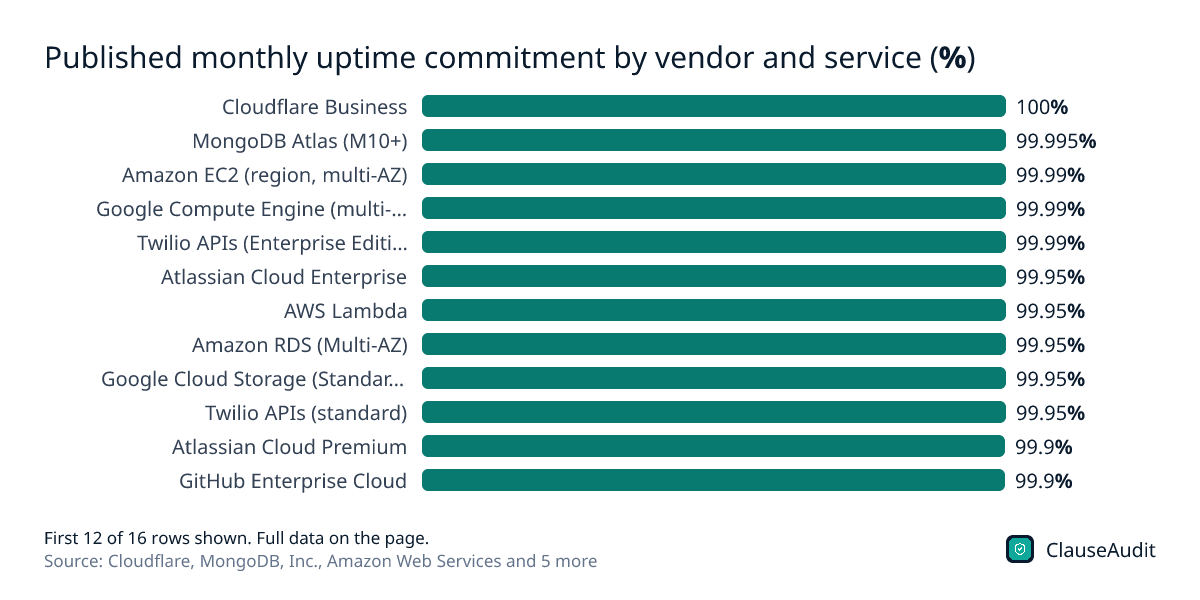
Published monthly uptime commitment by vendor and service (%)
Chart data
| Label | Value |
|---|---|
| Cloudflare Business | 100% |
| MongoDB Atlas (M10+) | 99.995% |
| Amazon EC2 (region, multi-AZ) | 99.99% |
| Google Compute Engine (multi-zone, Premium Tier) | 99.99% |
| Twilio APIs (Enterprise Edition) | 99.99% |
| Atlassian Cloud Enterprise | 99.95% |
| AWS Lambda | 99.95% |
| Amazon RDS (Multi-AZ) | 99.95% |
| Google Cloud Storage (Standard, multi-region) | 99.95% |
| Twilio APIs (standard) | 99.95% |
| Atlassian Cloud Premium | 99.9% |
| GitHub Enterprise Cloud | 99.9% |
| Google Workspace | 99.9% |
| Amazon S3 Standard | 99.9% |
| Google Compute Engine (single instance, general) | 99.9% |
| Amazon EC2 (single instance) | 99.5% |
Most commitments sit between 99.9% and 99.99%. Watch the qualifiers in the labels: a single Amazon EC2 instance drops to 99.5%, and the 99.99% figure only holds when you run across two or more zones.
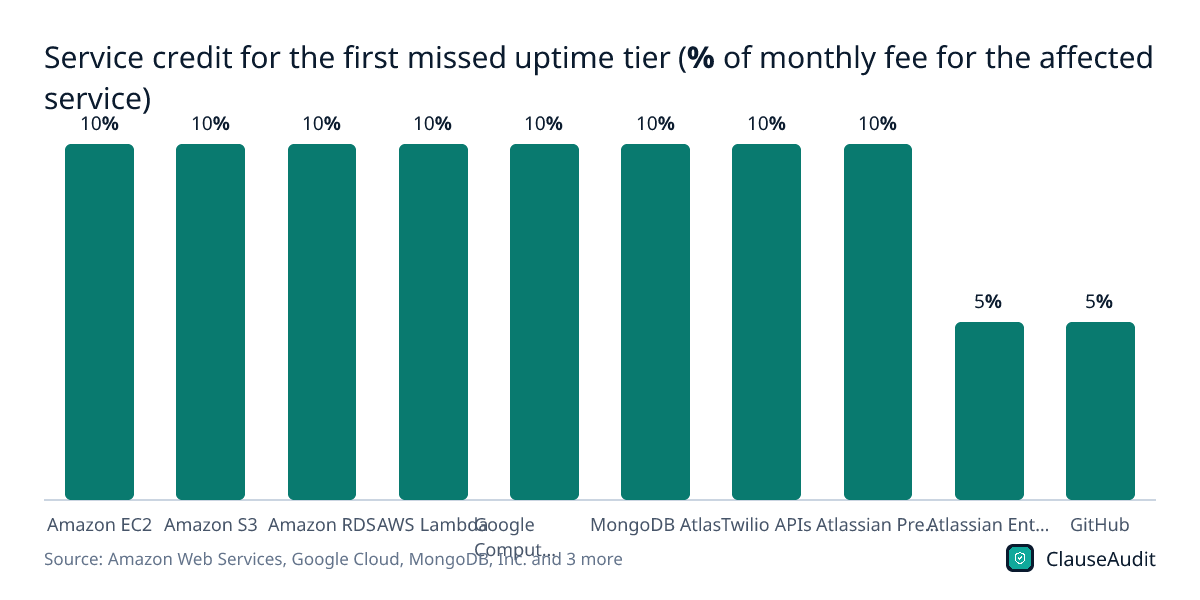
Download this chart (PNG)Service credit for the first missed uptime tier (% of monthly fee for the affected service)
Chart data
| Label | Value |
|---|---|
| Amazon EC2 | 10% |
| Amazon S3 | 10% |
| Amazon RDS | 10% |
| AWS Lambda | 10% |
| Google Compute Engine | 10% |
| MongoDB Atlas | 10% |
| Twilio APIs | 10% |
| Atlassian Premium | 10% |
| Atlassian Enterprise | 5% |
| GitHub | 5% |
A 10% credit is the most common first payout. GitHub and Atlassian Enterprise start at 5%, so a small miss on those plans is worth very little.
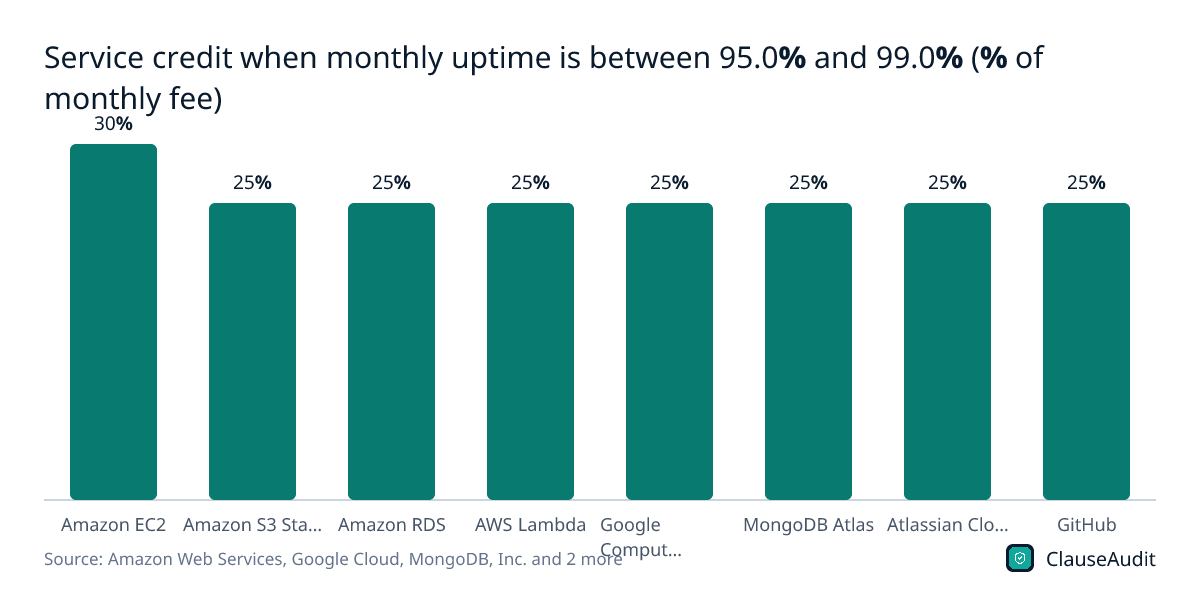
Download this chart (PNG)Service credit when monthly uptime is between 95.0% and 99.0% (% of monthly fee)
Chart data
| Label | Value (% of monthly fee) |
|---|---|
| Amazon EC2 | 30% |
| Amazon S3 Standard | 25% |
| Amazon RDS | 25% |
| AWS Lambda | 25% |
| Google Compute Engine (multi-zone) | 25% |
| MongoDB Atlas | 25% |
| Atlassian Cloud | 25% |
| GitHub | 25% |
Even a rough month with uptime between 95.0% and 99.0% usually returns 25% of the fee. Amazon EC2 is the outlier at 30%.
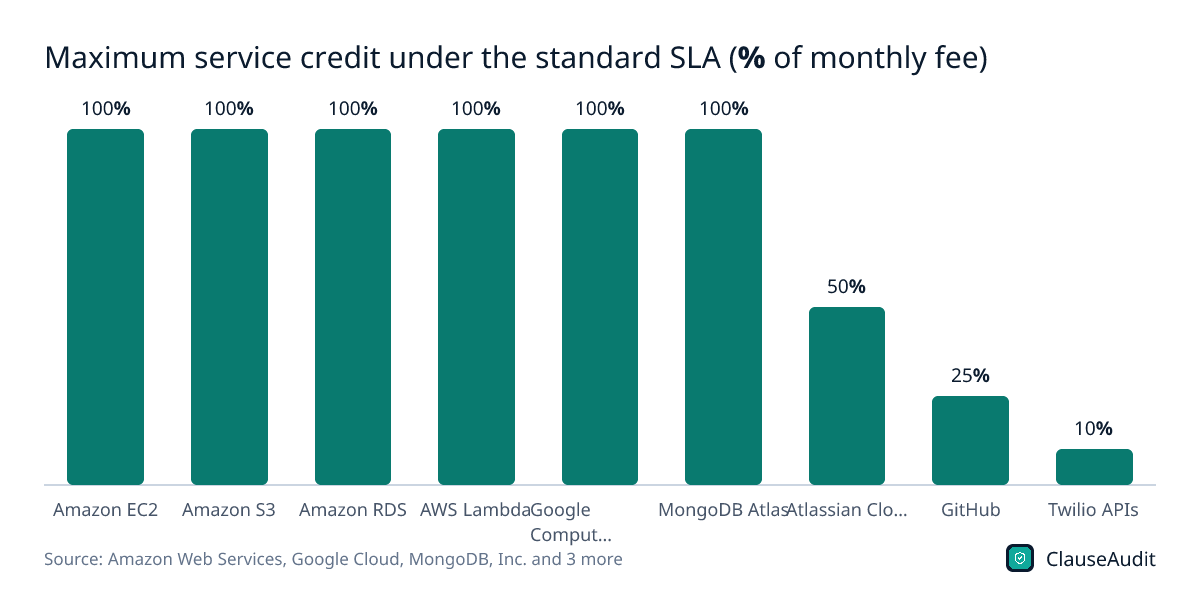
Download this chart (PNG)Maximum service credit under the standard SLA (% of monthly fee)
Chart data
| Label | Value |
|---|---|
| Amazon EC2 | 100% |
| Amazon S3 | 100% |
| Amazon RDS | 100% |
| AWS Lambda | 100% |
| Google Compute Engine (multi-zone) | 100% |
| MongoDB Atlas | 100% |
| Atlassian Cloud | 50% |
| GitHub | 25% |
| Twilio APIs | 10% |
A 100% credit exists, but AWS, Google Compute Engine and MongoDB only pay it when uptime falls below 95.0%. Atlassian tops out at 50% and Twilio APIs at 10%, however bad the month.
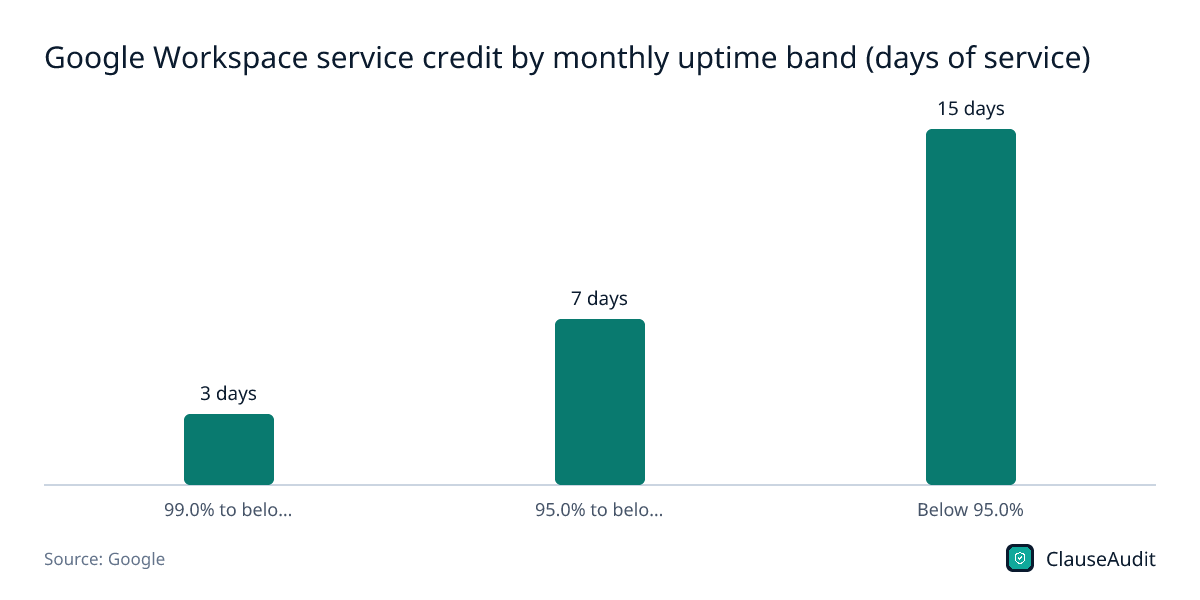
Download this chart (PNG)Google Workspace service credit by monthly uptime band (days of service)
Chart data
| Label | Value (days of service) |
|---|---|
| 99.0% to below 99.9% | 3 days |
| 95.0% to below 99.0% | 7 days |
| Below 95.0% | 15 days |
Google pays in extra days of service rather than a percentage refund. Fifteen days is the ceiling, and it only applies below 95.0% uptime.
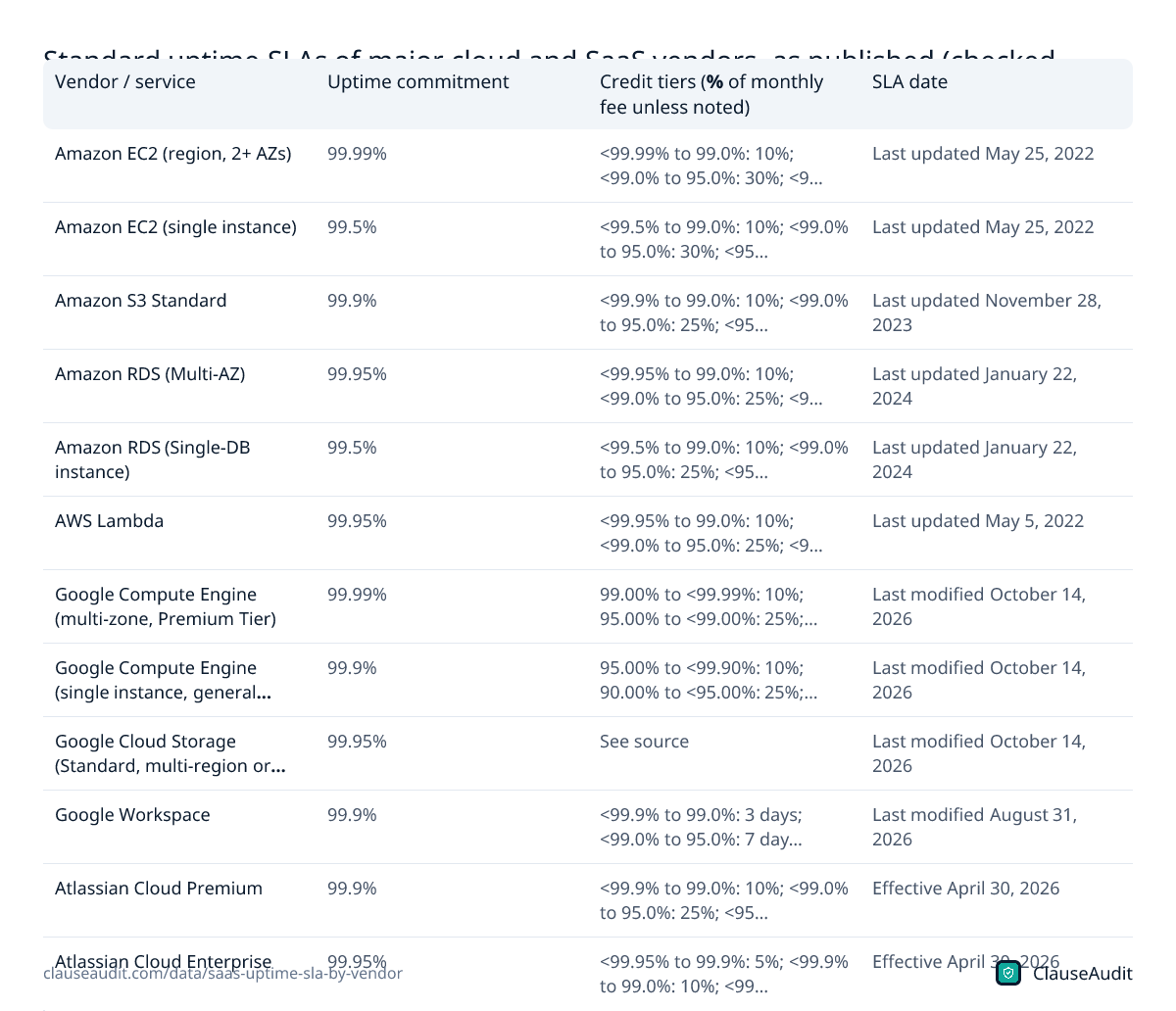
Download this chart (PNG)Standard uptime SLAs of major cloud and SaaS vendors, as published (checked October 2026)
| Vendor / service | Uptime commitment | Credit tiers (% of monthly fee unless noted) | SLA date |
|---|---|---|---|
| Amazon EC2 (region, 2+ AZs) | 99.99% | <99.99% to 99.0%: 10%; <99.0% to 95.0%: 30%; <95.0%: 100% | Last updated May 25, 2022 |
| Amazon EC2 (single instance) | 99.5% | <99.5% to 99.0%: 10%; <99.0% to 95.0%: 30%; <95.0%: 100% | Last updated May 25, 2022 |
| Amazon S3 Standard | 99.9% | <99.9% to 99.0%: 10%; <99.0% to 95.0%: 25%; <95.0%: 100% | Last updated November 28, 2023 |
| Amazon RDS (Multi-AZ) | 99.95% | <99.95% to 99.0%: 10%; <99.0% to 95.0%: 25%; <95.0%: 100% | Last updated January 22, 2024 |
| Amazon RDS (Single-DB instance) | 99.5% | <99.5% to 99.0%: 10%; <99.0% to 95.0%: 25%; <95.0%: 100% | Last updated January 22, 2024 |
| AWS Lambda | 99.95% | <99.95% to 99.0%: 10%; <99.0% to 95.0%: 25%; <95.0%: 100% | Last updated May 5, 2022 |
| Google Compute Engine (multi-zone, Premium Tier) | 99.99% | 99.00% to <99.99%: 10%; 95.00% to <99.00%: 25%; <95.00%: 100% | Last modified October 14, 2026 |
| Google Compute Engine (single instance, general families) | 99.9% | 95.00% to <99.90%: 10%; 90.00% to <95.00%: 25%; <90.00%: 100% | Last modified October 14, 2026 |
| Google Cloud Storage (Standard, multi-region or dual-region) | 99.95% | See source | Last modified October 14, 2026 |
| Google Workspace | 99.9% | <99.9% to 99.0%: 3 days; <99.0% to 95.0%: 7 days; <95.0%: 15 days | Last modified August 31, 2026 |
| Atlassian Cloud Premium | 99.9% | <99.9% to 99.0%: 10%; <99.0% to 95.0%: 25%; <95.0%: 50% | Effective April 30, 2026 |
| Atlassian Cloud Enterprise | 99.95% | <99.95% to 99.9%: 5%; <99.9% to 99.0%: 10%; <99.0% to 95.0%: 25%; <95.0%: 50% | Effective April 30, 2026 |
| GitHub (Enterprise Cloud, Actions, Packages) | 99.9% | 99.5% to <99.9%: 5%; 99.0% to <99.5%: 10%; <99.0%: 25% | Version June 2026 |
| MongoDB Atlas (M10 and above) | 99.995% | <99.995% to 99.0%: 10%; <99.0%: 25%; <95.0%: 100% | Last updated June 23, 2021 |
| Twilio Services APIs | 99.95% (99.99% on Enterprise Edition) | Below threshold: 10% | Last updated April 9, 2026 |
| Cloudflare Business plan | 100% | Prorated: outage minutes x share of visitors affected / scheduled minutes | No date shown |
| Slack | No percentage stated | Not stated on the public SLA page; 'commercially reasonable efforts' to be available 24/7 | Effective 11 July 2024 |
Source: Amazon Web Services, Amazon Compute Service Level Agreement; Amazon Web Services, Amazon S3 Service Level Agreement; Amazon Web Services, Amazon RDS Service Level Agreement; Amazon Web Services, AWS Lambda Service Level Agreement; Google Cloud, Compute Engine Service Level Agreement (SLA); Google Cloud, Cloud Storage Service Level Agreement (SLA); Google, Google Workspace Service Level Agreement; Atlassian, Atlassian Cloud Service Level Agreement; GitHub, GitHub Online Services SLA; MongoDB, Inc., MongoDB Atlas Service Level Agreement; Twilio, Twilio APIs Service Level Agreement; Cloudflare, Business Service Level Agreement; Slack (Salesforce), Slack Service Level Agreement. Download as image
What is the industry standard uptime for SaaS?
For business software you log into, 99.9% a month is the baseline. Google Workspace, GitHub Enterprise Cloud and Atlassian Cloud Premium all commit to exactly that. Atlassian's Enterprise plan steps up to 99.95%.
Infrastructure is held to a higher bar. Amazon EC2 run across two or more zones and Google Compute Engine in a multi-zone setup both promise 99.99%. MongoDB Atlas sets its threshold at 99.995% for M10 and larger clusters. Cloudflare's Business plan goes all the way to 100% for serving your content.
So if a smaller vendor offers 99.9%, that is normal. If they offer no number at all, that is not unusual either: Slack's public SLA states no uptime percentage, only "commercially reasonable efforts" to be available. You can still ask for one in your order form.
What happens when a vendor misses its uptime SLA?
You get a service credit. Not a refund, not damages, a discount on a future bill for the service that went down.
The first tier is where most real outages land, and it is modest. Amazon EC2, S3, RDS, Lambda, Google Compute Engine, MongoDB Atlas, Twilio APIs and Atlassian Premium all pay 10% of that month's fee for the affected service. GitHub and Atlassian Enterprise start at 5%.
Bigger misses pay more, but slowly. Between 95.0% and 99.0% uptime, most of these vendors credit 25%, with Amazon EC2 at 30%. A full 100% credit at AWS and Google Compute Engine requires uptime below 95.0%. Atlassian never goes past 50%. GitHub's top tier is 25%, and its total credits are limited to 90 days of paid service per calendar quarter.
Picture a team paying for a project tool that goes down for a whole afternoon. They lose half a day of output. The SLA hands back a small slice of one monthly invoice, and only if someone files a claim.
Google Workspace does not refund a percentage. It adds days. Uptime from 99.0% to below 99.9% earns 3 extra days, 95.0% to below 99.0% earns 7, and below 95.0% earns 15.
For a company on annual billing, extra days at the end of the term are easy to forget. If you buy Workspace through a reseller or on a custom agreement, ask how credits are applied and whether they show up on an invoice.
Is 99.99% uptime really better than 99.9%?
On paper, yes. In a contract, it depends on the fine print around the number.
Start with scope. Amazon's 99.99% applies to a region when your workloads span two or more zones. A single EC2 instance is covered at 99.5%. Google Compute Engine is similar: multi-zone gets 99.99%, a single general-purpose instance gets 99.9%, and that single instance earns 25% from 90.00% to below 95.00% uptime and 100% only below 90.00%. MongoDB's 99.995% applies only to M10 or larger deployments that have been running for at least 24 hours.
Then look at the remedy. A higher target with a thin credit can be worth less to you than a lower target with a meaningful payout. Twilio's API SLA has a single 10% credit tier no matter how long the outage runs. Cloudflare's 100% promise pays a credit prorated by outage minutes and the share of your visitors affected, rather than a fixed tier.
What should a small business ask for in a SaaS SLA?
You will rarely rewrite Amazon's SLA. With mid-size SaaS vendors, though, the SLA is often more flexible than the sales team admits, especially on an annual deal. These are the asks that tend to matter:
- A stated monthly uptime number in the contract itself, not a link to a web page the vendor can edit.
- A clear definition of downtime, including whether slow performance or a broken core feature counts.
- A list of exclusions you can live with. Scheduled maintenance should come with advance notice and a cap.
- Credits that apply automatically, or at least a claim window long enough that someone on your team will notice.
- A right to terminate without penalty after repeated misses, so you are not stuck paying for a tool that keeps failing.
- A check that the liability cap and the credit clause do not cancel each other out, since credits are often listed as your sole remedy.
How to check an SLA before you sign
Open the SLA and find three things: the number, the definition, and the remedy. If any of them lives on a separate web page, note the date on that page. Several of the SLAs behind this benchmark were updated in 2026, and a web page can change after you sign.
Next, find the sentence that calls service credits your "sole and exclusive remedy." Many large vendors include one, AWS and Google among them. It means a 10% credit may be all you can ever recover for downtime, even if the outage cost you far more.
Finally, write down what an hour of downtime costs you, roughly. Lost sales, idle staff, missed client deadlines. Compare that to the credit schedule. The gap between the two is the risk you are carrying, and it is what you should plan around with backups, exports and a second provider where it matters.
What these numbers mean for freelancers and agencies
If you build or host sites and apps for clients, your vendors' SLAs set a ceiling on what you can safely promise. Offering a client 99.99% while you run on a single cloud instance covered at 99.5% means you carry the gap yourself.
Keep your own client promise at or below what your stack guarantees, and match your remedy to theirs. If your host pays a 10% credit, do not sign a client contract that makes you liable for their lost sales.
How ClauseAudit helps
Upload a SaaS agreement and the automated review pulls out the uptime commitment, the credit schedule and the clauses that quietly limit them. It flags terms that fall below the published vendor benchmarks on this page and explains each one in plain English.
You get a list of what to push back on before renewal, not after the next outage.
- Whether the contract states an uptime percentage or only promises reasonable efforts
- How downtime is defined, and what maintenance and other exclusions remove from it
- The service credit tiers and whether credits are your sole remedy for outages
- The deadline and process for claiming a credit
- The liability cap and how it interacts with data loss during an outage
- Termination rights for repeated SLA misses and how that ties to auto-renewal
Frequently asked questions
What uptime percentage should a SaaS contract guarantee?
For most business software, 99.9% a month is the common benchmark. Google Workspace, GitHub Enterprise Cloud and Atlassian Cloud Premium all commit to 99.9%. Infrastructure services aim higher, with Amazon EC2 across multiple zones and Google Compute Engine multi-zone at 99.99%. If a vendor offers less than 99.9% for a core business tool, ask why.
Is 99.9% uptime good enough?
For a collaboration or productivity tool, it is in line with what the largest vendors publish. Whether it is enough for you depends on what an outage costs your business. If the tool runs payments, bookings or customer-facing systems, look for a higher commitment, a stronger credit schedule, or a backup plan that does not depend on the SLA at all.
How much is an SLA service credit usually worth?
Usually 10% of the monthly fee for the affected service at the first missed tier. That is the starting credit at Amazon EC2, S3, RDS, Lambda, Google Compute Engine, MongoDB Atlas, Twilio APIs and Atlassian Premium. GitHub and Atlassian Enterprise start at 5%. Credits apply to the service that failed, not your whole account.
Can I get a full refund if a SaaS service goes down?
Rarely. AWS, Google Compute Engine multi-zone and MongoDB Atlas credit 100% of the monthly fee only when uptime falls below 95.0%. Atlassian caps credits at 50% and GitHub at 25%. Even then it is a credit against future bills, not cash, and it usually does not cover your lost revenue.
Does Slack have an uptime SLA?
Slack publishes an SLA, but its public page does not state an uptime percentage. It promises commercially reasonable efforts to be available around the clock. If Slack or a similar tool is critical to how you work, ask during contract talks whether a specific uptime number and credit schedule can be added to your order form.
Do I have to claim SLA credits myself?
With many vendors, yes. Credits are often not automatic, and the SLA sets a deadline and a process for submitting a claim with evidence of the outage. Read that section of your agreement, put the deadline in your calendar, and assign someone to file after any significant incident. A credit you never claim is worth nothing.
Why is a single cloud server covered at a lower uptime?
Because one machine can fail in ways a multi-zone setup can survive. Amazon covers a single EC2 instance at 99.5%, compared with 99.99% for a region with workloads across two or more zones. Google Compute Engine covers a single general instance at 99.9%. If you need the higher number, you have to design for it.
How does Google Workspace compensate for downtime?
With extra days of service instead of a percentage refund. Uptime from 99.0% to below 99.9% earns 3 days, 95.0% to below 99.0% earns 7 days, and below 95.0% earns 15 days. Days are added to the end of the term on offline billing or applied as their value to a future invoice on online billing.
Use this data
Every chart and card below is free to reuse under CC BY 4.0. Download what you need and link back to this page.
 Stat cards
 Key findings card
 Infographic
 Published monthly uptime commitment by vendor and service (%)
 Service credit for the first missed uptime tier (% of monthly fee for the affected service)
 Service credit when monthly uptime is between 95.0% and 99.0% (% of monthly fee)
 Maximum service credit under the standard SLA (% of monthly fee)
 Google Workspace service credit by monthly uptime band (days of service)
 Standard uptime SLAs of major cloud and SaaS vendors, as published (checked October 2026)
Embed the infographic
Free to share on your site, blog or slides under CC BY 4.0. Please keep the credit link.
Sources and method
Every number on this page comes from the sources below, each opened and read on or before October 18, 2026. A second, independent review checked every figure against its source and corrected anything that did not match. Figures that could not be confirmed were left out.
- Amazon Web Services, Amazon Compute Service Level Agreement (Last Updated: May 25, 2022 (read October 2026))
- Amazon Web Services, Amazon S3 Service Level Agreement (Last Updated: November 28, 2023 (read October 2026))
- Amazon Web Services, Amazon RDS Service Level Agreement (Last Updated: January 22, 2024 (read October 2026))
- Amazon Web Services, AWS Lambda Service Level Agreement (Last Updated: May 5, 2022 (read October 2026))
- Google Cloud, Compute Engine Service Level Agreement (SLA) (Last modified October 14, 2026)
- Google Cloud, Cloud Storage Service Level Agreement (SLA) (Last modified October 14, 2026)
- Google, Google Workspace Service Level Agreement (Last modified: August 31, 2026)
- Atlassian, Atlassian Cloud Service Level Agreement (Effective starting: April 30, 2026)
- GitHub, GitHub Online Services SLA (Version June 2026)
- MongoDB, Inc., MongoDB Atlas Service Level Agreement (Last updated: June 23, 2021 (read October 2026))
- Twilio, Twilio APIs Service Level Agreement (Last Updated: April 9, 2026)
- Cloudflare, Business Service Level Agreement (Current page, no effective date shown (read October 2026))
- Slack (Salesforce), Slack Service Level Agreement (Effective: 11 July 2024)
Cite this page
ClauseAudit, “SaaS Uptime SLA Benchmarks: What Major Vendors Actually Promise (and Pay)”, updated October 18, 2026, https://clauseaudit.com/data/saas-uptime-sla-by-vendor. Free to reuse with a link back (CC BY 4.0).
This page summarises published data and law as checked on October 18, 2026. Figures are updated as new editions are released, and your own situation may differ. It is general information, not legal, tax or financial advice.