Relocation Package and Sign-On Bonus Benchmarks: What Employers Typically Offer
By ClauseAudit Research · 3 sources ·
What is the average relocation package?
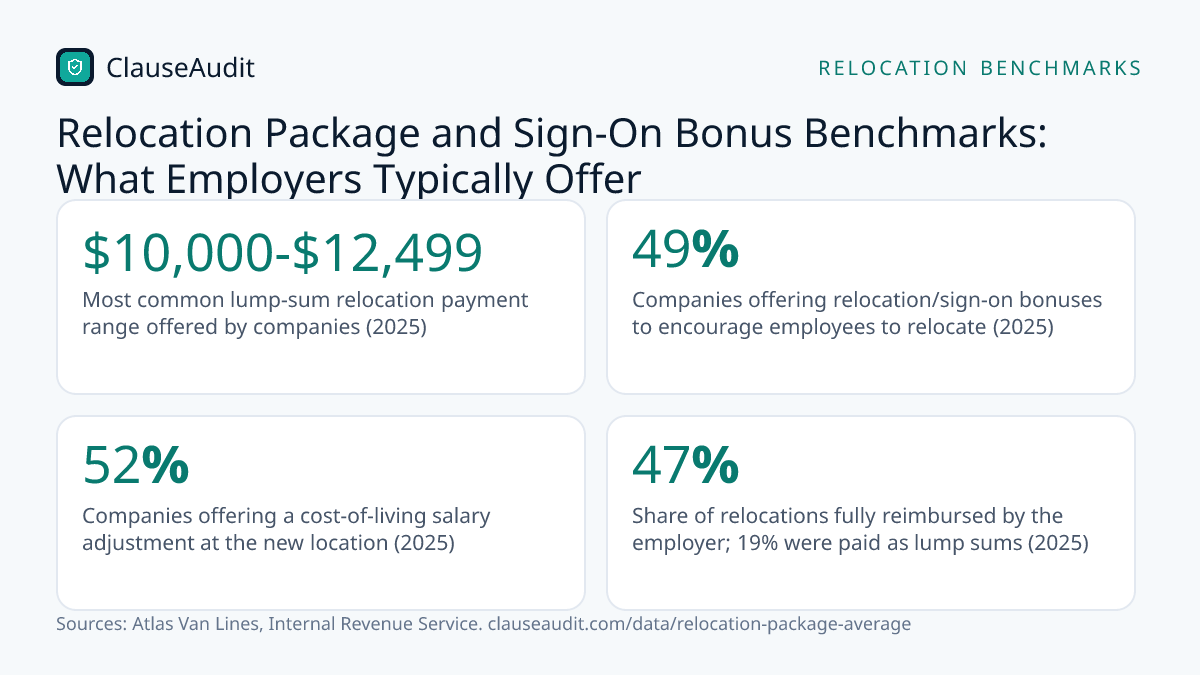
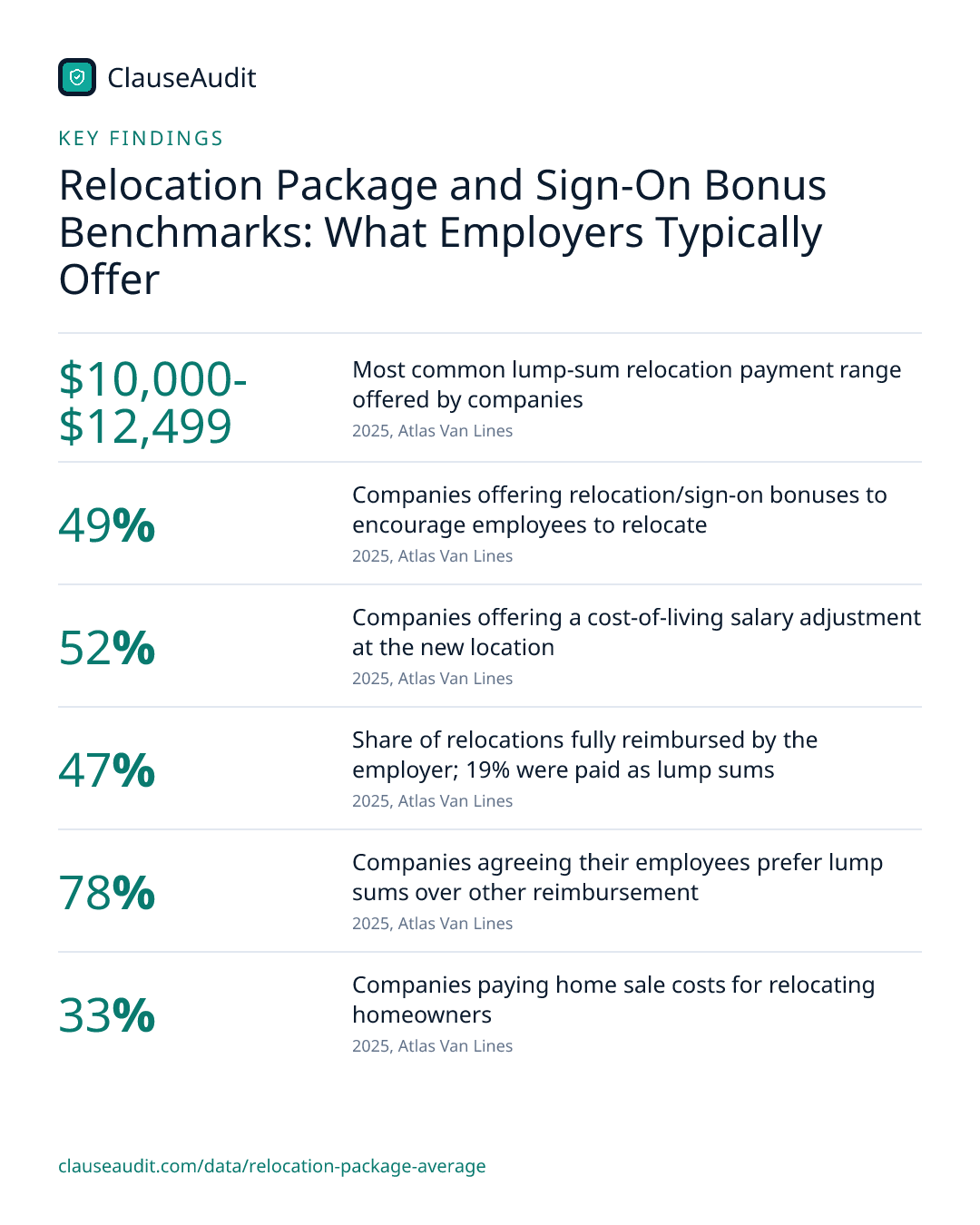
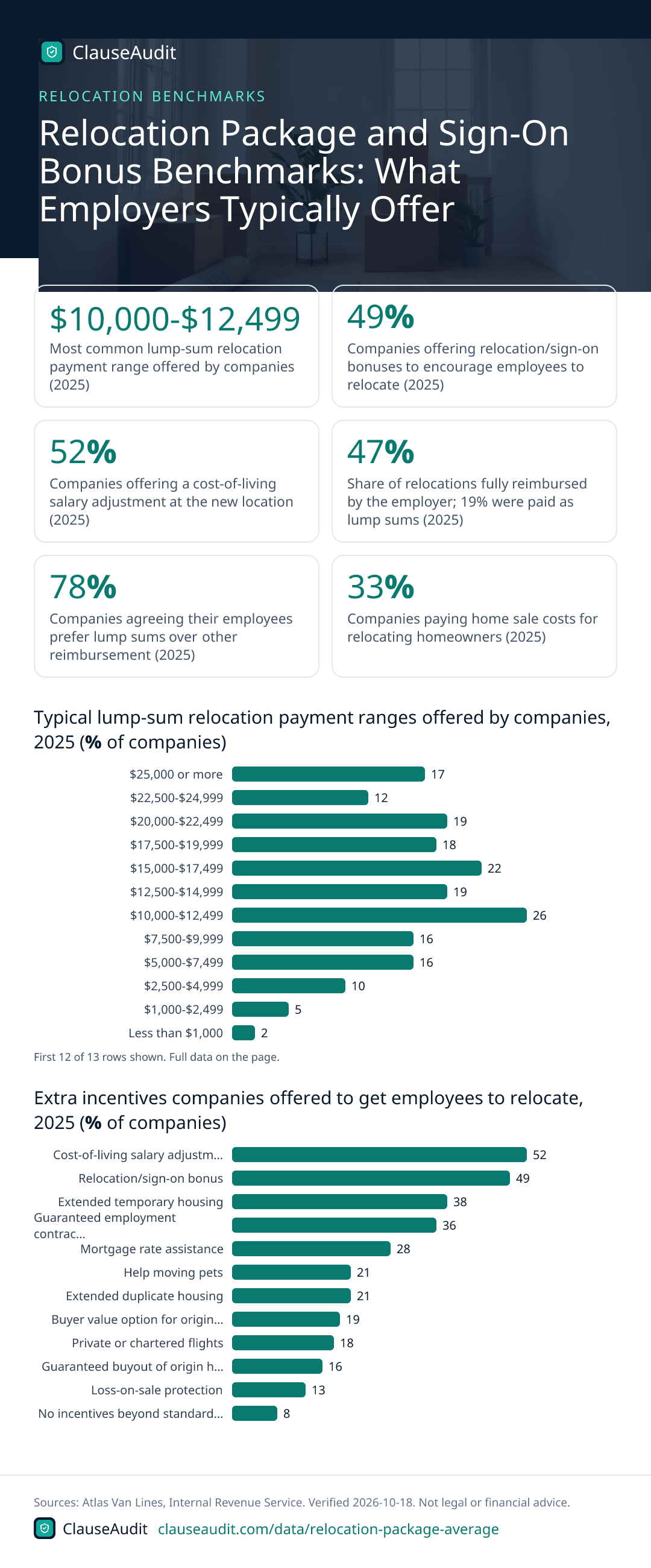
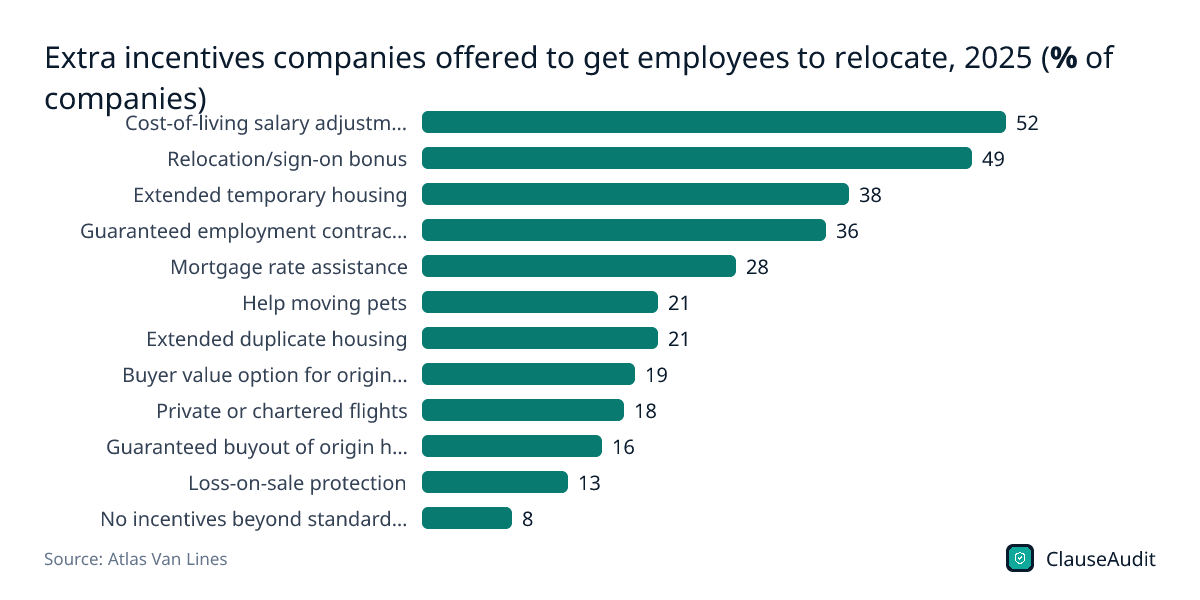
Most employers that pay a relocation lump sum land in the $10,000-$12,499 range, the most common band in 2025, chosen by 26% of companies. About 17% offered $25,000 or more. Separately, 49% of companies used a relocation or sign-on bonus to get people to move, and 52% adjusted salary for cost of living.

- Most common lump-sum relocation payment range offered by companies (2025, Atlas Van Lines)
- $10,000-$12,499
- Companies offering relocation/sign-on bonuses to encourage employees to relocate (2025, Atlas Van Lines)
- 49%
- Companies offering a cost-of-living salary adjustment at the new location (2025, Atlas Van Lines)
- 52%
- Share of relocations fully reimbursed by the employer; 19% were paid as lump sums (2025, Atlas Van Lines)
- 47%
- Companies agreeing their employees prefer lump sums over other reimbursement (2025, Atlas Van Lines)
- 78%
- Companies paying home sale costs for relocating homeowners (2025, Atlas Van Lines)
- 33%
- Companies giving relocating renters a temporary housing or rental allowance (2025, Atlas Van Lines)
- 41%
- Federal flat withholding rate on bonuses and other supplemental wages (2026, Internal Revenue Service)
- 22%
If a recruiter just asked whether you would move for the job, you probably want to know one thing: what is normal? The short answer is that a five-figure lump sum is common, but the range is wide, and the cash is only half the story.
This page pulls together employer survey data on lump sums, sign-on bonuses, cost-of-living raises and what companies pay for homeowners and renters. Below the numbers, you will find what they mean for your offer, what to ask for, and the repayment terms that catch people out a year later.
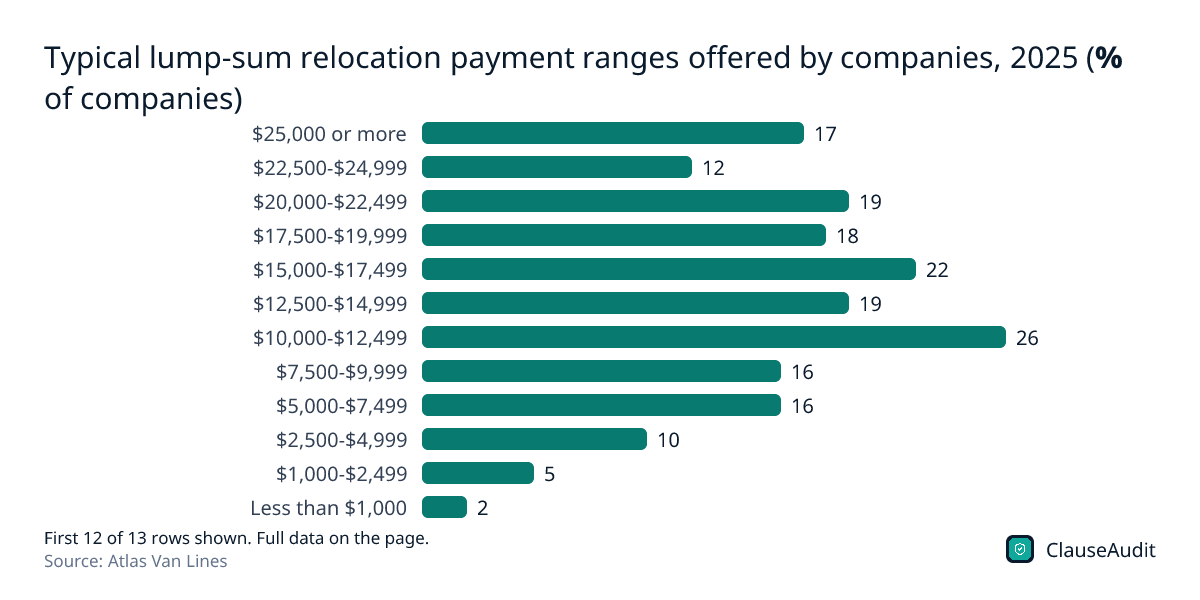
Typical lump-sum relocation payment ranges offered by companies, 2025 (% of companies)
Chart data
| Label | Value |
|---|---|
| $25,000 or more | 17 |
| $22,500-$24,999 | 12 |
| $20,000-$22,499 | 19 |
| $17,500-$19,999 | 18 |
| $15,000-$17,499 | 22 |
| $12,500-$14,999 | 19 |
| $10,000-$12,499 | 26 |
| $7,500-$9,999 | 16 |
| $5,000-$7,499 | 16 |
| $2,500-$4,999 | 10 |
| $1,000-$2,499 | 5 |
| Less than $1,000 | 2 |
| No lump sum offered | 6 |
Companies could pick more than one band, so the bars overlap. The takeaway is spread: $10,000-$12,499 is the most common answer, yet 17% of companies go to $25,000 or more.
Download this chart (PNG)Extra incentives companies offered to get employees to relocate, 2025 (% of companies)
Chart data
| Label | Value |
|---|---|
| Cost-of-living salary adjustment | 52 |
| Relocation/sign-on bonus | 49 |
| Extended temporary housing | 38 |
| Guaranteed employment contract if relocation accepted | 36 |
| Mortgage rate assistance | 28 |
| Help moving pets | 21 |
| Extended duplicate housing | 21 |
| Buyer value option for origin home | 19 |
| Private or chartered flights | 18 |
| Guaranteed buyout of origin home | 16 |
| Loss-on-sale protection | 13 |
| No incentives beyond standard policy | 8 |
A cost-of-living raise (52%) edges out a relocation or sign-on bonus (49%). A raise keeps paying every year, so it is often worth more than a one-time check.
Download this chart (PNG)Companies offering relocation/sign-on bonuses, by company size, 2025 (% of companies)
Chart data
| Label | Value (% of companies) |
|---|---|
| Small (<500 employees) | 44 |
| Medium (500-4,999) | 52 |
| Large (5,000+) | 53 |
| All companies | 49 |
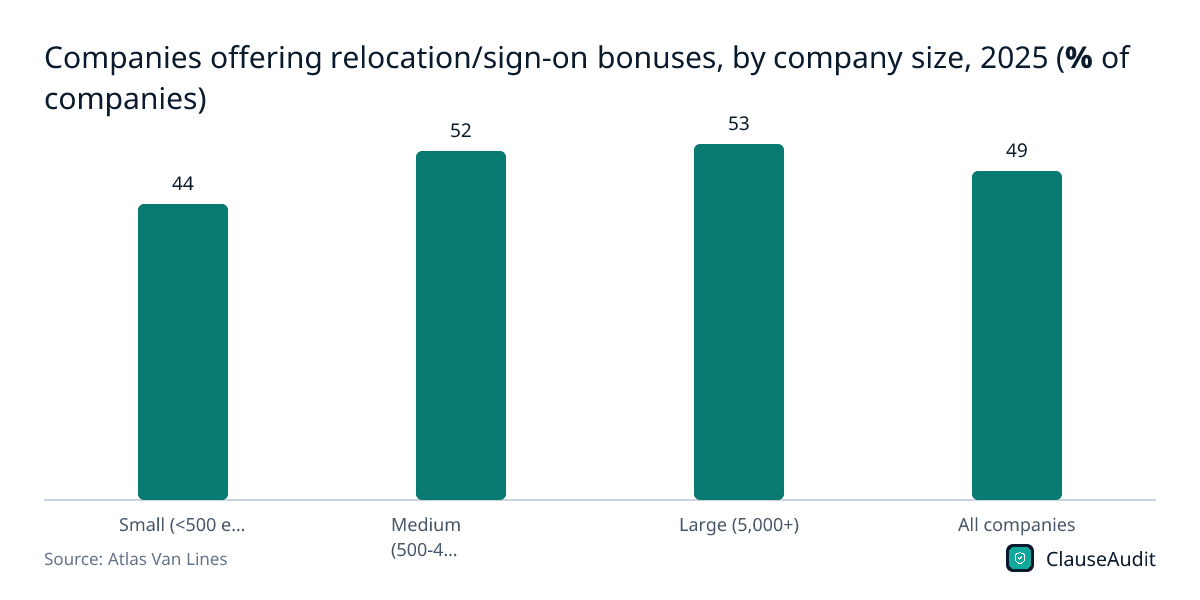
Bigger employers are a bit more likely to offer a bonus: 53% of large companies versus 44% of small ones. At a small company, ask anyway, but expect more pushback.
Download this chart (PNG)How relocations were funded: share of total relocations, 2025 (% of relocations)
Chart data
| Label | Value (% of relocations) |
|---|---|
| Fully covered/reimbursed | 47 |
| Partially reimbursed | 23 |
| Lump-sum payment | 19 |
| Not reimbursed | 12 |
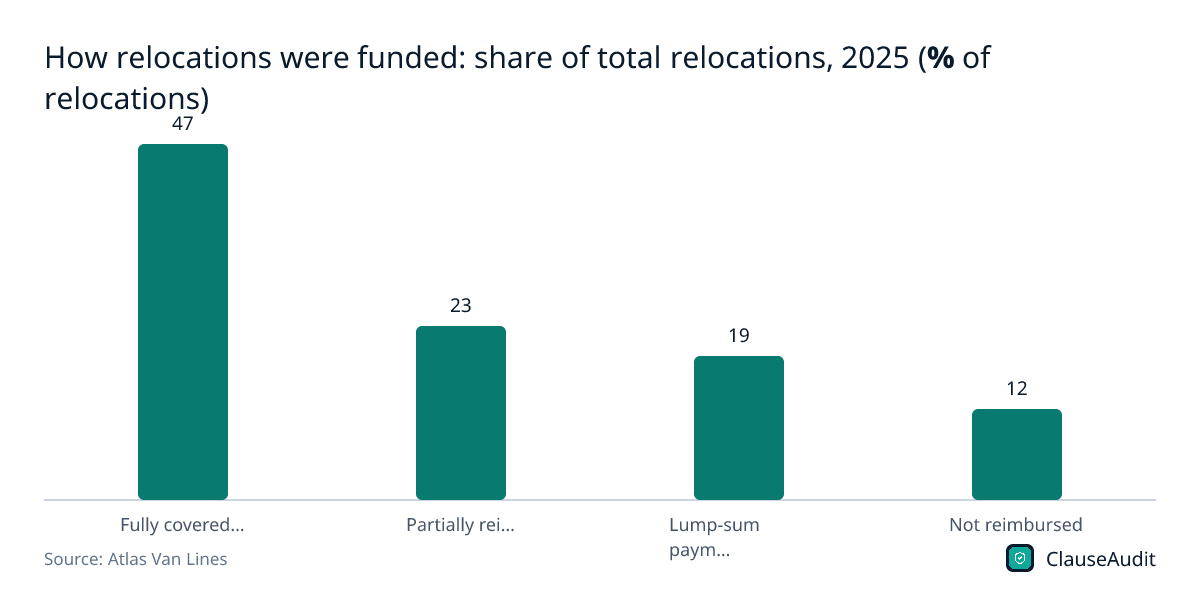
Nearly half of moves (47%) were fully covered, while 12% got nothing. Only 19% were paid as a flat lump sum, even though companies say employees prefer them.
Download this chart (PNG)Benefits companies offer relocating homeowners who will buy, 2025 (% of companies)
Chart data
| Label | Value |
|---|---|
| Pay home sale costs | 33 |
| Home finding trips | 31 |
| Pay home purchase costs | 29 |
| Bonus for employee-generated home sale | 27 |
| Pay loss-on-sale | 27 |
| Temporary housing allowance | 27 |
| Home marketing assistance | 23 |
| Storage | 23 |
| Duplicate housing assistance | 23 |
| Buyer value option | 23 |
| Pay federal tax liability | 21 |
| Mortgage subsidy or allowance | 21 |
| Guaranteed buyout/appraised value | 19 |
| None, or lump sum only | 12 |
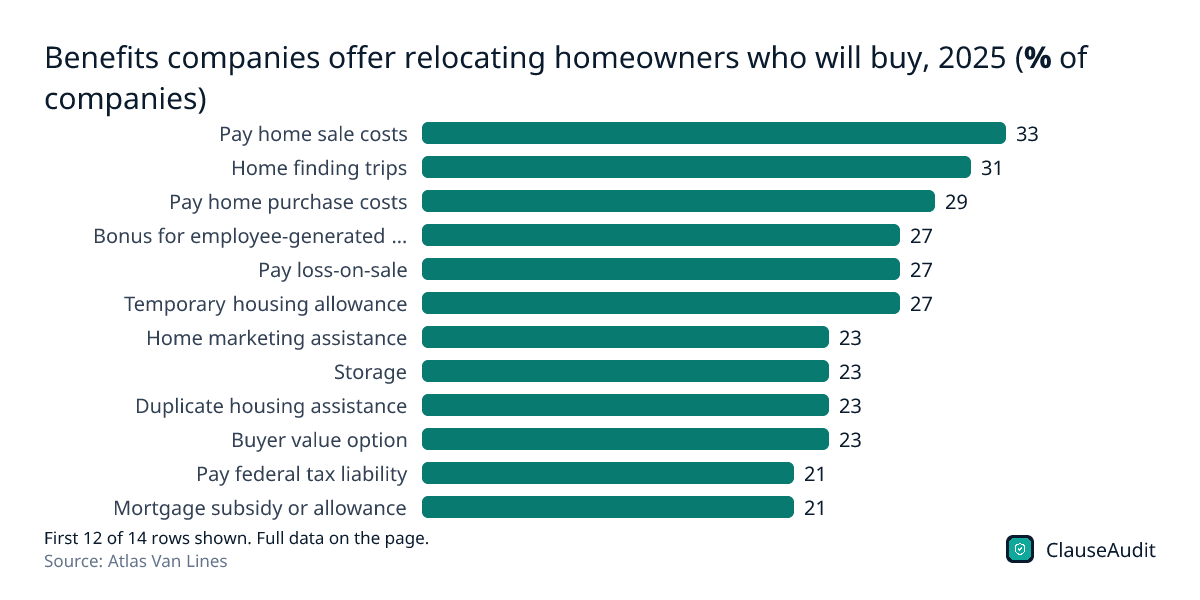
Selling a house is where real money moves. Only 33% of companies pay home sale costs, so homeowners should ask about this item by name.
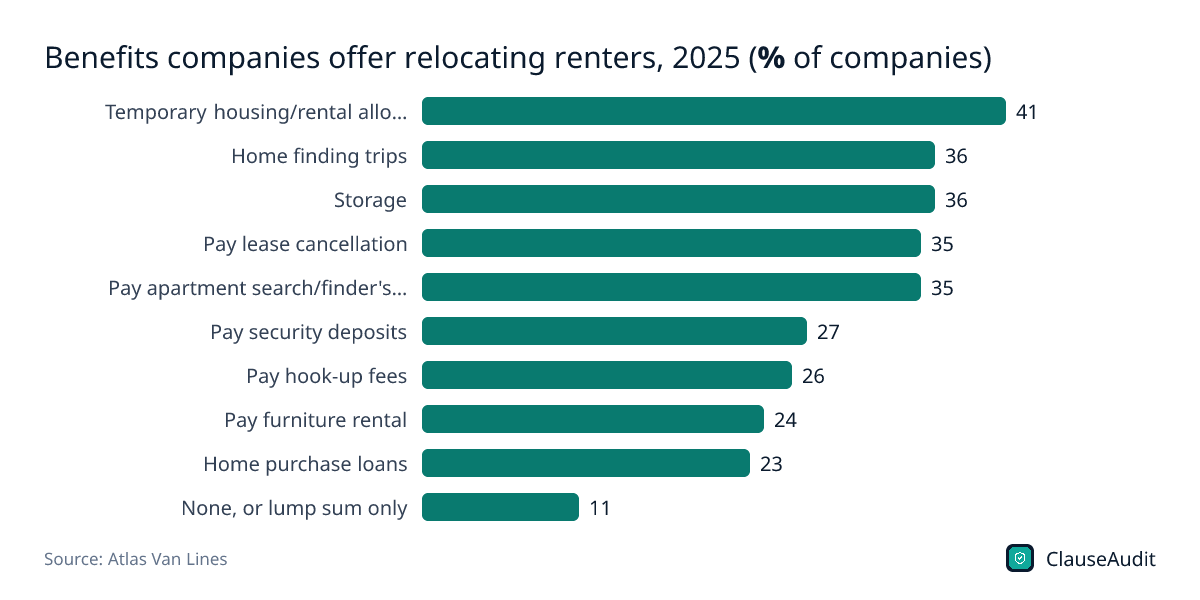
Download this chart (PNG)Benefits companies offer relocating renters, 2025 (% of companies)
Chart data
| Label | Value |
|---|---|
| Temporary housing/rental allowance | 41 |
| Home finding trips | 36 |
| Storage | 36 |
| Pay lease cancellation | 35 |
| Pay apartment search/finder's fees | 35 |
| Pay security deposits | 27 |
| Pay hook-up fees | 26 |
| Pay furniture rental | 24 |
| Home purchase loans | 23 |
| None, or lump sum only | 11 |
Renters do best on temporary housing (41%) and lease cancellation (35%). If you are breaking a lease, that line item matters more than a bigger lump sum.
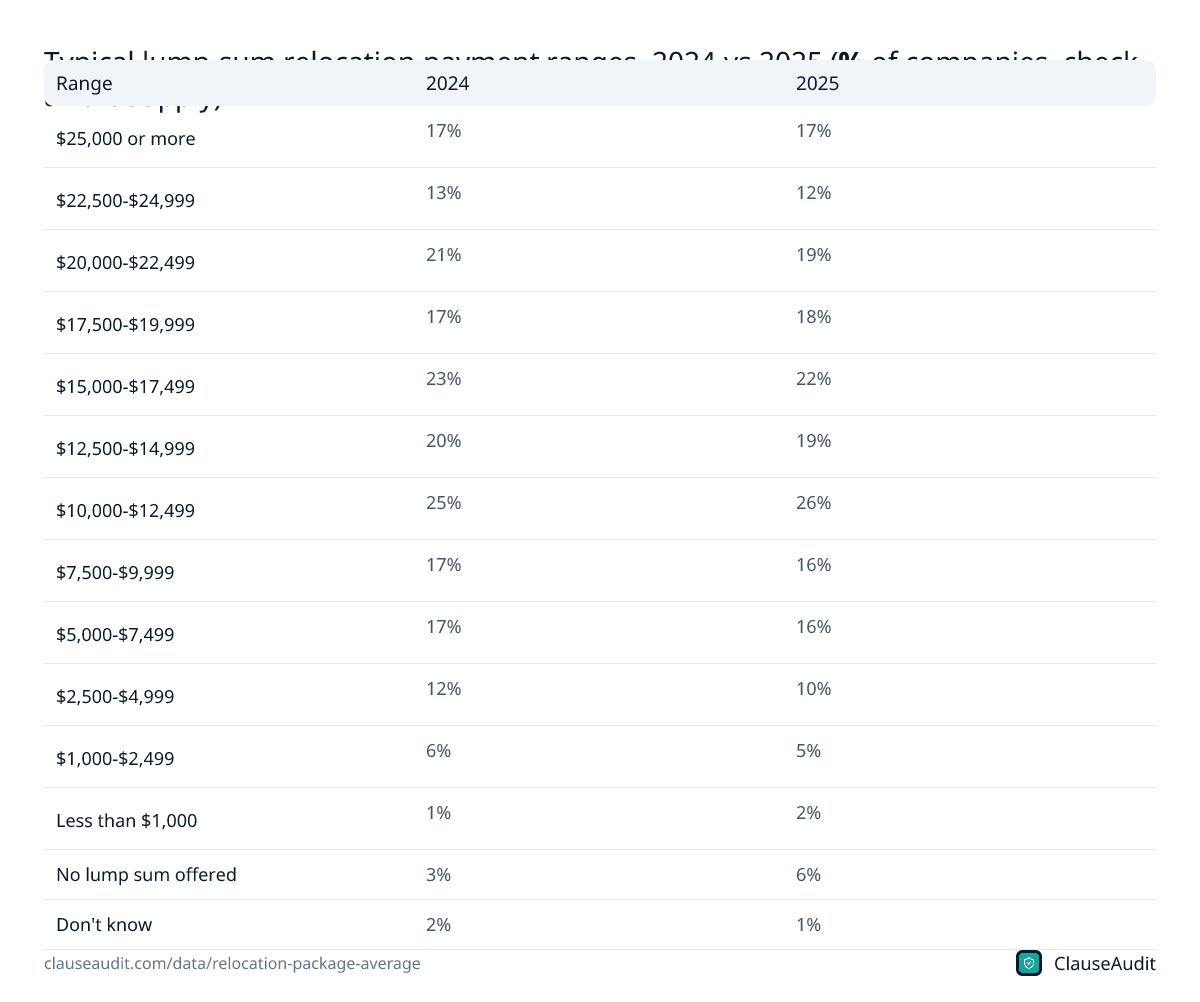
Download this chart (PNG)Typical lump-sum relocation payment ranges, 2024 vs 2025 (% of companies, check all that apply)
| Range | 2024 | 2025 |
|---|---|---|
| $25,000 or more | 17% | 17% |
| $22,500-$24,999 | 13% | 12% |
| $20,000-$22,499 | 21% | 19% |
| $17,500-$19,999 | 17% | 18% |
| $15,000-$17,499 | 23% | 22% |
| $12,500-$14,999 | 20% | 19% |
| $10,000-$12,499 | 25% | 26% |
| $7,500-$9,999 | 17% | 16% |
| $5,000-$7,499 | 17% | 16% |
| $2,500-$4,999 | 12% | 10% |
| $1,000-$2,499 | 6% | 5% |
| Less than $1,000 | 1% | 2% |
| No lump sum offered | 3% | 6% |
| Don't know | 2% | 1% |
Source: Atlas Van Lines, Atlas Corporate Relocation Survey 2026 - Appendix A (full results tables). Download as image
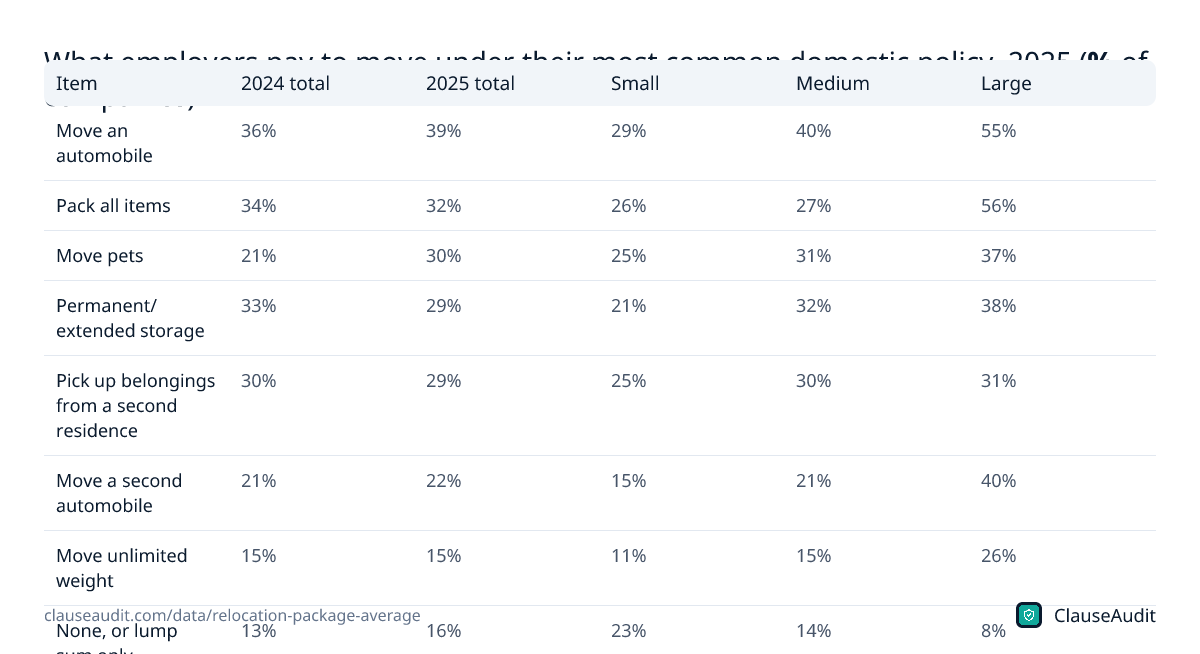
What employers pay to move under their most common domestic policy, 2025 (% of companies)
| Item | 2024 total | 2025 total | Small | Medium | Large |
|---|---|---|---|---|---|
| Move an automobile | 36% | 39% | 29% | 40% | 55% |
| Pack all items | 34% | 32% | 26% | 27% | 56% |
| Move pets | 21% | 30% | 25% | 31% | 37% |
| Permanent/extended storage | 33% | 29% | 21% | 32% | 38% |
| Pick up belongings from a second residence | 30% | 29% | 25% | 30% | 31% |
| Move a second automobile | 21% | 22% | 15% | 21% | 40% |
| Move unlimited weight | 15% | 15% | 11% | 15% | 26% |
| None, or lump sum only | 13% | 16% | 23% | 14% | 8% |
Source: Atlas Van Lines, Atlas Corporate Relocation Survey 2026 - Appendix A (full results tables). Download as image
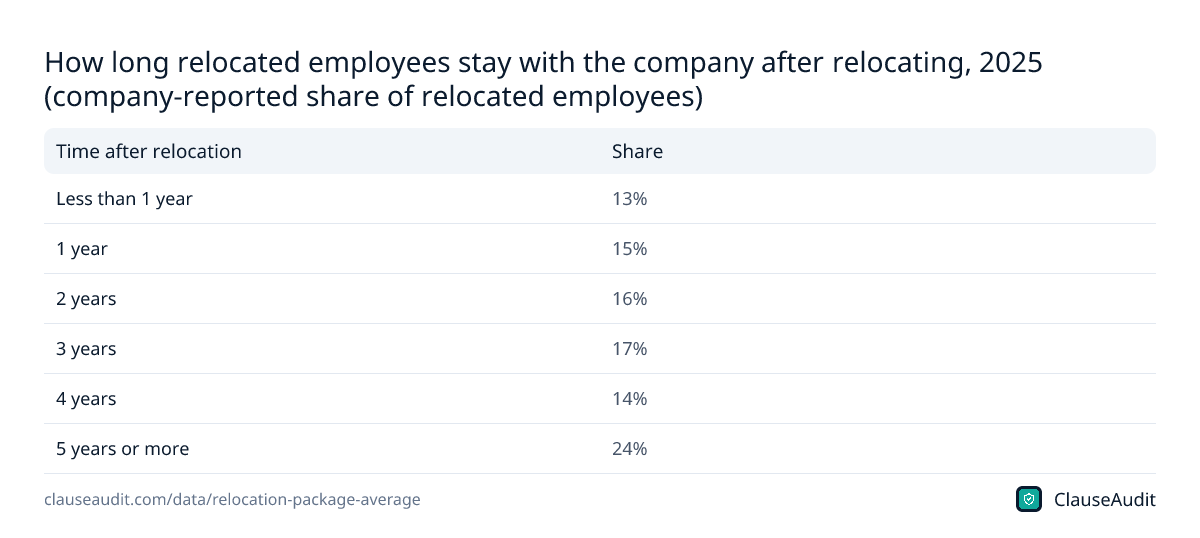
How long relocated employees stay with the company after relocating, 2025 (company-reported share of relocated employees)
| Time after relocation | Share |
|---|---|
| Less than 1 year | 13% |
| 1 year | 15% |
| 2 years | 16% |
| 3 years | 17% |
| 4 years | 14% |
| 5 years or more | 24% |
Source: Atlas Van Lines, Atlas Corporate Relocation Survey 2026 - Appendix A (full results tables). Download as image
What is the average relocation package in 2026?
There is no single average, because companies pay in different ways. Some write one check. Some reimburse receipts. Some hire the movers directly and never hand you cash at all.
For lump sums, the most common band in 2025 was $10,000-$12,499, picked by 26% of companies, the same top band as the two prior years. But the spread is real. 17% of companies offered $25,000 or more, and 6% offered no lump sum at all.
Full coverage is also common. Companies said 47% of their relocations were fully covered or reimbursed, 23% were partly reimbursed, and 12% were not reimbursed. So if you are offered nothing, you are in a minority, and it is fair to ask why.
What does a relocation package usually include?
Look past the headline number and check what the company will actually move. Under the most common domestic policies in 2025, 39% of companies paid to move a car, 32% paid for packing, and 30% paid to move pets. Only 15% allowed unlimited weight.
Company size shows up here too. 56% of large companies paid for full packing, against 26% of small ones. At the other end, 23% of small companies offered nothing beyond a lump sum, or nothing at all.
Say you have two cars, a dog and a three-bedroom house. A policy that covers one car and a weight limit could leave you paying for the second car and the extra load yourself. Ask for the policy document, not just the summary in the offer email, and match it against what you own.
Lump sum or reimbursement: which is better for you?
78% of companies agreed their employees prefer lump sums. It is easy to see why. You get cash, you spend it how you like, and if you move cheaply, you keep the difference.
The catch is that a lump sum caps the company's risk and shifts it to you. If the movers cost more than quoted, or you need an extra month of temporary housing, that comes out of your pocket.
A quick test: price the move before you accept. Get one moving quote, look up a month of furnished rent in the new city, and add travel and any lease-break fee. If that total is above the offered lump sum, ask for the difference or for the company to pay the big items directly.
Reimbursement works better when costs are hard to predict, like selling a house or moving a family across the country. Just check what counts as an eligible expense and how fast you get paid back.
How much relocation or sign-on bonus should I ask for?
49% of companies used a relocation or sign-on bonus to encourage moves in 2025, down from 53% in 2024. Large companies were the most likely to offer one at 53%, medium-sized companies at 52%, and small companies at 44%.
Anchor your ask to your real costs, not to a round number you heard somewhere. If your move costs more than the lump sum, the gap is your opening request. If the company will not raise the bonus, try a different line item.
The cost-of-living raise is often the stronger ask. 52% of companies offered one in 2025, down from 61% in 2024. Moving from a cheaper city to an expensive one with no salary change can wipe out a bonus within the first year.
- Ask for a cost-of-living adjustment if rent or home prices are clearly higher in the new city.
- Ask for temporary housing by the month, not a fixed dollar amount.
- Ask the company to cover the tax on the payment (a gross-up) if the lump sum is meant to cover real costs.
- Ask for any bonus in writing, with the payment date stated.
Is relocation money taxable?
For most workers, yes. Federal law now permanently ends the income exclusion for moving expense reimbursements, except for active-duty military moving under orders and certain intelligence community employees. IRS guidance treats bonuses and payments for nondeductible moving expenses as supplemental wages.
That means employers can withhold federal income tax at a flat 22% on those payments in 2026, and Social Security, Medicare and any state tax come out on top of that. A lump sum that looks generous on the offer letter can shrink a lot by the time it hits your bank account.
This is why a tax gross-up matters. Only 21% of companies said they pay the federal tax liability for relocating homeowners. If the offer is silent on taxes, assume you pay them, and ask whether the number is before or after tax.
Do I have to pay back relocation if I quit?
Often, yes. Many relocation and sign-on bonuses come with a repayment agreement. If you leave, or get fired for cause, before a set date, you owe some or all of the money back.
Employers have a reason for this. Companies reported that 13% of relocated employees left in less than a year, while 24% stayed five years or more. The repayment clause is how they protect that bet.
What you can negotiate is the shape of the clause. A fair version shrinks the amount you owe month by month, and says you owe nothing if you are laid off or let go without cause. A one-sided version makes the full amount due no matter why you leave, sometimes with the gross-up added on top.
Read the clause before you sign the offer, not after the movers have come. Once you have moved, your bargaining power is close to zero.
How ClauseAudit helps
A relocation offer is usually a few lines in an offer letter plus a separate repayment agreement. The dollar amount gets all the attention. The terms around it decide what you actually keep.
Upload your offer letter or relocation agreement and the automated review flags the clauses that can cost you money, with plain-English notes on what to ask for before you sign.
- Repayment or clawback terms: how much you owe if you leave, and whether it shrinks over time
- Whether repayment applies if you are laid off or let go without cause
- Tax treatment: whether the payment is grossed up or you carry the tax
- Which expenses count as eligible, and the deadline to submit receipts
- Whether a sign-on bonus has a stated payment date and conditions
- Salary change or pay adjustment language tied to the new location
Frequently asked questions
What is a typical relocation lump sum?
The most common lump-sum band in 2025 was $10,000-$12,499, picked by 26% of companies. Companies could pick more than one band, and the spread is wide: 17% offered $25,000 or more, and 6% offered no lump sum. Your number depends on distance, family size, seniority and whether you own a home.
Do most companies offer a sign-on bonus to relocate?
About half do. 49% of companies offered a relocation or sign-on bonus to encourage moves in 2025, down from 53% the year before. Large companies were more likely to offer one than small ones, at 53% versus 44%. If you are not offered one, it is still reasonable to ask.
Is a cost-of-living raise better than a relocation bonus?
Often, yes. A bonus is paid once and usually comes with strings. A cost-of-living raise lifts your salary every year and raises the base for future raises. 52% of companies offered one in 2025. If the new city is clearly more expensive, ask for the raise first and the bonus second.
Is relocation reimbursement taxed?
For most civilian workers, yes. The income exclusion for moving expense reimbursements is now permanently gone, except for active-duty military moving under orders and certain intelligence community employees. Employers can withhold federal income tax at a flat 22% on these supplemental wages in 2026, plus payroll and state taxes.
What is a relocation tax gross-up?
A gross-up is extra money the employer adds so that, after taxes, you net the amount promised. Without one, a lump sum shrinks once withholding comes out. Only 21% of companies said they pay the federal tax liability for relocating homeowners, so check your offer and ask if it is not mentioned.
What do companies pay for homeowners who relocate?
Home sale costs were the top homeowner benefit, offered by 33% of companies. Home finding trips came in at 31% and home purchase costs at 29%. If you own a home, these items can be worth far more than a lump sum, so ask about each one by name.
What relocation help do renters usually get?
Temporary housing or a rental allowance is the most common renter benefit, offered by 41% of companies. 35% paid lease cancellation costs and 35% paid apartment finder's fees. If you will break a lease to move, ask the employer to cover the penalty directly.
Can I negotiate the repayment clause in a relocation agreement?
Usually, yes, and it is worth trying. Ask for the amount you owe to shrink month by month, and for no repayment if you are laid off or let go without cause. Also ask whether the tax gross-up must be repaid. Get any change in writing before you accept.
Use this data
Every chart and card below is free to reuse under CC BY 4.0. Download what you need and link back to this page.
 Stat cards
 Key findings card
 Infographic
 Typical lump-sum relocation payment ranges offered by companies, 2025 (% of companies)
 Extra incentives companies offered to get employees to relocate, 2025 (% of companies)
 Companies offering relocation/sign-on bonuses, by company size, 2025 (% of companies)
 How relocations were funded: share of total relocations, 2025 (% of relocations)
 Benefits companies offer relocating homeowners who will buy, 2025 (% of companies)
 Benefits companies offer relocating renters, 2025 (% of companies)
 Typical lump-sum relocation payment ranges, 2024 vs 2025 (% of companies, check all that apply)
 What employers pay to move under their most common domestic policy, 2025 (% of companies)
 How long relocated employees stay with the company after relocating, 2025 (company-reported share of relocated employees)
Embed the infographic
Free to share on your site, blog or slides under CC BY 4.0. Please keep the credit link.
Sources and method
Every number on this page comes from the sources below, each opened and read on or before October 18, 2026. A second, independent review checked every figure against its source and corrected anything that did not match. Figures that could not be confirmed were left out.
- Atlas Van Lines, Atlas Corporate Relocation Survey 2026 (59th Annual) - Survey Booklet (2026 edition (59th annual; fielded January 5-16, 2026; covers 2025))
- Atlas Van Lines, Atlas Corporate Relocation Survey 2026 - Appendix A (full results tables) (2026 edition (59th annual))
- Internal Revenue Service, Publication 15 (2026), (Circular E), Employer's Tax Guide (2026 edition, For use in 2026)
Cite this page
ClauseAudit, “Relocation Package and Sign-On Bonus Benchmarks: What Employers Typically Offer”, updated October 18, 2026, https://clauseaudit.com/data/relocation-package-average. Free to reuse with a link back (CC BY 4.0).
This page summarises published data and law as checked on October 18, 2026. Figures are updated as new editions are released, and your own situation may differ. It is general information, not legal, tax or financial advice.