Paid Family Leave for Self-Employed Workers by State (2026): Who Can Opt In, What It Costs and When It Pays
By ClauseAudit Research · 31 sources ·
Can self-employed workers get paid family leave?
Yes, but only in a handful of states, and only if you opt in. You pay a share of your income and commit for years. Rates run from 0.44% of gross income in Colorado to 0.75% in DC. California charges 8.84% of net profit because that premium also buys disability coverage.

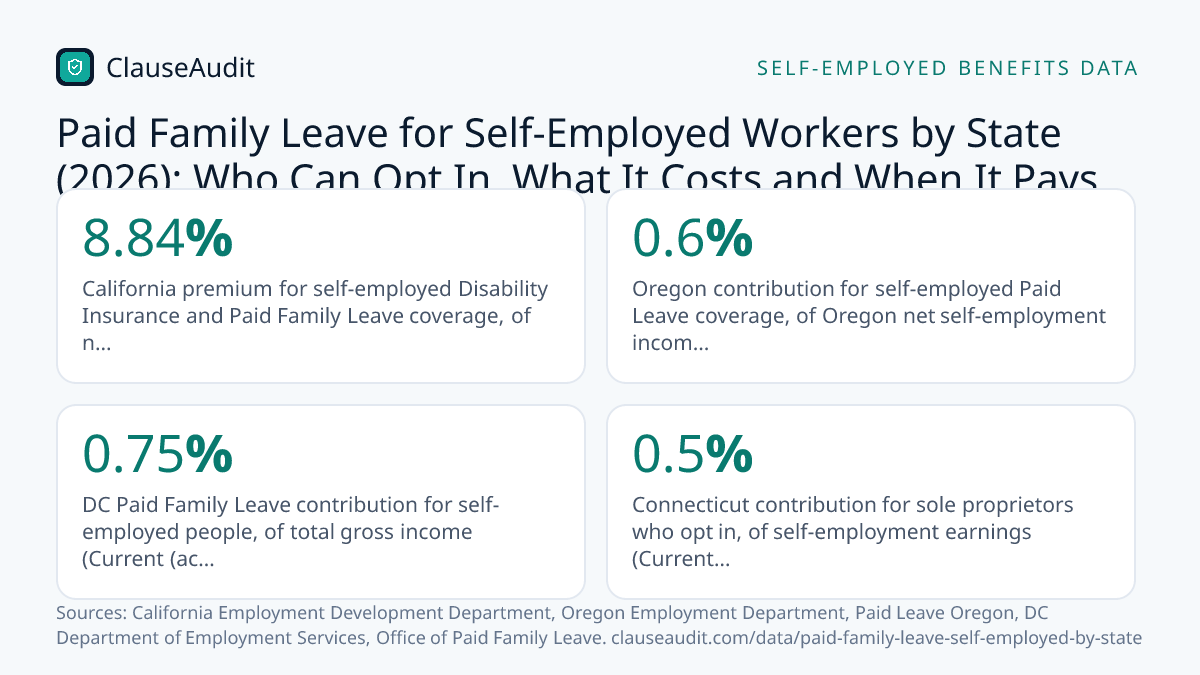
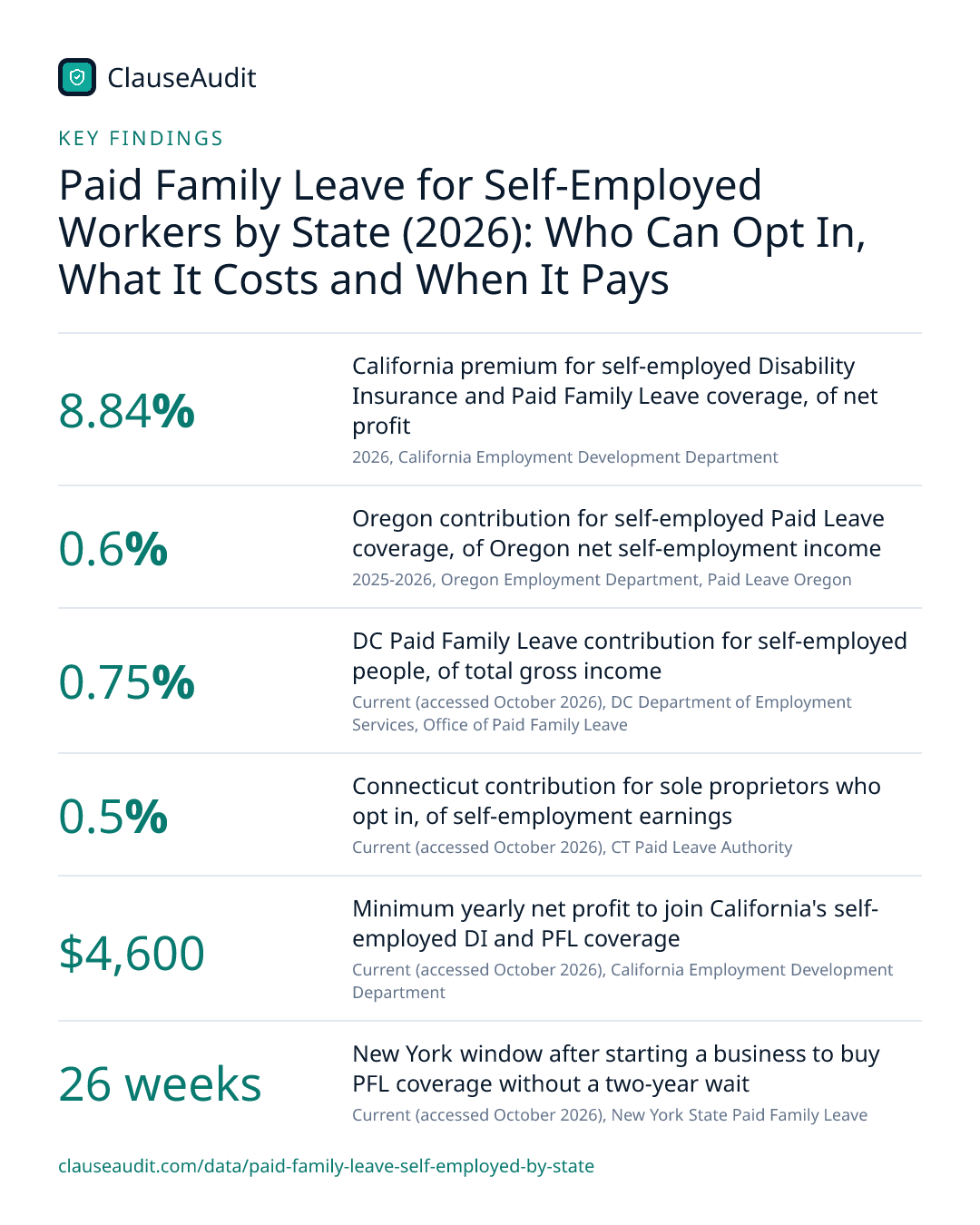
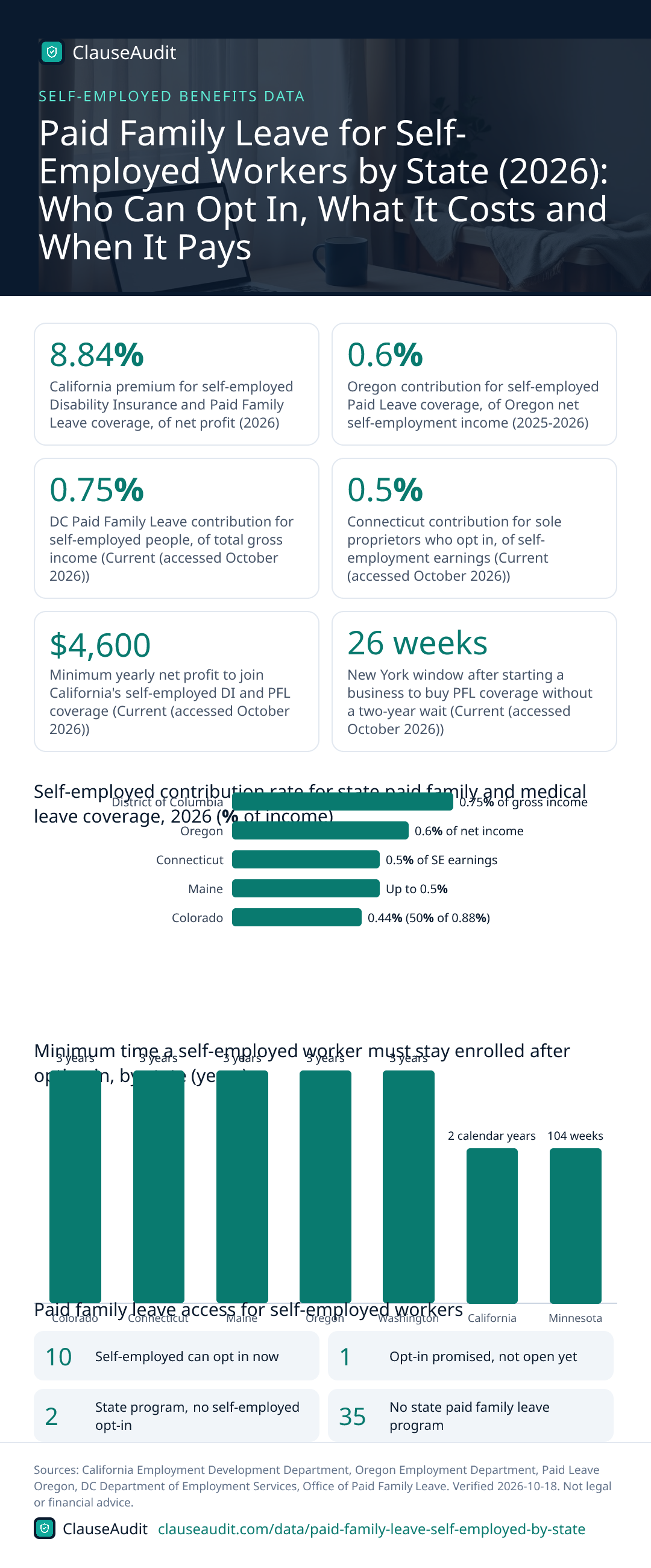
- California premium for self-employed Disability Insurance and Paid Family Leave coverage, of net profit (2026, California Employment Development Department)
- 8.84%
- Oregon contribution for self-employed Paid Leave coverage, of Oregon net self-employment income (2025-2026, Oregon Employment Department, Paid Leave Oregon)
- 0.6%
- DC Paid Family Leave contribution for self-employed people, of total gross income (Current (accessed October 2026), DC Department of Employment Services, Office of Paid Family Leave)
- 0.75%
- Connecticut contribution for sole proprietors who opt in, of self-employment earnings (Current (accessed October 2026), CT Paid Leave Authority)
- 0.5%
- Minimum yearly net profit to join California's self-employed DI and PFL coverage (Current (accessed October 2026), California Employment Development Department)
- $4,600
- New York window after starting a business to buy PFL coverage without a two-year wait (Current (accessed October 2026), New York State Paid Family Leave)
- 26 weeks
- Washington's initial commitment period when self-employed workers opt in to Paid Leave (Current (accessed October 2026), Washington Employment Security Department, Paid Leave)
- 3 years
- Minnesota's minimum coverage period for self-employed people and independent contractors who elect Paid Leave (2025 Minnesota Statutes, Minnesota Office of the Revisor of Statutes)
- 104 weeks
If you work for yourself, no state signs you up for paid family leave automatically. In the states that run a program, employees are covered by default and the self-employed have to choose it, pay for it and stick with it. In most of the country there is no state program to join at all.
This page shows where you can opt in, what each state charges, how long you are locked in and how much you could collect per week. Below the data, you will find what those rules mean if you are planning a baby, caring for a parent or just trying to decide whether the premium is worth it.
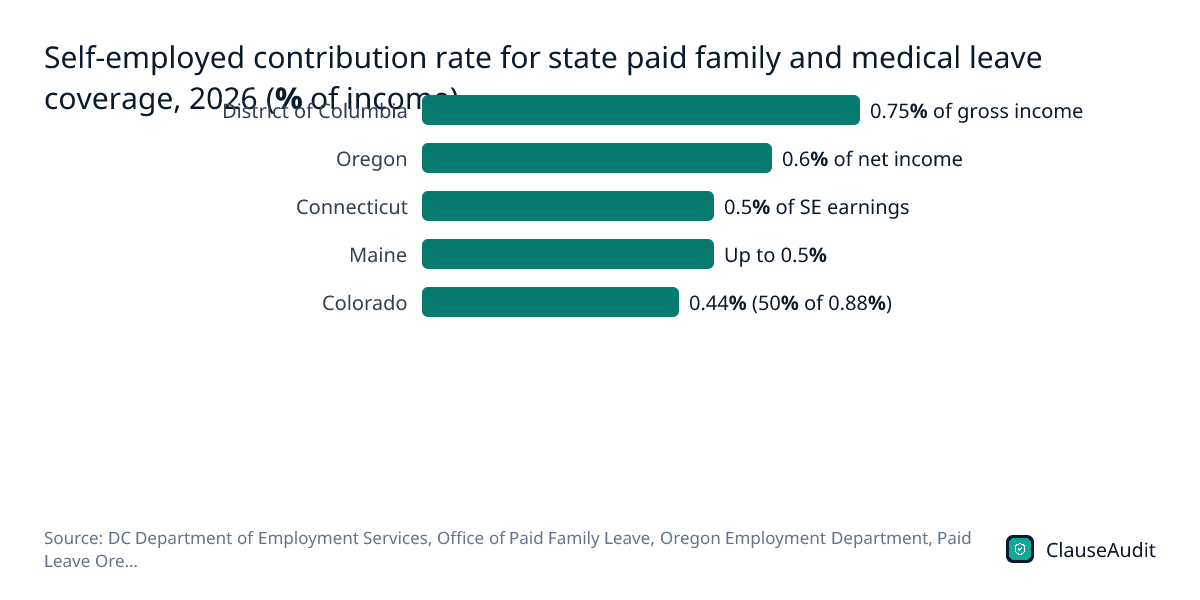
Self-employed contribution rate for state paid family and medical leave coverage, 2026 (% of income)
Chart data
| Label | Value |
|---|---|
| District of Columbia | 0.75% of gross income |
| Oregon | 0.6% of net income |
| Connecticut | 0.5% of SE earnings |
| Maine | Up to 0.5% |
| Colorado | 0.44% (50% of 0.88%) |
These rates look close, but the income base changes from state to state. DC takes 0.75% of total gross income, while Oregon takes 0.6% of net income after expenses, so a freelancer with heavy costs pays less in Oregon than the gap suggests.
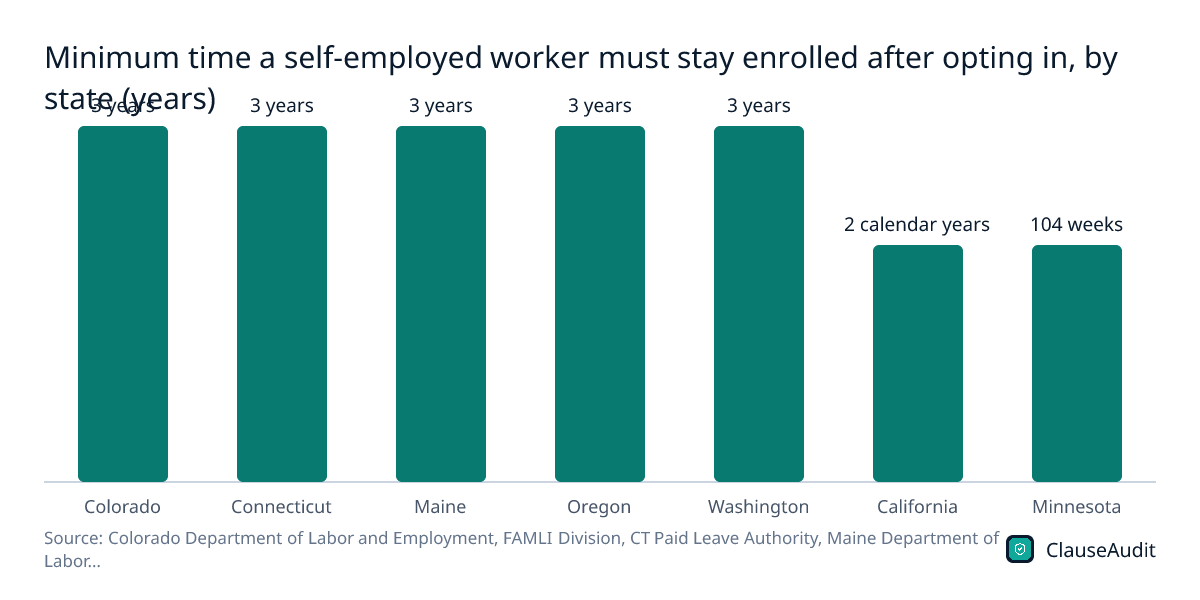
Download this chart (PNG)Minimum time a self-employed worker must stay enrolled after opting in, by state (years)
Chart data
| Label | Value (years) |
|---|---|
| Colorado | 3 years |
| Connecticut | 3 years |
| Maine | 3 years |
| Oregon | 3 years |
| Washington | 3 years |
| California | 2 calendar years |
| Minnesota | 104 weeks |
Opting in is a multi-year promise almost everywhere. Most states hold you for 3 years, and California and Minnesota hold you for about two, so do not sign up for one short leave and expect to quit right after.
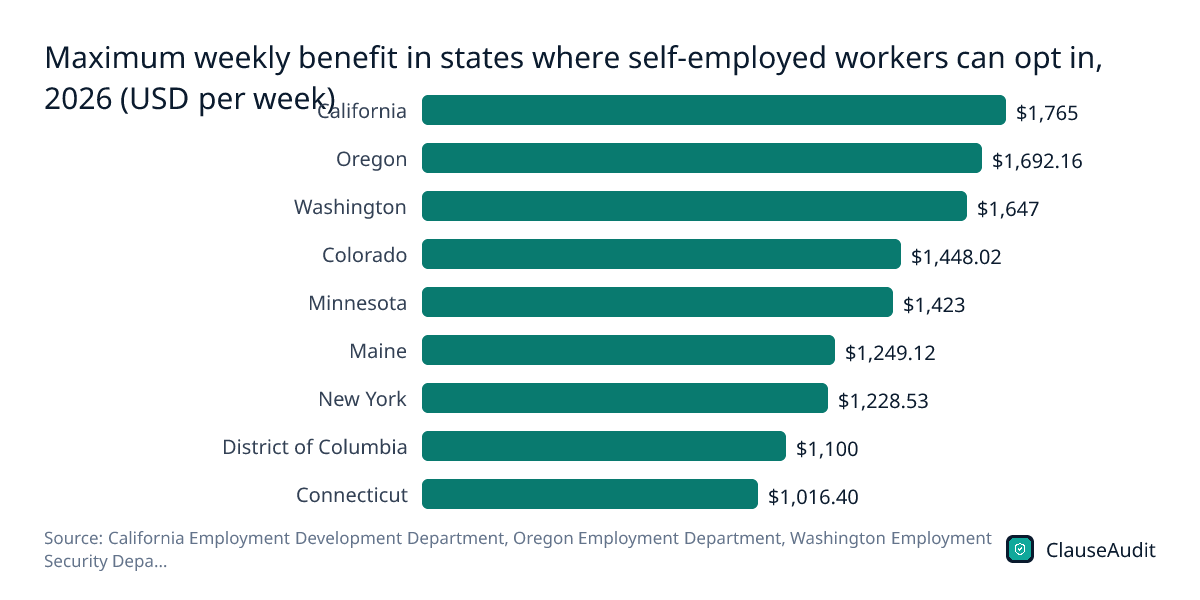
Download this chart (PNG)Maximum weekly benefit in states where self-employed workers can opt in, 2026 (USD per week)
Chart data
| Label | Value |
|---|---|
| California | $1,765 |
| Oregon | $1,692.16 |
| Washington | $1,647 |
| Colorado | $1,448.02 |
| Minnesota | $1,423 |
| Maine | $1,249.12 |
| New York | $1,228.53 |
| District of Columbia | $1,100 |
| Connecticut | $1,016.40 |
California tops out at $1,765 a week and Connecticut at $1,016.40. These are ceilings. What you actually get depends on the income you reported, so a lean year before your leave can shrink the check.
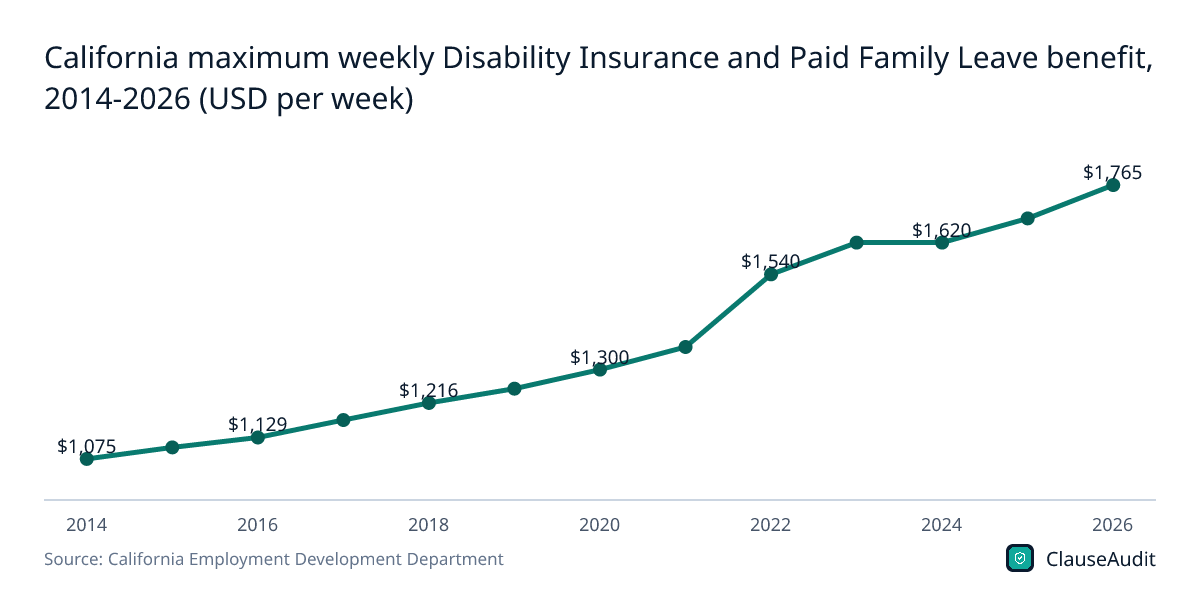
Download this chart (PNG)California maximum weekly Disability Insurance and Paid Family Leave benefit, 2014-2026 (USD per week)
Chart data
| Label | Value (USD per week) |
|---|---|
| 2014 | $1,075 |
| 2015 | $1,104 |
| 2016 | $1,129 |
| 2017 | $1,173 |
| 2018 | $1,216 |
| 2019 | $1,252 |
| 2020 | $1,300 |
| 2021 | $1,357 |
| 2022 | $1,540 |
| 2023 | $1,620 |
| 2024 | $1,620 |
| 2025 | $1,681 |
| 2026 | $1,765 |
California's ceiling climbed from $1,075 in 2014 to $1,765 in 2026, and it only stalled once, between 2023 and 2024. The cap is reset every January, so check the current figure before you plan around it.
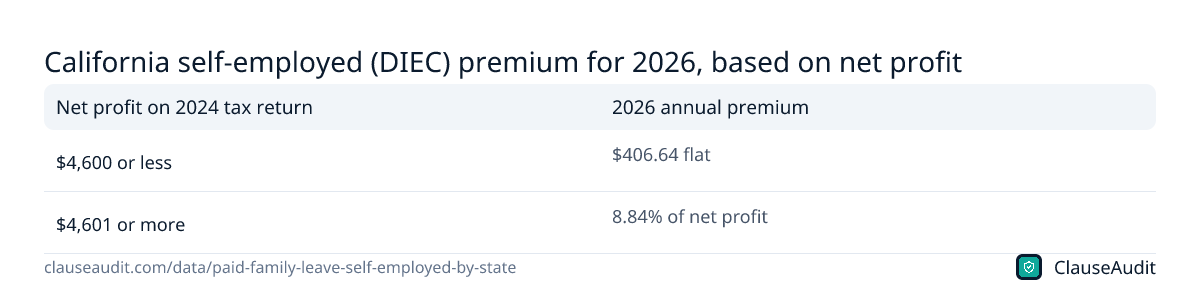
Download this chart (PNG)California self-employed (DIEC) premium for 2026, based on net profit
| Net profit on 2024 tax return | 2026 annual premium |
|---|---|
| $4,600 or less | $406.64 flat |
| $4,601 or more | 8.84% of net profit |
Source: California Employment Development Department, Self-Employed Benefit Amounts (DIEC). Download as image
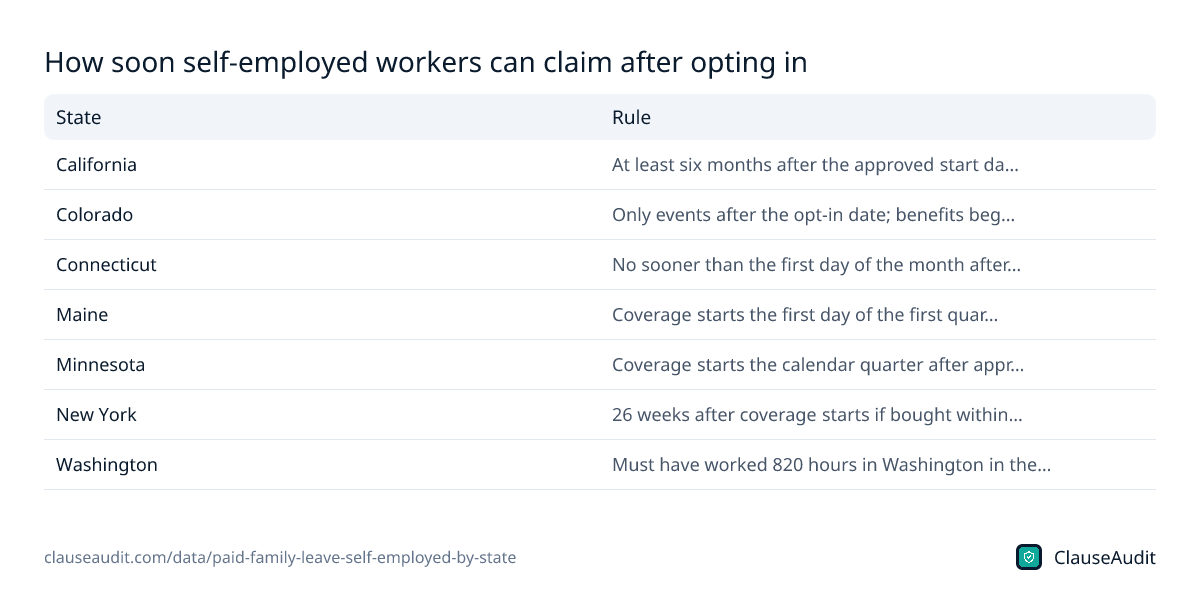
How soon self-employed workers can claim after opting in
| State | Rule |
|---|---|
| California | At least six months after the approved start date of the plan |
| Colorado | Only events after the opt-in date; benefits begin after you report wages and pay premiums at the end of your first reporting quarter |
| Connecticut | No sooner than the first day of the month after 3 full calendar months from registration (registered after January 1, 2022) |
| Maine | Coverage starts the first day of the first quarter after the election |
| Minnesota | Coverage starts the calendar quarter after approval |
| New York | 26 weeks after coverage starts if bought within 26 weeks of starting the business; otherwise a two-year waiting period may apply |
| Washington | Must have worked 820 hours in Washington in the qualifying period |
Source: California Employment Development Department, Disability Insurance Elective Coverage (DIEC) for self-employed; Colorado Department of Labor and Employment, FAMLI Division, Elective coverage for self-employed Coloradans (Opting in to FAMLI); CT Paid Leave Authority, Sole Proprietor or Self-employed Individual; Maine Department of Labor, PFML FAQs: Elective Coverage for Self-Employed Individuals and Tribal Governments; Minnesota Office of the Revisor of Statutes, Minn. Stat. §268B.11, Self-employed and independent contractor election of coverage; New York State Paid Family Leave, Self-Employed Individuals; Washington Employment Security Department, Paid Leave, Elective coverage: opt in. Download as image
Paid family leave access for self-employed workers by state
- 10Self-employed can opt in now
- 1Opt-in promised, not open yet
- 0Voluntary state program (self-employed access not confirmed)
- 2State program, no self-employed opt-in
- 35No state paid family leave program
- Self-employed can opt in now10
- Opt-in promised, not open yet1
- Voluntary state program (self-employed access not confirmed)0
- State program, no self-employed opt-in2
- No state paid family leave program35
- Not yet confirmed3
Can self-employed people get paid family leave?
In some states, yes. California, Colorado, Connecticut, DC, Maine, Massachusetts, Minnesota, New York, Oregon and Washington all give self-employed people a way in. In every one of them it is elective. Nobody deducts anything from your client payments, and nothing happens until you enroll.
Maryland has promised an opt-in for residents but has not opened it. The state says more information for self-employed people will come in 2028. New Jersey lists contractors among the workers its program does not cover, and Delaware's law defines covered workers as people employed by an employer, with no election for anyone else.
Everywhere else, the map is blank. If you freelance in Texas, Florida or Illinois, there is no state fund to buy into. Your options there are private insurance and your own savings, which we cover further down.
How much does paid family leave cost if you're self-employed?
It depends on two things: the rate and the income it applies to. DC charges 0.75% of total gross income. Oregon charges 0.6% of Oregon net self-employment income, counted up to $184,500. Connecticut charges 0.5% of self-employment earnings. Colorado's law says you pay only half of the premium, so in 2026 that is 0.44% of gross income against a full premium of 0.88%.
Washington works the same way in spirit. You pay only the employee share of the premium, not the employer part. New York is the odd one out: you buy a policy from an insurer, and that policy has to bundle disability and Paid Family Leave together, so the price comes from the insurer, not a state table.
California looks expensive at 8.84% of net profit, but compare carefully. That premium pays for Disability Insurance Elective Coverage, which covers your own illness, injury and pregnancy recovery as well as family leave. If your net profit is $4,600 or less, you pay a flat $406.64 for 2026 instead of the percentage. It is closer to an income protection policy than a pure family leave fee.
One practical tip. Gross income and net income are very different numbers for most freelancers. If you spend heavily on equipment, subcontractors or software, a net-income state charges you on a much smaller base than a gross-income state does.
How soon can you use paid family leave after opting in?
Not right away, and this catches a lot of people. Most programs are built to stop someone from enrolling the week before a planned leave.
In California you need at least six months in the plan before you can claim. Connecticut makes newer registrants wait until the first day of the month after 3 full calendar months. In New York, if you buy coverage within 26 weeks of starting your business, you become eligible 26 weeks after coverage begins. Miss that window and a two-year waiting period may apply. Colorado only pays for events that happen after your opt-in date, and Washington still requires 820 hours worked in the state during the qualifying period.
So if you are expecting a child next year, the time to enroll is now. Work backward from your due date, add the waiting period and the time it takes to process the application, and give yourself a cushion. DC adds another wrinkle: enrollment runs November 1 to December 31, or within 60 days of first earning self-employment income there.
Is opting in worth it for a freelancer?
Look at the lock-in first. Colorado, Connecticut, Maine, Oregon and Washington each hold you for 3 years. Minnesota requires 104 weeks. California asks for two complete calendar years, with exceptions if you close the business or leave the state. You are paying for coverage through quiet years as well as the year you need it.
Then check that you even qualify. Oregon wants at least $1,000 in Oregon net self-employment income from the previous tax year. California wants a yearly net profit of at least $4,600. DC only counts income from work you do at least 50% of the time in the District.
It usually makes sense if you have a specific event coming, like a birth, adoption or a parent's surgery, and your income is steady enough that the benefit will be meaningful. It makes less sense if your income swings wildly, if you might move states soon, or if you already have a spouse's employer plan that covers the family. Run the numbers on your own net income and the state's weekly maximum before you commit.
What to do if your state has no program
Most states have nothing for the self-employed to opt in to. That means leave is something you fund and plan yourself.
Price it into your rates. Set aside a fixed share of every invoice in a separate account labeled for leave. Look at private short-term disability insurance. Some policies cover recovery after childbirth if you buy them well before a pregnancy, so read the exclusions. None of them will pay you to care for a relative. And plan your client work so a few months away does not cost you the relationship.
- Tell long-term clients early and agree on dates, coverage and who handles urgent requests.
- Line up a trusted subcontractor, and check that your contracts allow you to use one.
- Get paid for finished work before you go. Invoice milestones rather than waiting for a final sign-off.
- Move retainers to a pause, not a cancellation, so the client and the rate are still there when you return.
- Avoid signing new deals with tight deadlines or heavy penalties that land inside your leave window.
Your client contracts matter as much as the state program
Even the best state benefit replaces only part of your income, and it does nothing about the clients waiting on you. The contract you signed decides whether a client can walk away mid-project, withhold a payment because a deliverable slipped, or charge you for a missed deadline.
Before a planned leave, reread every active contract. Look for termination rights that let the client end the deal on short notice, payment that only arrives on final approval, and clauses that make you personally liable for delays. Those are the terms most likely to turn a few weeks off into lost money.
How ClauseAudit helps
State paid leave covers part of your income. Your client contracts decide if you get paid for the work you finished before leave, and if the client is still there when you come back.
Upload a freelance or service agreement and the automated review flags the clauses that matter when you plan time away, with plain-English notes on what to ask for.
- Payment terms and payment tied to subjective final approval
- Termination for convenience and short notice periods that let a client exit while you are away
- Deadline penalties, liquidated damages and liability for delays
- Whether you can bring in a subcontractor or substitute to cover your work
- Retainer and renewal terms, including whether a pause is allowed instead of a cancellation
- Late fee and interest terms so overdue invoices keep earning while you are out
Frequently asked questions
Do 1099 contractors get paid family leave?
Not automatically. State programs cover employees by default. As a 1099 contractor you only get coverage if your state offers a self-employed opt-in and you enroll, pay the contribution and meet the waiting period. If your state has no program, your options are private disability insurance and personal savings.
Can I get California Paid Family Leave if I'm self-employed?
Yes, through Disability Insurance Elective Coverage with the EDD. For 2026 you pay 8.84% of net profit, or a flat $406.64 if your net profit was $4,600 or less. You must stay in for two complete calendar years and be enrolled at least six months before you can claim.
How does New York Paid Family Leave work for the self-employed?
You buy a policy from an insurer, and it must cover disability and Paid Family Leave together. Buy within 26 weeks of starting your business to avoid a two-year waiting period. Even then, you become eligible 26 weeks after coverage starts. The maximum weekly benefit is $1,228.53.
Can I opt in right before having a baby?
Usually not in time. California needs six months of enrollment, New York 26 weeks, and Connecticut about 3 full calendar months for newer registrants. Colorado only pays for events after your opt-in date. If you are planning a family, enroll well before you expect to need the leave.
Can I quit the program once my leave is over?
Generally no. Opting in is a multi-year commitment. Colorado, Connecticut, Maine, Oregon and Washington require 3 years, Minnesota requires 104 weeks and California two complete calendar years. DC allows opting out after 3 years. Plan to pay for the full period, not just the year you use it.
What is the most a self-employed person can collect per week?
It depends on the state. California has the highest 2026 ceiling at $1,765 a week, followed by Oregon at $1,692.16 and Washington at $1,647. Connecticut's maximum is $1,016.40. These are caps, and your actual benefit is based on the income you reported.
Does Washington Paid Leave cover self-employed people?
Yes, if you opt in with the Employment Security Department. You pay only the employee share of the premium, commit for 3 years with 1-year renewals after that, and still need 820 hours worked in Washington during the qualifying period before you can take leave.
What if my state has no paid family leave program?
Then there is nothing to opt in to, and you will need to fund leave yourself. Build a leave fund from each invoice, look at private short-term disability coverage (bought well before a pregnancy, since many policies exclude one that has already started), and set up your client contracts so work can pause rather than end while you are away.
Use this data
Every chart and card below is free to reuse under CC BY 4.0. Download what you need and link back to this page.
 Stat cards
 Key findings card
 Infographic
 Self-employed contribution rate for state paid family and medical leave coverage, 2026 (% of income)
 Minimum time a self-employed worker must stay enrolled after opting in, by state (years)
 Maximum weekly benefit in states where self-employed workers can opt in, 2026 (USD per week)
 California maximum weekly Disability Insurance and Paid Family Leave benefit, 2014-2026 (USD per week)
 California self-employed (DIEC) premium for 2026, based on net profit
 How soon self-employed workers can claim after opting in
Embed the infographic
Free to share on your site, blog or slides under CC BY 4.0. Please keep the credit link.
Sources and method
Every number on this page comes from the sources below, each opened and read on or before October 18, 2026. A second, independent review checked every figure against its source and corrected anything that did not match. 48 of 51 state entries were confirmed; any that could not be are marked "Not yet confirmed" and left out of every count and chart.
- California Employment Development Department, Disability Insurance Elective Coverage (DIEC) for self-employed (Accessed 2026-10-18)
- California Employment Development Department, Self-Employed Benefit Amounts (DIEC) (Calendar year 2026 rates (accessed 2026-10-18))
- California Employment Development Department, Elective Coverage FAQs (Accessed 2026-10-18)
- California Employment Development Department, State Disability Insurance Quick Statistics: Maximum Weekly Benefit Amount (CY 2026 edition)
- Colorado Department of Labor and Employment, FAMLI Division, Elective coverage for self-employed Coloradans (Opting in to FAMLI) (Accessed 2026-10-18)
- Colorado Department of Labor and Employment, FAMLI Division, Premium and Benefits Calculator (2026 premiums; 2026-2027 benefit figures (accessed 2026-10-18))
- Colorado Department of Labor and Employment, FAMLI Division, Colorado Paid Family and Medical Leave Insurance Act, C.R.S. 8-13.3-501 et seq. (FAMLI Statute, as linked from FAMLI Rules & Guidance) (Revised Aug 6, 2025)
- Colorado Department of Labor and Employment, FAMLI Division, FAMLI Rules & Guidance (Accessed 2026-10-18 (maximum as of July 1, 2026))
- CT Paid Leave Authority, Sole Proprietor or Self-employed Individual (Accessed 2026-10-18)
- CT Paid Leave Authority, Before you Apply (Accessed 2026-10-18 (figures as of 1/1/2026))
- DC Department of Employment Services, Office of Paid Family Leave, Self-Employed Individuals: DC Paid Family Leave (Accessed 2026-10-18)
- DC Department of Employment Services, DC Paid Family Leave (Accessed 2026-10-18 (amounts effective October 1, 2026))
- Maine Department of Labor, For Self-Employed Mainers (Accessed 2026-10-18)
- Maine Department of Labor, PFML FAQs: Elective Coverage for Self-Employed Individuals and Tribal Governments (March 2025)
- Maine Legislature, Office of the Revisor of Statutes, 26 M.R.S. §850-F, Fund; premiums (Accessed 2026-10-18)
- Maine Legislature, Office of the Revisor of Statutes, 26 M.R.S. §850-C, Benefits (Accessed 2026-10-18)
- Maine Workers' Compensation Board, State Average Weekly Wage Notice (rev. 8-14-26) (Effective July 1, 2026 (revised August 14, 2026))
- Massachusetts Department of Family and Medical Leave, Paid Family and Medical Leave (PFML) overview and benefits (Accessed 2026-10-18)
- Massachusetts Department of Revenue / Department of Family and Medical Leave, Opt in and contribute to PFML as a self-employed individual (Accessed 2026-10-18)
- Minnesota Office of the Revisor of Statutes, Minn. Stat. §268B.11, Self-employed and independent contractor election of coverage (2025 Minnesota Statutes)
- Minnesota Department of Labor and Industry, Your job, your rights: Protections under Minnesota's Paid Leave law (webinar slides) (June 2026)
- New York State Paid Family Leave, Self-Employed Individuals (Accessed 2026-10-18)
- New York State Paid Family Leave, New York Paid Family Leave Updates for 2026 (2026)
- Oregon Employment Department, Paid Leave Oregon, Self-employed: Overview (Accessed 2026-10-18 (2025-2026 rate))
- Oregon Employment Department, Employer News: Weekly Benefit Amounts Increasing for New Unemployment Insurance and Paid Leave Oregon Claims (June 11, 2026)
- Washington Employment Security Department, Paid Leave, Elective coverage: opt in (Accessed 2026-10-18)
- Washington Employment Security Department, Paid Leave, Paid Family and Medical Leave paycheck insert 2026 (December 2025 (2026 figures))
- Maryland Department of Labor, About the program (FAMLI) (Accessed 2026-10-18)
- New Jersey Department of Labor and Workforce Development, Family Leave Insurance (worker page) (Accessed 2026-10-18)
- Delaware General Assembly, Delaware Code Online, Delaware Code Title 19, Chapter 37, Family and Medical Leave Insurance Program (Accessed 2026-10-18)
- Ernst & Young LLP (EY Tax News), 2026 state disability, paid family and medical leave and long-term care insurance wage base and rates (January 2026 (2026 rates))
Cite this page
ClauseAudit, “Paid Family Leave for Self-Employed Workers by State (2026): Who Can Opt In, What It Costs and When It Pays”, updated October 18, 2026, https://clauseaudit.com/data/paid-family-leave-self-employed-by-state. Free to reuse with a link back (CC BY 4.0).
This page summarises published data and law as checked on October 18, 2026. Figures are updated as new editions are released, and your own situation may differ. It is general information, not legal, tax or financial advice.