Most Negotiated Contract Terms: What Businesses Actually Fight Over
By ClauseAudit Research · 3 sources ·
What are the most negotiated contract terms?
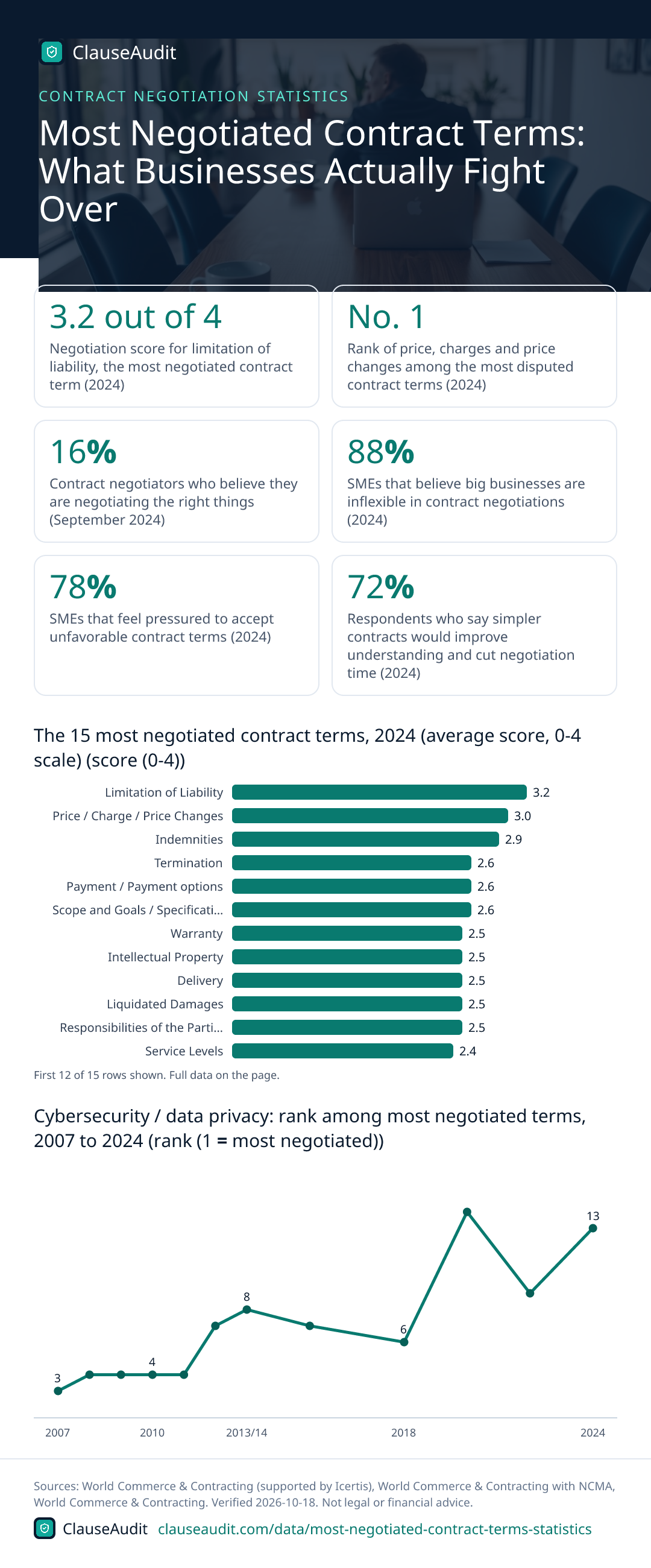
Limitation of liability is the most negotiated contract term, with an average score of 3.2 out of 4 in WorldCC's 2024 survey of 937 organizations. Price and charges (3.0) and indemnities (2.9) follow. Liability has held the No. 1 spot in every edition since the first survey in 2007.

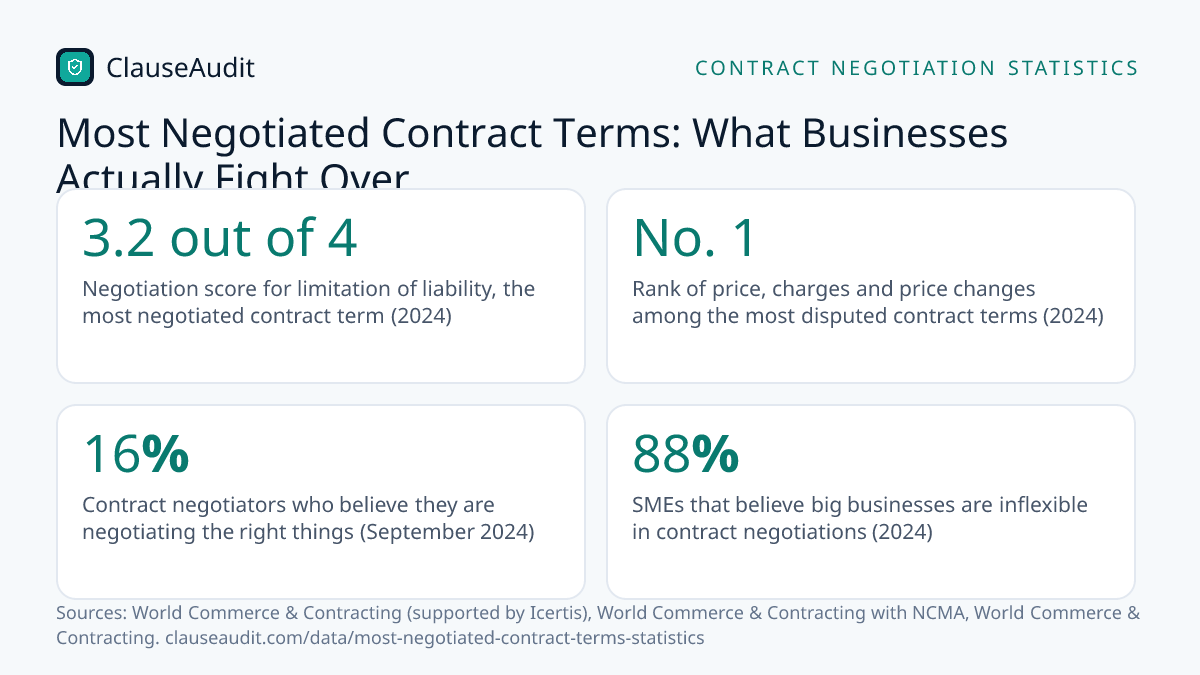
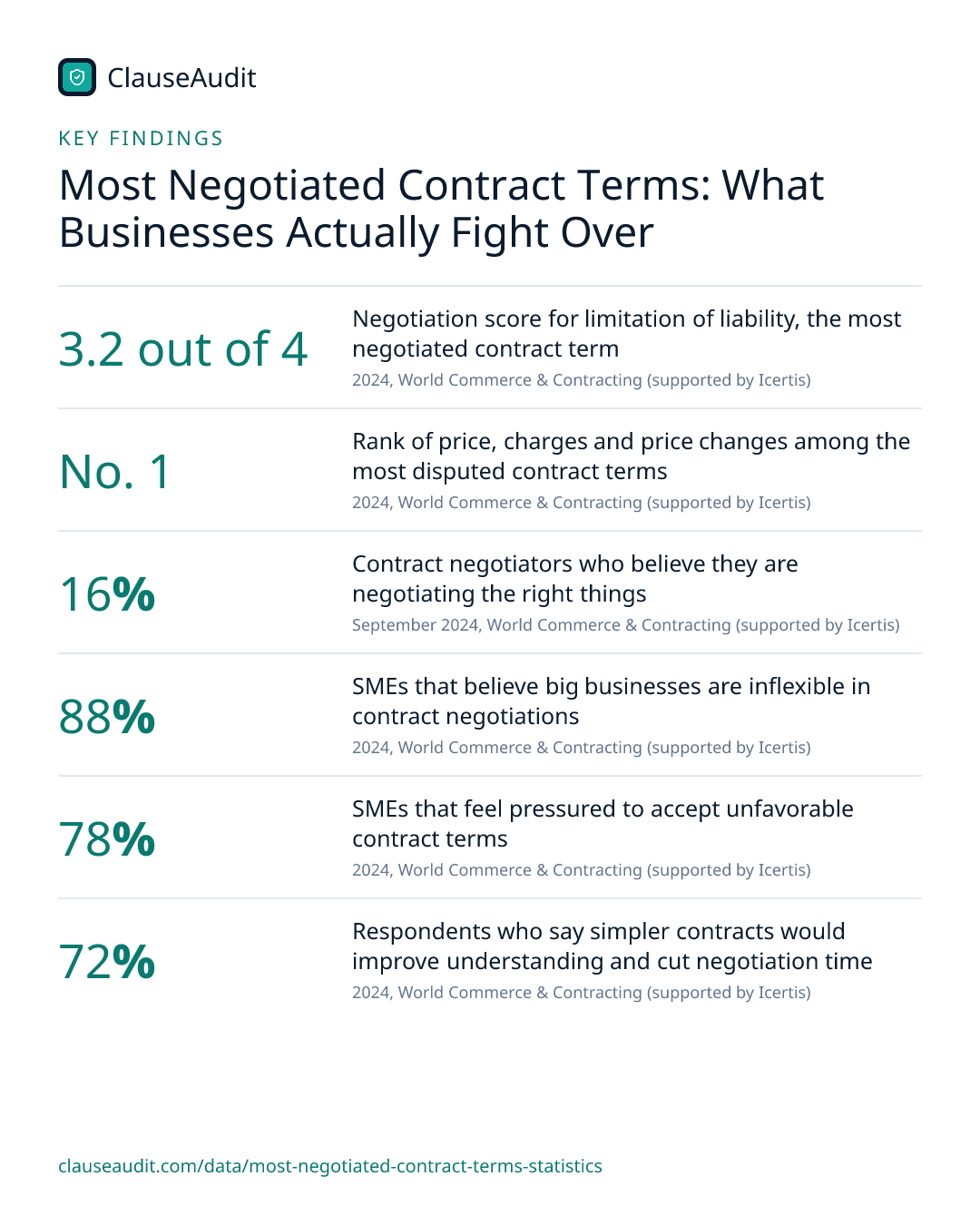
- Negotiation score for limitation of liability, the most negotiated contract term (2024, World Commerce & Contracting (supported by Icertis))
- 3.2 out of 4
- Rank of price, charges and price changes among the most disputed contract terms (2024, World Commerce & Contracting (supported by Icertis))
- No. 1
- Contract negotiators who believe they are negotiating the right things (September 2024, World Commerce & Contracting (supported by Icertis))
- 16%
- SMEs that believe big businesses are inflexible in contract negotiations (2024, World Commerce & Contracting (supported by Icertis))
- 88%
- SMEs that feel pressured to accept unfavorable contract terms (2024, World Commerce & Contracting (supported by Icertis))
- 78%
- Respondents who say simpler contracts would improve understanding and cut negotiation time (2024, World Commerce & Contracting (supported by Icertis))
- 72%
- Cost reduction US government agencies could achieve with less adversarial negotiation (2024, World Commerce & Contracting with NCMA)
- Up to 13.3%
- Rank of liquidated damages among most negotiated terms in oil, gas and energy (2025 (energy sector edition), World Commerce & Contracting)
- 3rd
Every contract has a few clauses that decide who pays when something goes wrong. Those are the ones that get marked up, sent back and argued over on calls. World Commerce & Contracting (then called IACCM) has tracked them since 2007, and the top of the list barely moves: liability, price and indemnities.
The more useful story sits underneath. The terms people fight over at signing are not the terms that cause trouble later, and smaller companies often feel they have no room to push at all. This page walks through what the rankings mean and how to spend your limited negotiating energy where it pays off.
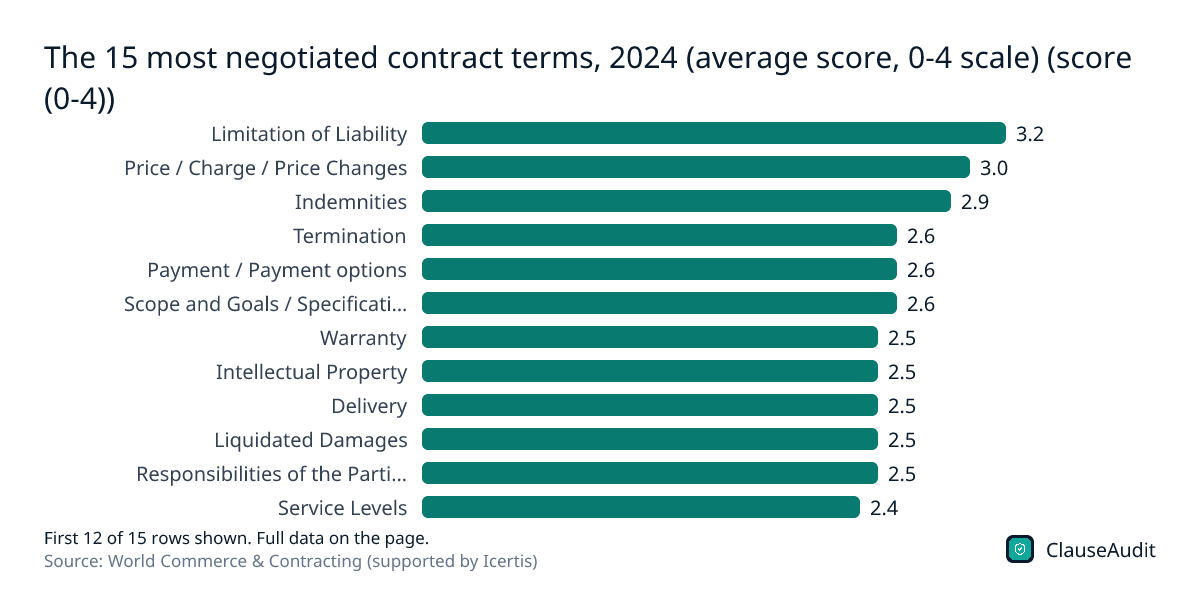
The 15 most negotiated contract terms, 2024 (average score, 0-4 scale) (score (0-4))
Chart data
| Label | Value |
|---|---|
| Limitation of Liability | 3.2 |
| Price / Charge / Price Changes | 3.0 |
| Indemnities | 2.9 |
| Termination | 2.6 |
| Payment / Payment options | 2.6 |
| Scope and Goals / Specification | 2.6 |
| Warranty | 2.5 |
| Intellectual Property | 2.5 |
| Delivery | 2.5 |
| Liquidated Damages | 2.5 |
| Responsibilities of the Parties | 2.5 |
| Service Levels | 2.4 |
| Cybersecurity / Data Privacy | 2.3 |
| Invoices / Late Payment | 2.3 |
| Amendments / Changes to Contract | 2.2 |
Liability (3.2), price (3.0) and indemnities (2.9) sit clearly above everything else. Then termination, payment and scope all tie at 2.6, so after the big three there is no single obvious next fight.
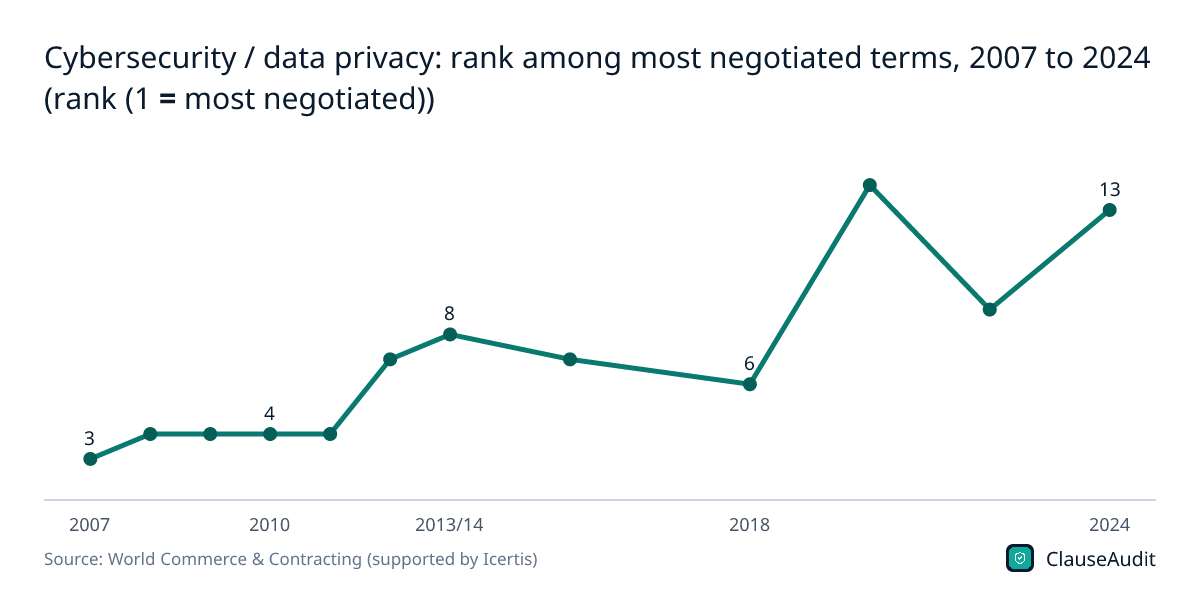
Download this chart (PNG)Cybersecurity / data privacy: rank among most negotiated terms, 2007 to 2024 (rank (1 = most negotiated))
Chart data
| Label | Value (rank (1 = most negotiated)) |
|---|---|
| 2007 | 3 |
| 2008 | 4 |
| 2009 | 4 |
| 2010 | 4 |
| 2011 | 4 |
| 2012 | 7 |
| 2013/14 | 8 |
| 2015 | 7 |
| 2018 | 6 |
| 2020 | 14 |
| 2022 | 9 |
| 2024 | 13 |
Cybersecurity and data privacy ranked 3rd in 2007 and 13th in 2024. The survey does not say why, and WorldCC has merged and split some term definitions over the years. A lower rank does not mean lower risk, so still read the data clauses yourself.
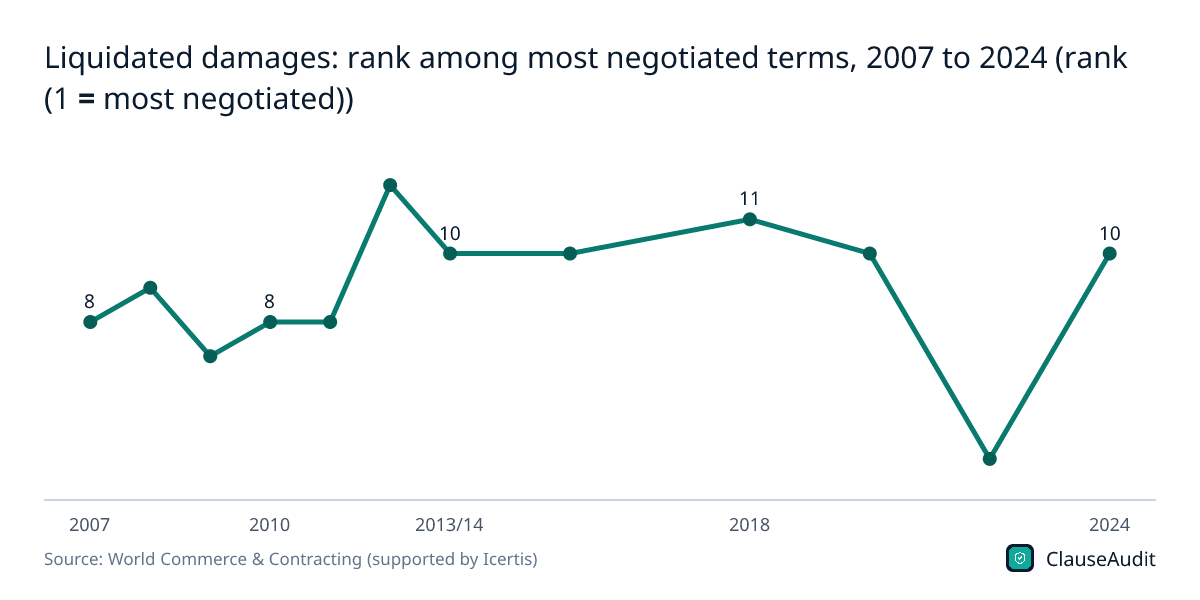
Download this chart (PNG)Liquidated damages: rank among most negotiated terms, 2007 to 2024 (rank (1 = most negotiated))
Chart data
| Label | Value (rank (1 = most negotiated)) |
|---|---|
| 2007 | 8 |
| 2008 | 9 |
| 2009 | 7 |
| 2010 | 8 |
| 2011 | 8 |
| 2012 | 12 |
| 2013/14 | 10 |
| 2015 | 10 |
| 2018 | 11 |
| 2020 | 10 |
| 2022 | 4 |
| 2024 | 10 |
Liquidated damages jumped to 4th in 2022 and fell back to 10th in 2024. Industry matters here: in the 2025 energy sector edition it ranks 3rd.
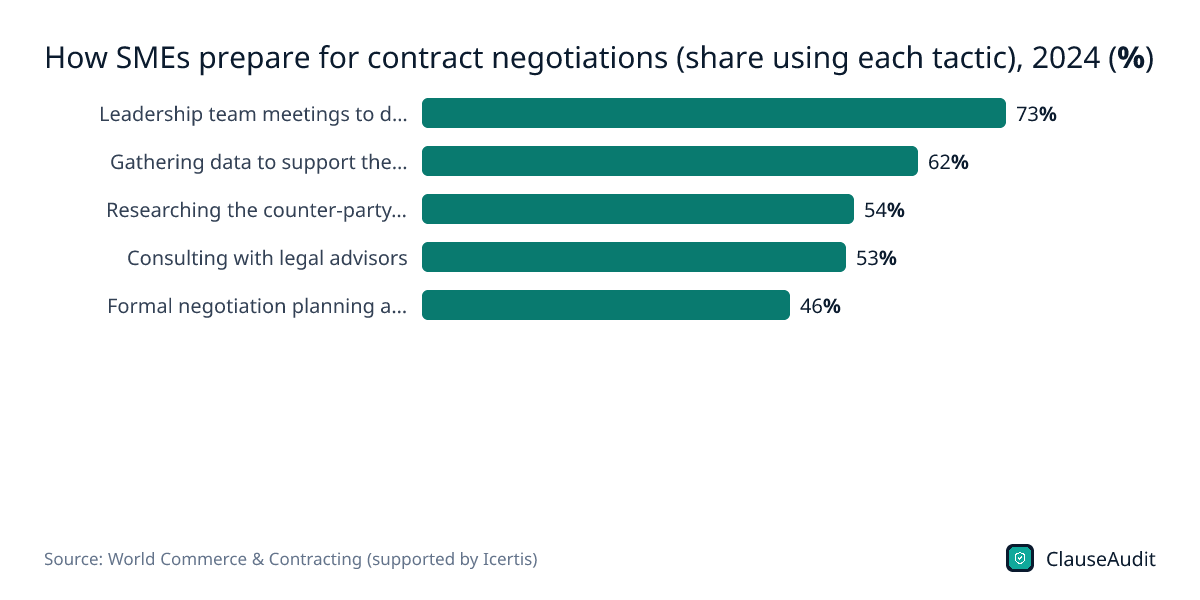
Download this chart (PNG)How SMEs prepare for contract negotiations (share using each tactic), 2024 (%)
Chart data
| Label | Value |
|---|---|
| Leadership team meetings to define goals | 73% |
| Gathering data to support their position | 62% |
| Researching the counter-party's needs and objectives | 54% |
| Consulting with legal advisors | 53% |
| Formal negotiation planning and role plays | 46% |
73% of SMEs hold leadership meetings to set goals, but only 53% consult a legal advisor. Knowing your walk-away points is good. Knowing what the clause actually says is better.
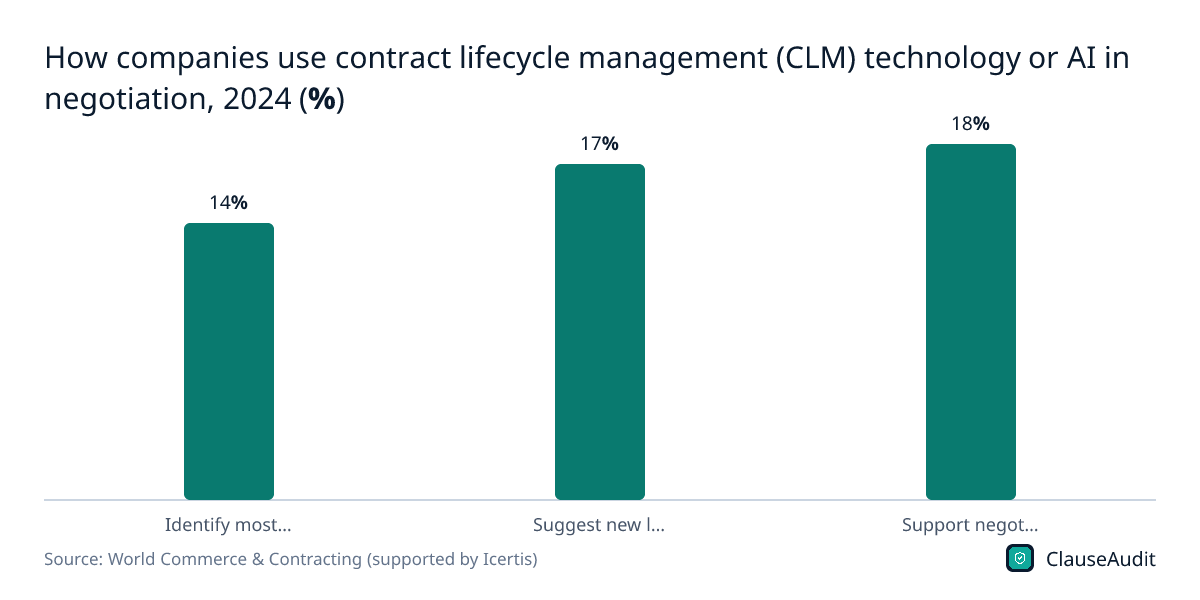
Download this chart (PNG)How companies use contract lifecycle management (CLM) technology or AI in negotiation, 2024 (%)
Chart data
| Label | Value (%) |
|---|---|
| Identify most negotiated terms | 14% |
| Suggest new language | 17% |
| Support negotiations | 18% |
Few companies use contract software or AI tools to spot the terms they fight over most: 14% overall, and 18% use it to support negotiations. Most of this work is still done by people reading drafts.
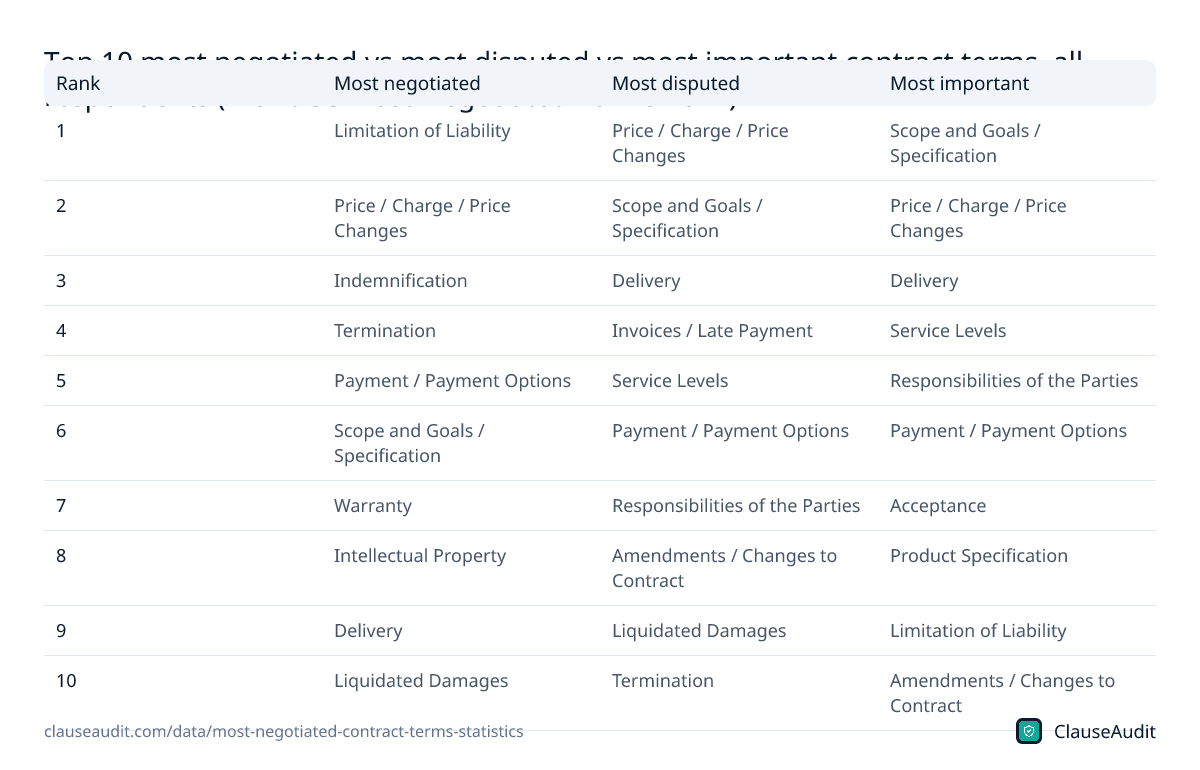
Download this chart (PNG)Top 10 most negotiated vs most disputed vs most important contract terms, all respondents (WorldCC Most Negotiated Terms 2024)
| Rank | Most negotiated | Most disputed | Most important |
|---|---|---|---|
| 1 | Limitation of Liability | Price / Charge / Price Changes | Scope and Goals / Specification |
| 2 | Price / Charge / Price Changes | Scope and Goals / Specification | Price / Charge / Price Changes |
| 3 | Indemnification | Delivery | Delivery |
| 4 | Termination | Invoices / Late Payment | Service Levels |
| 5 | Payment / Payment Options | Service Levels | Responsibilities of the Parties |
| 6 | Scope and Goals / Specification | Payment / Payment Options | Payment / Payment Options |
| 7 | Warranty | Responsibilities of the Parties | Acceptance |
| 8 | Intellectual Property | Amendments / Changes to Contract | Product Specification |
| 9 | Delivery | Liquidated Damages | Limitation of Liability |
| 10 | Liquidated Damages | Termination | Amendments / Changes to Contract |
Source: World Commerce & Contracting (supported by Icertis), Most Negotiated Terms 2024: Including exploration of the distinctions between big businesses and SMEs. Download as image
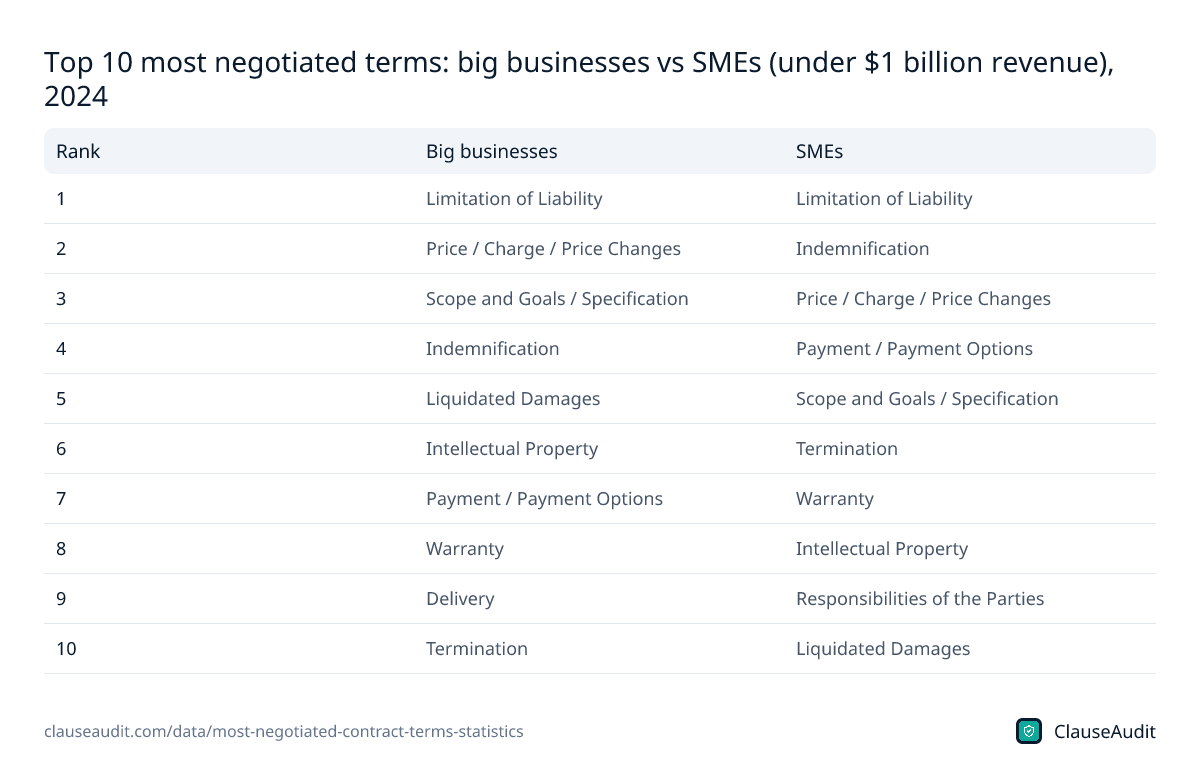
Top 10 most negotiated terms: big businesses vs SMEs (under $1 billion revenue), 2024
| Rank | Big businesses | SMEs |
|---|---|---|
| 1 | Limitation of Liability | Limitation of Liability |
| 2 | Price / Charge / Price Changes | Indemnification |
| 3 | Scope and Goals / Specification | Price / Charge / Price Changes |
| 4 | Indemnification | Payment / Payment Options |
| 5 | Liquidated Damages | Scope and Goals / Specification |
| 6 | Intellectual Property | Termination |
| 7 | Payment / Payment Options | Warranty |
| 8 | Warranty | Intellectual Property |
| 9 | Delivery | Responsibilities of the Parties |
| 10 | Termination | Liquidated Damages |
Source: World Commerce & Contracting (supported by Icertis), Most Negotiated Terms 2024: Including exploration of the distinctions between big businesses and SMEs. Download as image
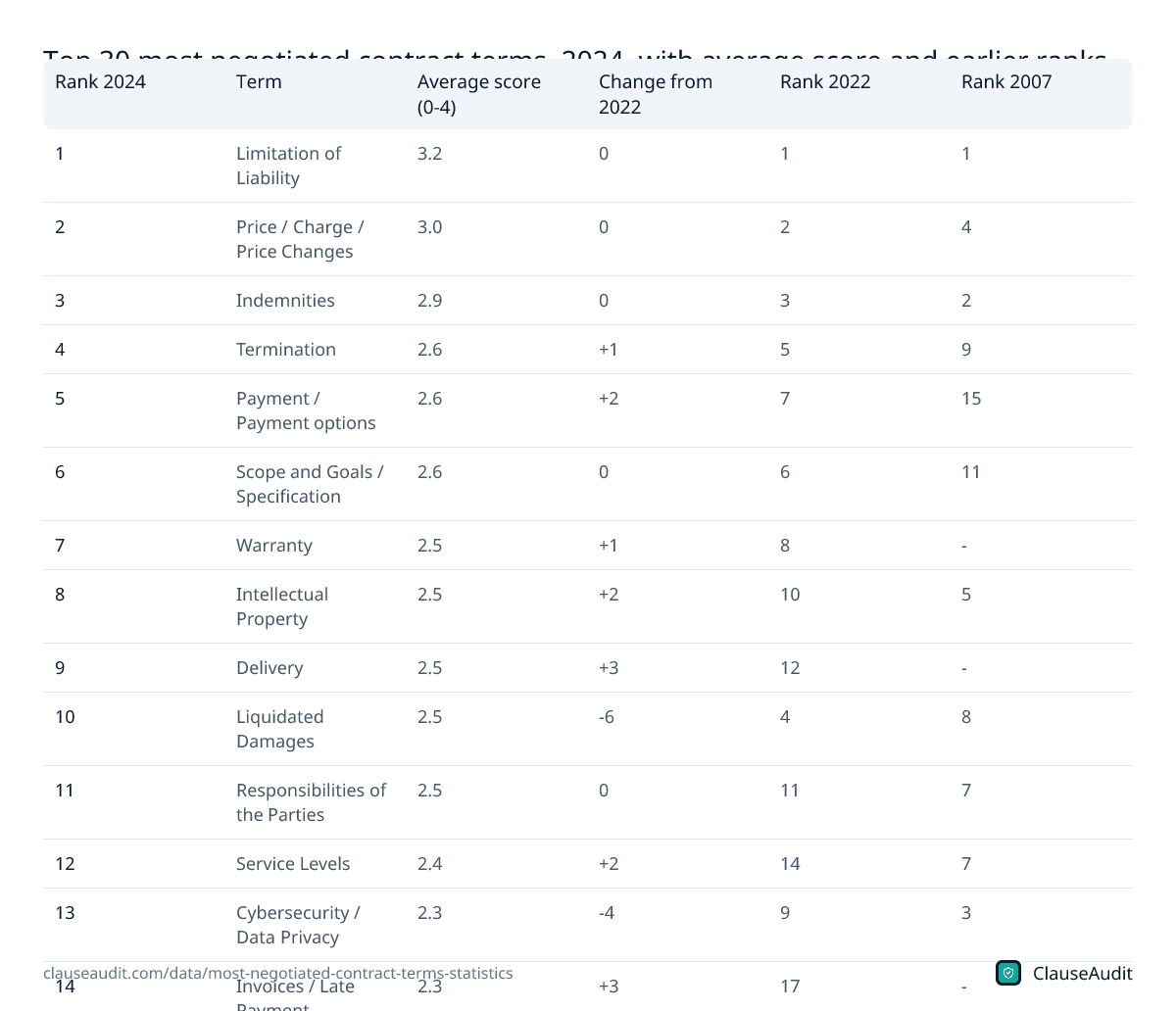
Top 30 most negotiated contract terms, 2024, with average score and earlier ranks
| Rank 2024 | Term | Average score (0-4) | Change from 2022 | Rank 2022 | Rank 2007 |
|---|---|---|---|---|---|
| 1 | Limitation of Liability | 3.2 | 0 | 1 | 1 |
| 2 | Price / Charge / Price Changes | 3.0 | 0 | 2 | 4 |
| 3 | Indemnities | 2.9 | 0 | 3 | 2 |
| 4 | Termination | 2.6 | +1 | 5 | 9 |
| 5 | Payment / Payment options | 2.6 | +2 | 7 | 15 |
| 6 | Scope and Goals / Specification | 2.6 | 0 | 6 | 11 |
| 7 | Warranty | 2.5 | +1 | 8 | - |
| 8 | Intellectual Property | 2.5 | +2 | 10 | 5 |
| 9 | Delivery | 2.5 | +3 | 12 | - |
| 10 | Liquidated Damages | 2.5 | -6 | 4 | 8 |
| 11 | Responsibilities of the Parties | 2.5 | 0 | 11 | 7 |
| 12 | Service Levels | 2.4 | +2 | 14 | 7 |
| 13 | Cybersecurity / Data Privacy | 2.3 | -4 | 9 | 3 |
| 14 | Invoices / Late Payment | 2.3 | +3 | 17 | - |
| 15 | Amendments / Changes to Contract | 2.2 | +1 | 16 | 10 |
| 16 | Confidential Information / Non-disclosure | 2.2 | -1 | 15 | 12 |
| 17 | Term (Period / Length) | 2.2 | -4 | 13 | 19 |
| 18 | Performance Guarantees / Undertakings | 2.2 | 0 | 18 | 14 |
| 19 | Insurance | 2.1 | +1 | 20 | - |
| 20 | Product Specification | 2.1 | +1 | 21 | - |
| 21 | Adherence to Policies (e.g. environmental, security, etc.) | 1.9 | +1 | 22 | 15 |
| 22 | Acceptance | 1.9 | -3 | 19 | - |
| 23 | Information Access and Management | 1.9 | +1 | 24 | 17 |
| 24 | Dispute Resolution | 1.8 | +4 | 28 | - |
| 25 | Regulatory Compliance | 1.7 | -2 | 23 | - |
| 26 | Rights of Use | 1.7 | +3 | 29 | - |
| 27 | Applicable Law / Jurisdiction | 1.6 | -2 | 25 | - |
| 28 | Communications and Reporting | 1.6 | New | - | - |
| 29 | Force Majeure | 1.6 | -3 | 26 | - |
| 30 | Product or Service Withdrawal | 1.6 | New | - | - |
Source: World Commerce & Contracting (supported by Icertis), Most Negotiated Terms 2024: Including exploration of the distinctions between big businesses and SMEs. Download as image
What are the most negotiated contract terms?
The top three in 2024 were limitation of liability, price and charges, and indemnities. All three hold the same ranks they held in 2022. After them comes a tight cluster at 2.6: termination, payment terms, and scope and specification.
Notice what those three leaders have in common. Each one moves money between the parties after something goes wrong. A liability cap decides the most you can recover if the other side causes a loss. An indemnity decides who pays for third-party claims. Price changes decide whether the number you signed is the number you pay after renewal.
Some terms climbed. Payment options rose two places to 5th, delivery rose three to 9th, and invoices and late payment rose three to 14th. Taken together, those moves suggest people are paying closer attention to when they get paid.
Are the terms people negotiate the ones that cause disputes?
Mostly no, and that is the most useful finding in the report. Price and price changes rank No. 1 for disputes, for big businesses and SMEs alike. Second on the dispute list is scope and specification, which ranks only 6th for negotiation. Delivery is 3rd for disputes and 9th for negotiation.
Limitation of liability, the term everyone fights over, does not appear in the top 10 disputed terms at all. It ranks 9th on the list of terms people call most important.
It fits a separate WorldCC and Deloitte finding from September 2024: only 16% of contract negotiators believe they are negotiating the right things. Teams spend hours on a liability cap that may never be triggered, then sign a vague scope that starts an argument a few months in. A freelancer sees the same pattern on a smaller scale: you push back on an indemnity, then get stuck in endless revisions because nobody wrote down what done looks like.
Why do smaller businesses struggle to negotiate?
The report defines SMEs as companies under $1 billion in annual revenue, which covers the vast majority of businesses. Within that group, 88% say big businesses are inflexible in negotiations and 78% feel pressured to accept unfavorable terms.
Their priorities also differ. For SMEs, indemnification ranks 2nd and payment options 4th. Big businesses put scope 3rd and liquidated damages 5th. A small company signing with a large customer worries about being dragged into someone else's lawsuit and about getting paid on time. Those are sensible fears.
If you are on the small side of the table, you rarely win by asking for everything. You win by picking a few points that would genuinely hurt you and making a clear case for each.
Which contract terms should you negotiate first?
Use the dispute list as your guide, not the negotiation list. Here is a simple order that works for most service, software and vendor deals:
- Scope. Write down deliverables, acceptance steps and what counts as a change. Scope is 2nd for disputes and 1st for importance.
- Price changes. Look for automatic increases on renewal and fees that can change on notice. Ask for a cap or a fixed price for the first term.
- Payment and late payment. Set the due date, the invoice process and what happens when money is late.
- Liability cap. Check what it is tied to, such as the fees paid over a set period, and whether data loss or confidentiality breaches sit outside it.
- Indemnities. Make them mutual where you can, and limit them to claims the other side's own conduct causes.
- Termination. Know how you get out, how much notice you owe and what you still pay after you leave.
What do these numbers mean for freelancers and small vendors?
The survey covers companies, but the same clauses show up in a short freelance agreement or a software order form. The difference is that you usually get the client's paper, and nobody expects you to push back.
Start with the clauses that end up in the dispute list. If the scope says "website redesign" and nothing else, you have no defense against yet another round of changes. Add the number of revision rounds, the pages or features included, and a line saying extra work is billed at your rate.
Then look at money. Payment options and late payment both moved up the 2024 rankings. Set a due date, say how invoices are approved, and add a late fee if your state allows one. A clause that pays you only on the client's "final approval" puts your income on hold for as long as they like.
Liability and indemnity still matter, even for a solo business. A clause that makes you liable for "any and all damages" with no cap can put a single project's risk on your savings. Asking for a cap tied to the fees paid is a common, reasonable request.
Buying software works the same way in reverse. You are the customer, so watch the renewal price, the notice period to cancel and how small the vendor's liability cap is compared with the data you hand over.
Simpler contracts and less adversarial talks
72% of respondents say simpler contracts would improve understanding and cut negotiation time. That matches what most people feel when a long vendor agreement lands in their inbox on a Friday.
The adversarial habit has a cost too. WorldCC and NCMA estimate US government agencies could cut costs by up to 13.3% with less adversarial negotiation. That is a modelled figure, not a measured saving, but the logic carries over to private deals: every week spent trading redlines on a cap that never gets used is a week the project is not moving.
So prepare well and keep the ask short. Gathering data to support your position (62% of SMEs do it) beats arguing on principle. A short reason, such as a past loss, a real dollar exposure or an industry norm, moves the other side further than a long markup.
How ClauseAudit helps
Upload a vendor, software or service agreement and the automated review flags the clauses this page talks about, rates each one HIGH, MEDIUM or LOW and explains it in plain English with a suggested fix you can send back.
It is a fast first pass so you know where to push before a call, not a replacement for a lawyer on a large deal.
- Limitation of liability: what the cap is tied to and what sits outside it
- Price and renewal: automatic increases, notice periods and auto-renewal
- Indemnities: one-sided or mutual, and how broad the covered claims are
- Scope and acceptance: whether deliverables and sign-off are defined
- Payment terms and late fees: due dates, invoice rules and interest
- Termination: exit rights, notice and fees owed after you leave
Frequently asked questions
What is the single most negotiated term in a contract?
Limitation of liability. It scored 3.2 out of 4 in WorldCC's 2024 survey and has ranked No. 1 in every edition since 2007. It sets the most one party can recover from the other if something goes wrong, which is why both sides care so much about it.
What is the most disputed contract term?
Price, charges and price changes rank No. 1 among disputed terms in 2024, for both big businesses and SMEs. Disputes usually come from unexpected costs or increases during the contract, so spell out how and when the price can change before you sign.
Why is limitation of liability negotiated so much?
Because it decides how much risk each side carries. A supplier wants a low cap tied to fees. A customer wants room to recover real losses, such as a data breach. The fight is over the cap amount and which losses fall outside it.
How was the most negotiated terms data collected?
World Commerce & Contracting surveyed 937 organizations for its 2024 report, with 31% based in North America. Respondents rated how often each term is negotiated on a scale from 0, rarely or never, to 4, most of the time or always. The survey has run since 2007.
Do small businesses negotiate different terms than big companies?
Somewhat. Both put limitation of liability first. SMEs rank indemnification 2nd and payment options 4th, while big businesses put price 2nd and scope 3rd. 78% of SMEs say they feel pressured to accept unfavorable terms, so choosing your battles matters more.
Is it worth negotiating a contract with a much bigger company?
Usually yes, if you keep it focused. 88% of SMEs find big businesses inflexible, but a short list of specific points, each backed by a clear reason, is far easier for a large company to accept than a full markup. Ask about scope, price increases and payment timing before you spend effort on boilerplate.
Why has cybersecurity dropped down the list?
Cybersecurity and data privacy ranked 3rd in 2007 and 13th in 2024. The survey does not give a reason, and WorldCC has redefined some terms over time. The clauses still matter, especially in software deals that hold your customer data.
What contract terms cause problems after signing?
The 2024 dispute list is led by price changes, scope and specification, delivery, and invoices and late payment. Those are practical, day-to-day terms. If they are vague when you sign, they tend to become arguments once the work starts. A clear scope and payment section is quick to write and saves weeks later.
Use this data
Every chart and card below is free to reuse under CC BY 4.0. Download what you need and link back to this page.
 Stat cards
 Key findings card
 Infographic
 The 15 most negotiated contract terms, 2024 (average score, 0-4 scale) (score (0-4))
 Cybersecurity / data privacy: rank among most negotiated terms, 2007 to 2024 (rank (1 = most negotiated))
 Liquidated damages: rank among most negotiated terms, 2007 to 2024 (rank (1 = most negotiated))
 How SMEs prepare for contract negotiations (share using each tactic), 2024 (%)
 How companies use contract lifecycle management (CLM) technology or AI in negotiation, 2024 (%)
 Top 10 most negotiated vs most disputed vs most important contract terms, all respondents (WorldCC Most Negotiated Terms 2024)
 Top 10 most negotiated terms: big businesses vs SMEs (under $1 billion revenue), 2024
 Top 30 most negotiated contract terms, 2024, with average score and earlier ranks
Embed the infographic
Free to share on your site, blog or slides under CC BY 4.0. Please keep the credit link.
Sources and method
Every number on this page comes from the sources below, each opened and read on or before October 18, 2026. A second, independent review checked every figure against its source and corrected anything that did not match. Figures that could not be confirmed were left out.
- World Commerce & Contracting (supported by Icertis), Most Negotiated Terms 2024: Including exploration of the distinctions between big businesses and SMEs (2024 (2024 edition; exact release date not printed in the report, PDF file created 14 October 2024))
- World Commerce & Contracting, Most Negotiated Terms: Energy Sector (2025 (page shows no publication date; footer reads (c) 2025 World Commerce & Contracting))
- World Commerce & Contracting with NCMA, Most Negotiated Terms 2024: A focus on US government procurement and contracting (report summary) (2024 edition (page shows no publication date; footer reads (c) 2025 World Commerce & Contracting))
Cite this page
ClauseAudit, “Most Negotiated Contract Terms: What Businesses Actually Fight Over”, updated October 18, 2026, https://clauseaudit.com/data/most-negotiated-contract-terms-statistics. Free to reuse with a link back (CC BY 4.0).
This page summarises published data and law as checked on October 18, 2026. Figures are updated as new editions are released, and your own situation may differ. It is general information, not legal, tax or financial advice.