Subscription and Auto-Renewal Enforcement Tracker: FTC ROSCA Cases and Settlements
By ClauseAudit Research · 23 sources ·
What happened to the FTC click to cancel rule?
The rule is gone, but enforcement is not. A federal appeals court vacated the FTC's click-to-cancel rule on July 8, 2025, before it ever took full effect. The FTC kept suing under ROSCA anyway, filing 5 cases and getting 6 settlements between January 2025 and March 2026, including Amazon's $2.5 billion Prime deal.

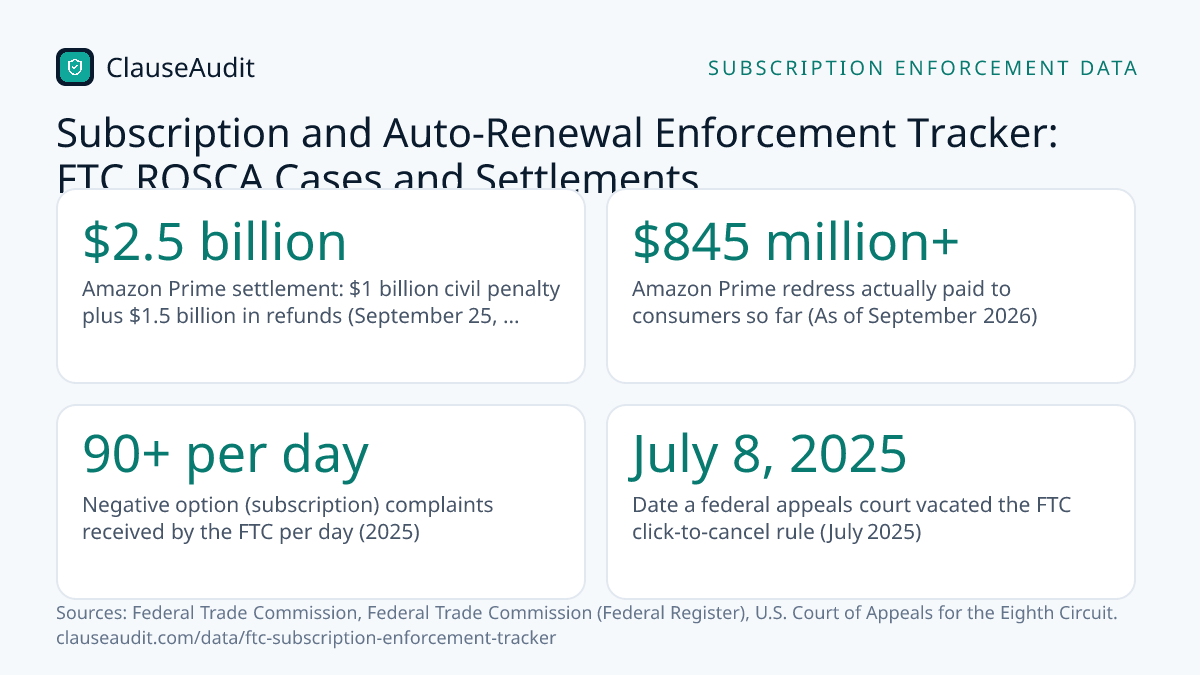
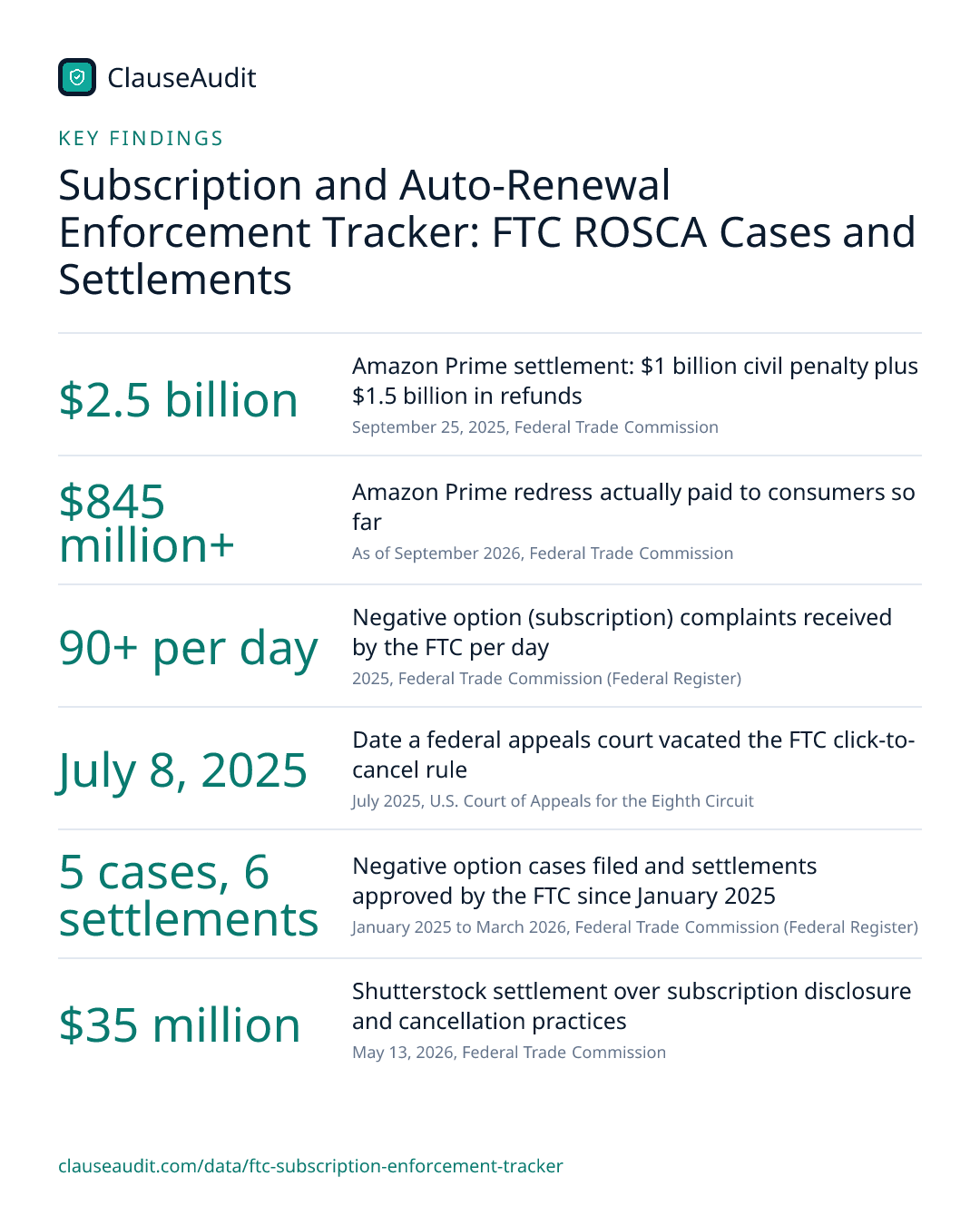
- Amazon Prime settlement: $1 billion civil penalty plus $1.5 billion in refunds (September 25, 2025, Federal Trade Commission)
- $2.5 billion
- Amazon Prime redress actually paid to consumers so far (As of September 2026, Federal Trade Commission)
- $845 million+
- Negative option (subscription) complaints received by the FTC per day (2025, Federal Trade Commission (Federal Register))
- 90+ per day
- Date a federal appeals court vacated the FTC click-to-cancel rule (July 2025, U.S. Court of Appeals for the Eighth Circuit)
- July 8, 2025
- Negative option cases filed and settlements approved by the FTC since January 2025 (January 2025 to March 2026, Federal Trade Commission (Federal Register))
- 5 cases, 6 settlements
- Shutterstock settlement over subscription disclosure and cancellation practices (May 13, 2026, Federal Trade Commission)
- $35 million
- Most screens and actions the FTC alleges Uber One users faced to cancel (Alleged in complaint filed April 21, 2025, Federal Trade Commission)
- 23 screens, 32 actions
- Subscription sites and apps using at least one possible dark pattern (Review announced July 10, 2024, Federal Trade Commission)
- Nearly 76%
If you followed the news in late 2024, you probably heard that canceling a subscription was about to get as easy as signing up. Then the click-to-cancel rule was struck down in court before companies ever had to comply. A lot of people read that as the end of the story. It wasn't.
This tracker follows what the FTC actually did instead: lawsuits and settlements under an older law, the Restore Online Shoppers' Confidence Act, plus the agency's restart of rulemaking in 2026. The tables above list the cases. Below is what they add up to, and what to look for in any contract that renews on its own.
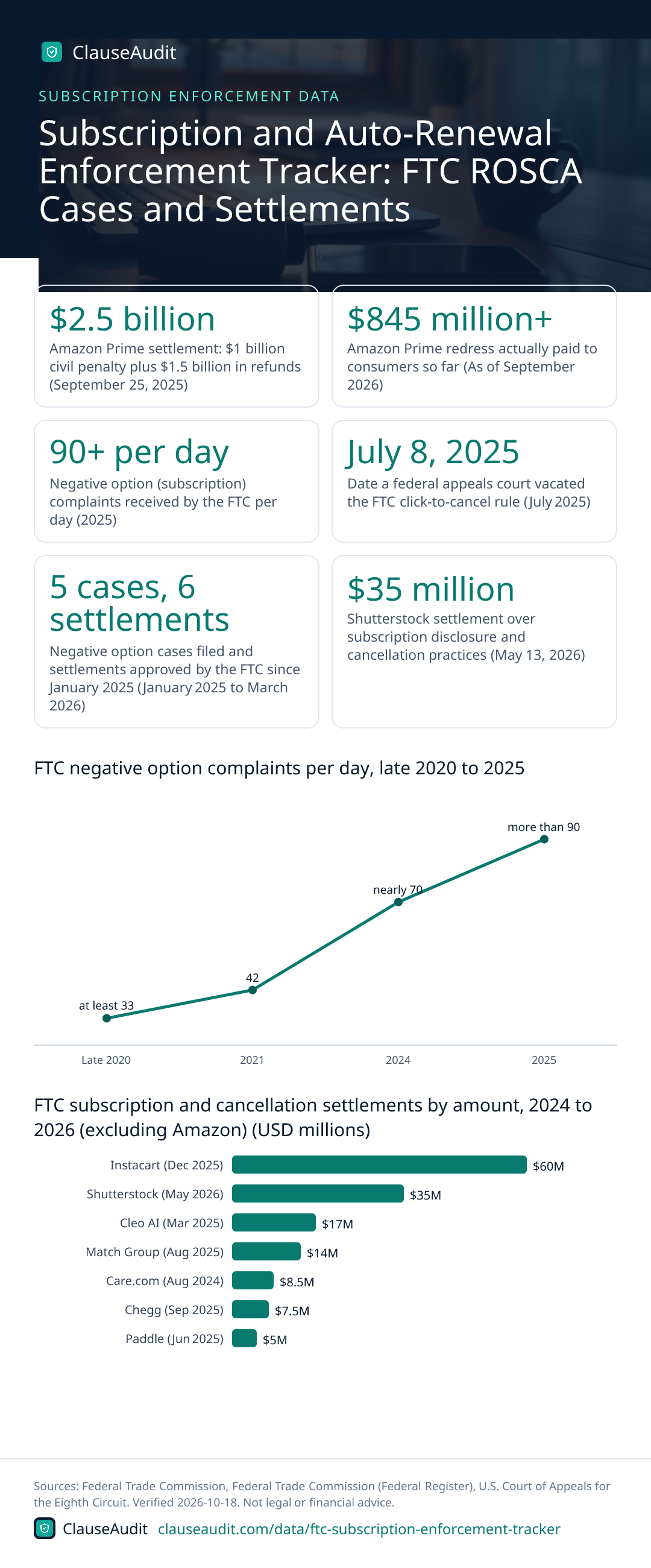
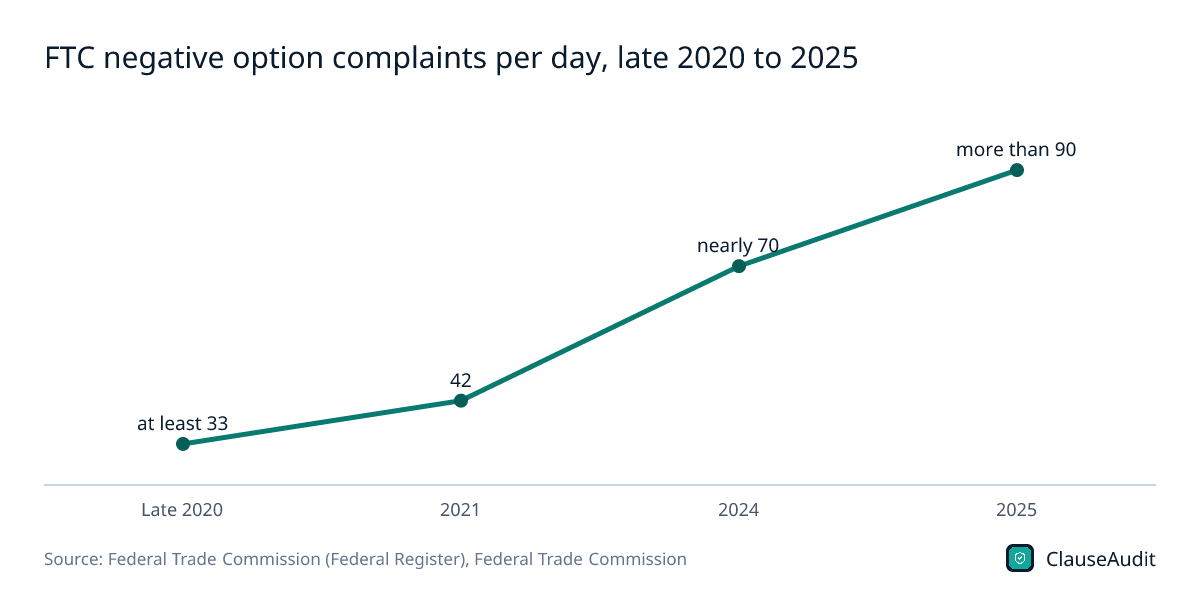
FTC negative option complaints per day, late 2020 to 2025
Chart data
| Label | Value |
|---|---|
| Late 2020 | at least 33 |
| 2021 | 42 |
| 2024 | nearly 70 |
| 2025 | more than 90 |
Complaints nearly tripled, from at least 33 a day in late 2020 to more than 90 a day in 2025. The FTC pointed to that climb when it restarted rulemaking in 2026.
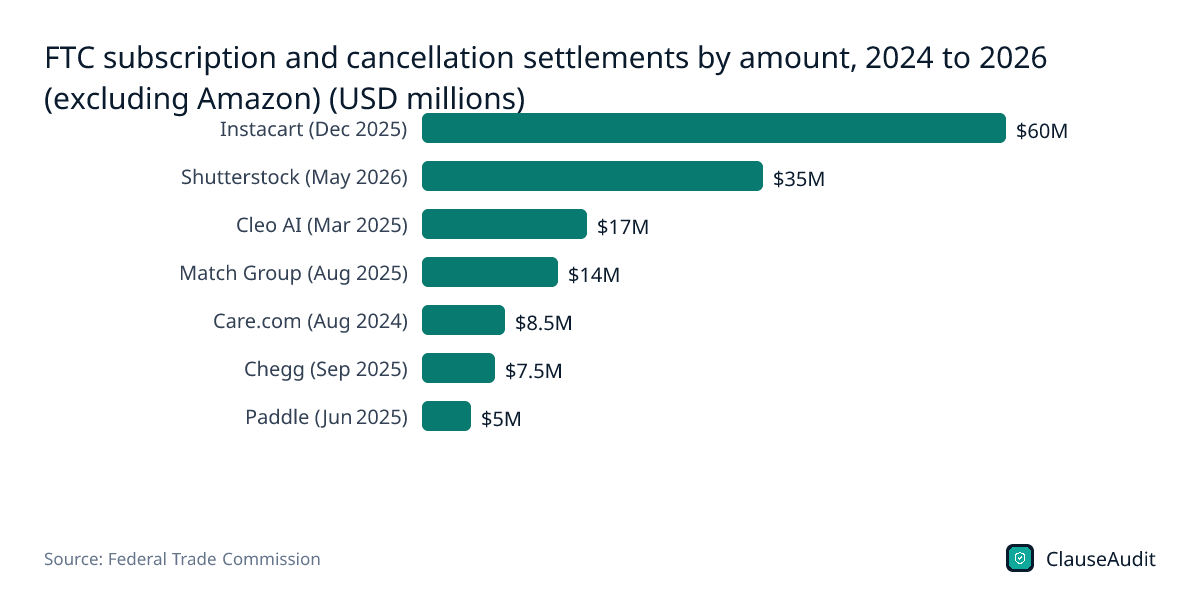
Download this chart (PNG)FTC subscription and cancellation settlements by amount, 2024 to 2026 (excluding Amazon) (USD millions)
Chart data
| Label | Value |
|---|---|
| Instacart (Dec 2025) | $60M |
| Shutterstock (May 2026) | $35M |
| Cleo AI (Mar 2025) | $17M |
| Match Group (Aug 2025) | $14M |
| Care.com (Aug 2024) | $8.5M |
| Chegg (Sep 2025) | $7.5M |
| Paddle (Jun 2025) | $5M |
Instacart's $60 million leads the non-Amazon cases, and the rest range from $35 million down to $5 million.
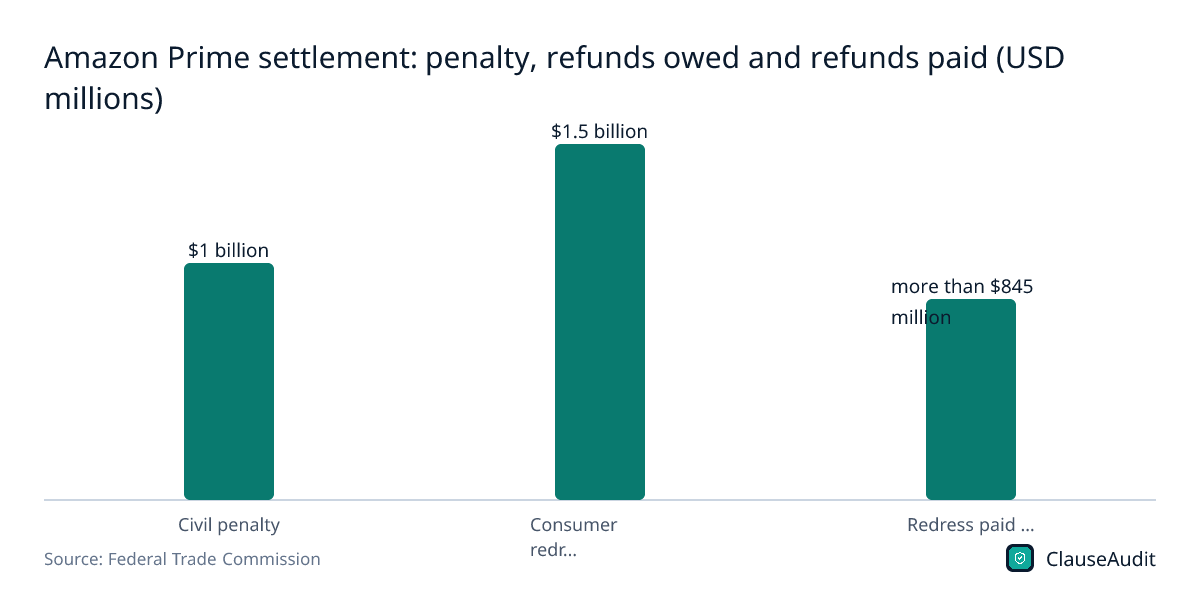
Download this chart (PNG)Amazon Prime settlement: penalty, refunds owed and refunds paid (USD millions)
Chart data
| Label | Value (USD millions) |
|---|---|
| Civil penalty | $1 billion |
| Consumer redress (up to) | $1.5 billion |
| Redress paid as of Sept 2026 | more than $845 million |
The $1 billion penalty goes to the government; the $1.5 billion in redress is what customers can get back. More than $845 million had reached consumers as of September 2026, and the FTC has raised the per-person cap from $51 to $200.
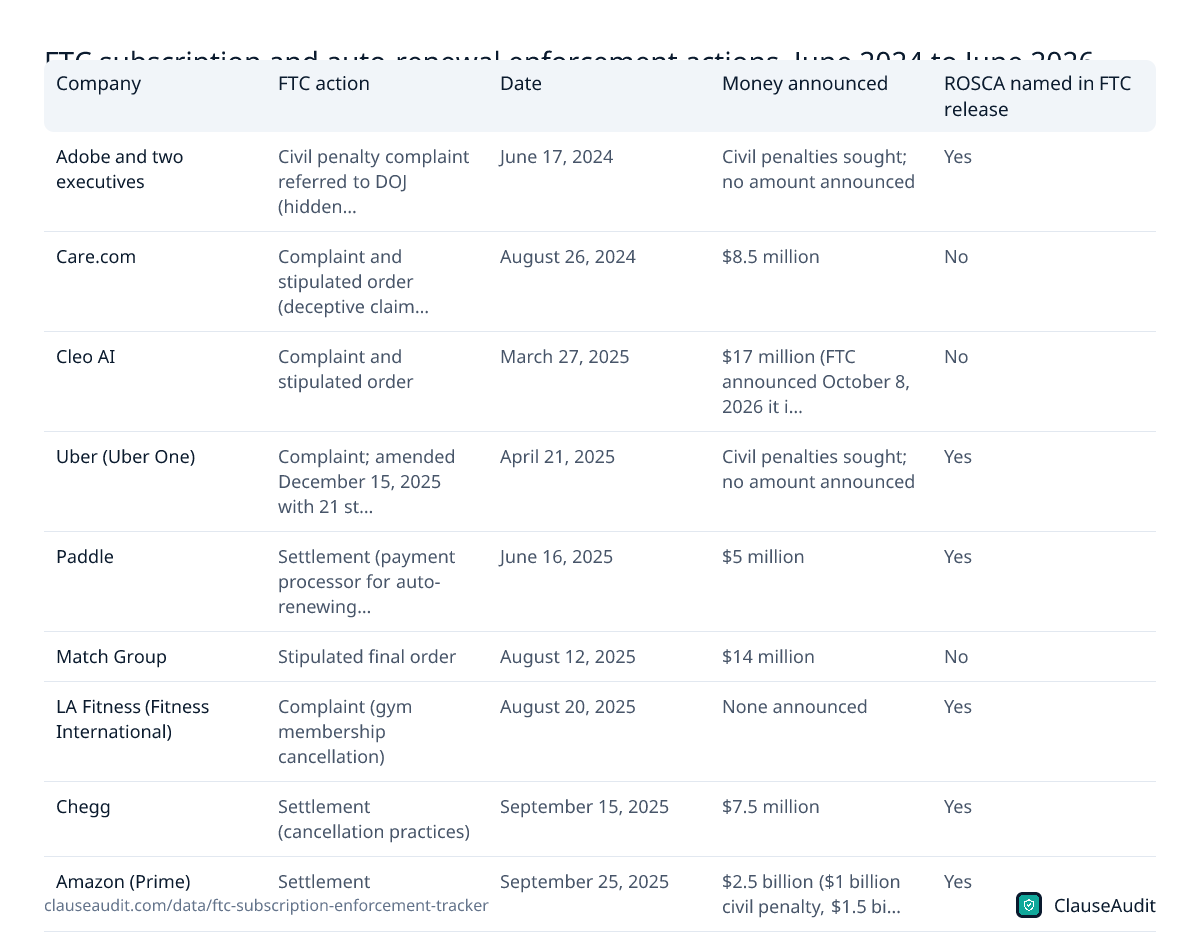
Download this chart (PNG)FTC subscription and auto-renewal enforcement actions, June 2024 to June 2026
| Company | FTC action | Date | Money announced | ROSCA named in FTC release |
|---|---|---|---|---|
| Adobe and two executives | Civil penalty complaint referred to DOJ (hidden early termination fee, hard cancellation) | June 17, 2024 | Civil penalties sought; no amount announced | Yes |
| Care.com | Complaint and stipulated order (deceptive claims, impeded cancellation) | August 26, 2024 | $8.5 million | No |
| Cleo AI | Complaint and stipulated order | March 27, 2025 | $17 million (FTC announced October 8, 2026 it is sending more than $15.8 million to 2,124,796 customers; PayPal payments begin October 27, 2026) | No |
| Uber (Uber One) | Complaint; amended December 15, 2025 with 21 states and DC | April 21, 2025 | Civil penalties sought; no amount announced | Yes |
| Paddle | Settlement (payment processor for auto-renewing subscriptions) | June 16, 2025 | $5 million | Yes |
| Match Group | Stipulated final order | August 12, 2025 | $14 million | No |
| LA Fitness (Fitness International) | Complaint (gym membership cancellation) | August 20, 2025 | None announced | Yes |
| Chegg | Settlement (cancellation practices) | September 15, 2025 | $7.5 million | Yes |
| Amazon (Prime) | Settlement | September 25, 2025 | $2.5 billion ($1 billion civil penalty, $1.5 billion redress) | Yes |
| Instacart (Maplebear) | Settlement | December 18, 2025 | $60 million in refunds | No |
| JustAnswer | Complaint ($1 or $5 join fee plus $28 to $125 monthly subscription) | January 13, 2026 | None announced | Yes |
| Shutterstock | Settlement (auto-renewal disclosure and cancellation) | May 13, 2026 | $35 million | No |
| Subscription enterprise (15 corporations, 8 individuals) | Complaint | June 17, 2026 | None announced | Yes |
Source: Federal Trade Commission, FTC Takes Action Against Adobe and Executives for Hiding Fees, Preventing Consumers from Easily Cancelling Software Subscriptions; Federal Trade Commission, FTC Takes Action Against Care.com for Deceiving Caregivers About Wages and Availability of Jobs on its Site, Impeding Cancellation Process; Federal Trade Commission, Cash Advance Company Cleo AI Agrees to Pay $17 Million As Result of FTC Lawsuit Charging It Deceives Consumers; Federal Trade Commission, FTC Returns More than $15.8 Million to Consumers Misled by Cash Advance App Company Cleo AI; Federal Trade Commission, FTC Takes Action Against Uber for Deceptive Billing and Cancellation Practices; Federal Trade Commission, FTC and States File Amended Complaint Against Uber for Deceptive Billing and Cancellation Practices; Federal Trade Commission, Paddle Will Pay $5 Million to Settle FTC Allegations of Unfair Payment-Processing Practices and Facilitation of Deceptive Tech-Support Schemes; Federal Trade Commission, Match Group Agrees to Pay $14 Million, Permanently Stop Deceptive Advertising, Cancellation, and Billing Practices; Federal Trade Commission, FTC Sues LA Fitness for Making it Difficult for Consumers to Cancel Gym Memberships; Federal Trade Commission, Ed Tech Provider Chegg to Pay $7.5 Million to Settle FTC Allegations Concerning Unlawful Cancellation Practices; Federal Trade Commission, FTC Secures Historic $2.5 Billion Settlement Against Amazon; Federal Trade Commission, Instacart to Pay $60 Million in Consumer Refunds to Settle FTC Lawsuit Over Allegations it Engaged in Deceptive Tactics; Federal Trade Commission, FTC Sues JustAnswer for Deceiving Consumers into Enrolling in a Costly Recurring Monthly Subscription; Federal Trade Commission, Shutterstock to Pay $35 Million to Settle FTC Allegations Over Illegal Subscription and Cancellation Practices; Federal Trade Commission, FTC Sues to Stop Sprawling Enterprise Operating Unlawful Subscription Schemes. Download as image
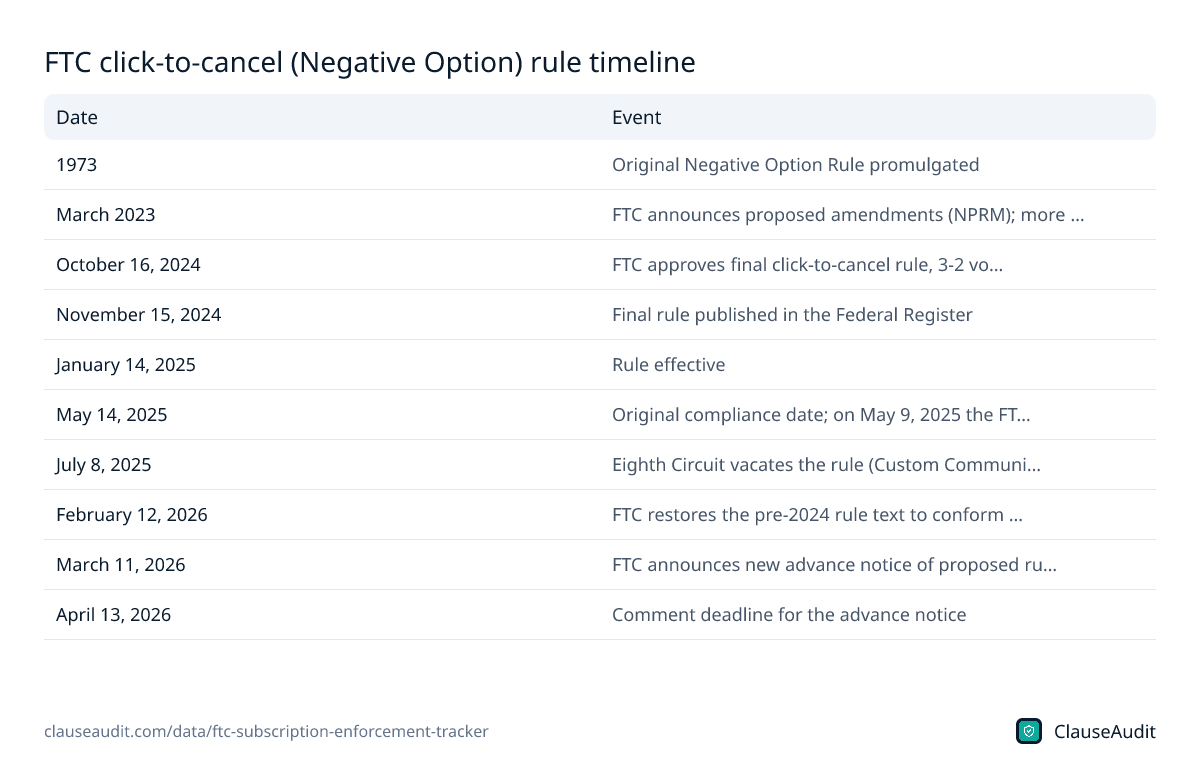
FTC click-to-cancel (Negative Option) rule timeline
| Date | Event |
|---|---|
| 1973 | Original Negative Option Rule promulgated |
| March 2023 | FTC announces proposed amendments (NPRM); more than 16,000 comments received |
| October 16, 2024 | FTC approves final click-to-cancel rule, 3-2 vote |
| November 15, 2024 | Final rule published in the Federal Register |
| January 14, 2025 | Rule effective |
| May 14, 2025 | Original compliance date; on May 9, 2025 the FTC deferred enforcement to July 14, 2025 |
| July 8, 2025 | Eighth Circuit vacates the rule (Custom Communications v. FTC) |
| February 12, 2026 | FTC restores the pre-2024 rule text to conform to the court decision |
| March 11, 2026 | FTC announces new advance notice of proposed rulemaking on negative options |
| April 13, 2026 | Comment deadline for the advance notice |
Source: Federal Trade Commission, Federal Trade Commission Announces Final "Click-to-Cancel" Rule Making It Easier for Consumers to End Recurring Subscriptions and Memberships; Federal Trade Commission (Federal Register), Negative Option Rule (final rule), 89 FR 90476, FR Doc. 2024-25534; U.S. Court of Appeals for the Eighth Circuit, Custom Communications, Inc. v. FTC, No. 24-3137 (8th Cir.); Federal Trade Commission (Federal Register), Revision of the Negative Option Rule, Withdrawal of the CARS Rule, Removal of the Non-Compete Rule To Conform These Rules to Federal Court Decisions, FR Doc. 2026-02866; Federal Trade Commission, FTC Seeks Public Comment in Response to Advance Notice of Proposed Rulemaking Regarding Negative Option Marketing Practices; Federal Trade Commission (Federal Register), Rule Concerning the Use of Prenotification Negative Option Plans (advance notice of proposed rulemaking), FR Doc. 2026-04952. Download as image
Is the FTC click-to-cancel rule still in effect?
No. The FTC approved its final click-to-cancel rule on October 16, 2024, by a 3-2 vote. It took effect January 14, 2025, but companies had until a later compliance date, which the agency pushed back to July 14, 2025. Before that date arrived, the Eighth Circuit vacated the rule on July 8, 2025.
The court didn't say subscription traps are fine. It said the FTC skipped a preliminary regulatory analysis that section 22 of the FTC Act requires for a rule this size. On February 12, 2026, the FTC put the pre-2024 rule text back in place, and on March 11, 2026, it opened a fresh advance notice of proposed rulemaking. Comments closed April 13, 2026. So a new rule may come, but not soon. An advance notice is only the first step.
How is the FTC still suing companies without the rule?
Because the rule was never the main weapon. ROSCA, passed by Congress, already makes it illegal to charge people for an online subscription unless the company clearly discloses the terms before billing, gets express consent, and offers a simple way to stop the recurring charges. The FTC Act's ban on deceptive practices sits on top of that.
Those laws didn't go anywhere when the rule was vacated. The FTC counted 5 negative option cases filed and 6 settlements approved from January 2025 to March 2026, and the tracker table shows more after that, including Shutterstock in May 2026 and a June 2026 complaint against a subscription enterprise made up of 15 corporations and 8 individuals.
Not every FTC press release named ROSCA. The ones for Care.com, Cleo AI, Match Group, Instacart and Shutterstock talked about deception and billing practices more broadly. The outcome for the company was the same: pay, and change the flow.
What do these subscription cases have in common?
Read the complaints side by side and the same few moves keep showing up.
- A cancellation maze. The FTC alleges Uber One members could face up to 23 screens and 32 actions to cancel. That is an allegation, not a finding, but it shows what regulators count as a red flag.
- A fee that appears only when you try to leave. Adobe was referred to the Justice Department over an early termination fee the FTC says was hidden. Shutterstock's annual plans paid monthly also carried an early cancellation fee.
- Renewals nobody explained. Shutterstock allegedly didn't make clear that on-demand image packs renewed automatically.
- A cheap front door. JustAnswer allegedly charged a $1 or $5 join fee, then rolled people into a subscription of $28 to $125 a month.
- Design that pushes you one way. An international review of 642 subscription sites and apps found nearly 76% used at least one possible dark pattern, and nearly 67% used several.
What this means if you sell subscriptions
If your business bills customers on a recurring basis, the vacated rule is not a safe harbor. The Paddle case is a useful warning: Paddle is a payment processor that acted as merchant of record for other companies' software, and it still paid $5 million, partly over auto-renewing subscriptions it charged for without clear disclosure. The FTC looks at everyone in the billing chain.
Put yourself in the customer's seat and try to cancel. Count the screens. If there's a retention offer, make sure it can be skipped in one click. Check that the price, the renewal date and any early termination fee show up before the card is charged, not buried in terms people scroll past. And if a reviewer at the FTC read your checkout, would they find anything that looks like the patterns above?
Your vendor contracts matter here too. If you sell through a reseller, a billing platform or an app store, find out who owns the disclosure and the cancel button. Write it down. When the FTC came after Adobe, it named two executives along with the company, so this is a leadership problem as much as a legal one.
How big are FTC subscription settlements?
Outside of Amazon, the money is smaller than the headlines suggest. Instacart agreed to $60 million in refunds, Shutterstock $35 million, Cleo AI $17 million, Match Group $14 million, Care.com $8.5 million, Chegg $7.5 million and Paddle $5 million. Several cases, including LA Fitness and JustAnswer, had no money announced at all when they were filed.
Don't read the smaller numbers as a sign the cases are mild. These settlements come with orders that limit how the company can do business going forward, and those orders are what change behavior. A company that slips back into old habits risks violating that order, which is a much harder spot to be in.
Amazon is the outlier for a reason. Prime has an enormous member base, and the $1 billion civil penalty alone is the largest the FTC has ever obtained in a case involving one of its rules. Most businesses will never see a number like that, but the conduct the FTC described there (a hard-to-find exit and sign-up screens that steered people into paying) is the same conduct it chases in much smaller companies.
What should you do if you're the one paying?
For consumers, the cases are good news. The FTC said Amazon's settlement covers an estimated 35 million people, and the Cleo AI case shows money really does go out: the FTC announced it is sending more than $15.8 million to 2,124,796 customers, with PayPal payments starting October 27, 2026.
If you run a business that buys software, read this with some care. These cases are mostly about consumers. When your company signs an annual SaaS order form, your protection usually comes from the contract itself and whatever your state's auto-renewal law covers. That makes the renewal clause worth reading before you sign, not the week it renews.
Set a calendar reminder well ahead of any cancellation deadline in your contract. Ask the vendor to confirm in writing how notice must be given. If a renewal surprised you, look at whether the notice terms were disclosed clearly; that's often where a refund conversation starts.
How ClauseAudit helps
Most subscription fights start with a clause nobody read. Upload your SaaS agreement or order form and the automated review flags the renewal, cancellation and pricing terms that the FTC cases above keep circling back to, then explains each one in plain English.
Here's what it checks.
- Auto-renewal term length and the notice window you need to cancel
- How notice must be given, and whether online cancellation is allowed
- Early termination or cancellation fees, especially on annual plans billed monthly
- Price increases at renewal and whether they have a cap
- Unilateral changes to terms with continued use treated as acceptance
- Refund rights and the liability cap if billing goes wrong
Frequently asked questions
Why was the click-to-cancel rule struck down?
The Eighth Circuit vacated it on July 8, 2025, because the FTC skipped a preliminary regulatory analysis that section 22 of the FTC Act requires. The court ruled on process, not on whether hard-to-cancel subscriptions are acceptable. That's why the FTC was able to start over with a new advance notice of proposed rulemaking in March 2026.
What is ROSCA?
The Restore Online Shoppers' Confidence Act is a federal law covering online subscriptions and other negative option sales. It requires clear disclosure of the material terms before billing, the customer's express informed consent, and a simple way to stop recurring charges. The FTC has used it in cases against Amazon, Uber, Chegg, LA Fitness and others listed in the tracker.
How much did Amazon pay to settle the Prime case?
$2.5 billion, announced September 25, 2025. That breaks down into a $1 billion civil penalty, which the FTC calls the largest ever in a case involving an FTC rule violation, and $1.5 billion in refunds. As of September 2026, Amazon had issued more than $845 million in redress payments.
Is there going to be a new click-to-cancel rule?
Possibly. On March 11, 2026, the FTC announced a new advance notice of proposed rulemaking on negative option practices, and the comment deadline was April 13, 2026. An advance notice is an early step, so a final rule would still need a proposed rule, more comments and a vote. Until then, ROSCA and the FTC Act do the work.
How common are subscription complaints?
Very. The FTC says it received more than 90 negative option complaints a day in 2025, up from at least 33 a day in late 2020. Its March 2026 release adds that it received more than 100,000 such complaints in the past five years.
Can a payment processor get in trouble for a client's subscriptions?
Yes. Paddle, a payment processor that acted as merchant of record and charged people for auto-renewing subscriptions, paid $5 million to settle FTC allegations in June 2025. The FTC's release named ROSCA. If you process, resell or bill on behalf of another company's subscriptions, your own contracts should spell out who handles disclosures, consent and cancellations.
Does any of this protect my business when a SaaS vendor auto-renews?
Indirectly at best. The FTC cases center on consumers. For a business buyer, your rights mostly come from the order form, the master agreement and your state's auto-renewal law, if it reaches business contracts. Read the notice window and cancellation method before you sign, and get any promised flexibility written into the contract.
How many states joined the FTC's Uber One case?
The FTC filed its complaint on April 21, 2025. An amended complaint on December 15, 2025, added 21 states and the District of Columbia as co-plaintiffs. The complaint alleges users could face up to 23 screens and 32 actions to cancel, though those are allegations the court has not ruled on.
Use this data
Every chart and card below is free to reuse under CC BY 4.0. Download what you need and link back to this page.
 Stat cards
 Key findings card
 Infographic
 FTC negative option complaints per day, late 2020 to 2025
 FTC subscription and cancellation settlements by amount, 2024 to 2026 (excluding Amazon) (USD millions)
 Amazon Prime settlement: penalty, refunds owed and refunds paid (USD millions)
 FTC subscription and auto-renewal enforcement actions, June 2024 to June 2026
 FTC click-to-cancel (Negative Option) rule timeline
Embed the infographic
Free to share on your site, blog or slides under CC BY 4.0. Please keep the credit link.
Sources and method
Every number on this page comes from the sources below, each opened and read on or before October 18, 2026. A second, independent review checked every figure against its source and corrected anything that did not match. Figures that could not be confirmed were left out.
- Federal Trade Commission, Federal Trade Commission Announces Final "Click-to-Cancel" Rule Making It Easier for Consumers to End Recurring Subscriptions and Memberships (October 16, 2024)
- Federal Trade Commission (Federal Register), Negative Option Rule (final rule), 89 FR 90476, FR Doc. 2024-25534 (November 15, 2024)
- U.S. Court of Appeals for the Eighth Circuit, Custom Communications, Inc. v. FTC, No. 24-3137 (8th Cir.) (Filed July 8, 2025)
- Federal Trade Commission (Federal Register), Revision of the Negative Option Rule, Withdrawal of the CARS Rule, Removal of the Non-Compete Rule To Conform These Rules to Federal Court Decisions, FR Doc. 2026-02866 (February 12, 2026)
- Federal Trade Commission (Federal Register), Rule Concerning the Use of Prenotification Negative Option Plans (advance notice of proposed rulemaking), FR Doc. 2026-04952 (March 13, 2026)
- Federal Trade Commission, FTC Seeks Public Comment in Response to Advance Notice of Proposed Rulemaking Regarding Negative Option Marketing Practices (March 11, 2026)
- Federal Trade Commission, FTC Secures Historic $2.5 Billion Settlement Against Amazon (September 25, 2025)
- Federal Trade Commission, FTC Announces Additional Payments to Consumers Stemming from FTC's Amazon Prime Settlement (September 17, 2026)
- Federal Trade Commission, Shutterstock to Pay $35 Million to Settle FTC Allegations Over Illegal Subscription and Cancellation Practices (May 13, 2026)
- Federal Trade Commission, Instacart to Pay $60 Million in Consumer Refunds to Settle FTC Lawsuit Over Allegations it Engaged in Deceptive Tactics (December 18, 2025)
- Federal Trade Commission, Ed Tech Provider Chegg to Pay $7.5 Million to Settle FTC Allegations Concerning Unlawful Cancellation Practices (September 15, 2025)
- Federal Trade Commission, Match Group Agrees to Pay $14 Million, Permanently Stop Deceptive Advertising, Cancellation, and Billing Practices (August 12, 2025)
- Federal Trade Commission, Cash Advance Company Cleo AI Agrees to Pay $17 Million As Result of FTC Lawsuit Charging It Deceives Consumers (March 27, 2025)
- Federal Trade Commission, FTC Returns More than $15.8 Million to Consumers Misled by Cash Advance App Company Cleo AI (October 8, 2026)
- Federal Trade Commission, FTC Takes Action Against Care.com for Deceiving Caregivers About Wages and Availability of Jobs on its Site, Impeding Cancellation Process (August 26, 2024)
- Federal Trade Commission, Paddle Will Pay $5 Million to Settle FTC Allegations of Unfair Payment-Processing Practices and Facilitation of Deceptive Tech-Support Schemes (June 16, 2025)
- Federal Trade Commission, FTC Takes Action Against Uber for Deceptive Billing and Cancellation Practices (April 21, 2025)
- Federal Trade Commission, FTC and States File Amended Complaint Against Uber for Deceptive Billing and Cancellation Practices (December 15, 2025)
- Federal Trade Commission, FTC Takes Action Against Adobe and Executives for Hiding Fees, Preventing Consumers from Easily Cancelling Software Subscriptions (June 17, 2024)
- Federal Trade Commission, FTC Sues JustAnswer for Deceiving Consumers into Enrolling in a Costly Recurring Monthly Subscription (January 13, 2026)
- Federal Trade Commission, FTC Sues LA Fitness for Making it Difficult for Consumers to Cancel Gym Memberships (August 20, 2025)
- Federal Trade Commission, FTC Sues to Stop Sprawling Enterprise Operating Unlawful Subscription Schemes (June 17, 2026)
- Federal Trade Commission, FTC, ICPEN, GPEN Announce Results of Review of Use of Dark Patterns Affecting Subscription Services, Privacy (July 10, 2024)
Cite this page
ClauseAudit, “Subscription and Auto-Renewal Enforcement Tracker: FTC ROSCA Cases and Settlements”, updated October 18, 2026, https://clauseaudit.com/data/ftc-subscription-enforcement-tracker. Free to reuse with a link back (CC BY 4.0).
This page summarises published data and law as checked on October 18, 2026. Figures are updated as new editions are released, and your own situation may differ. It is general information, not legal, tax or financial advice.